
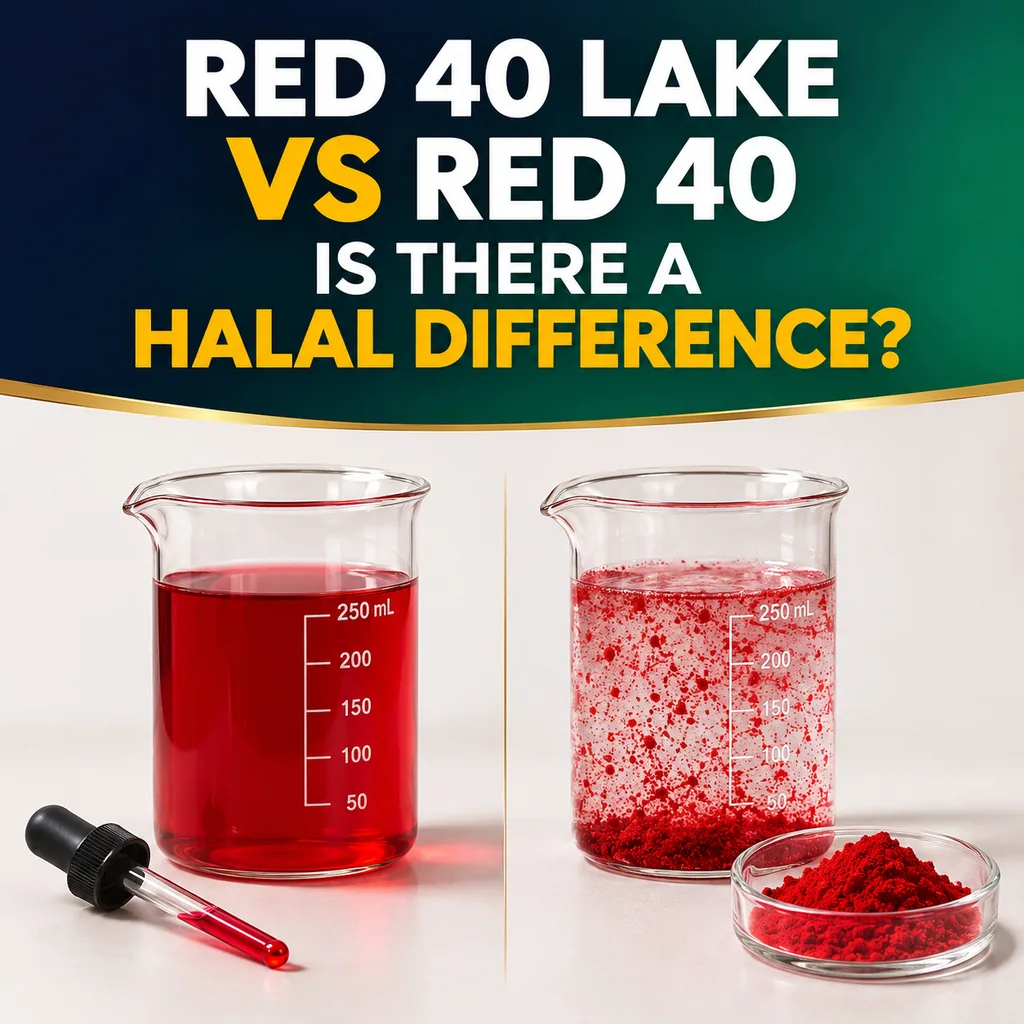
People often show me two labels side by side. One says “Red 40,” the other says “Red 40 Lake,” and they ask if the second one is something new or hidden. It is not. In this article I will explain what a lake is, why companies use it, and what you should still check on the label. For the full ruling on the dye itself, see our main guide: is Red 40 halal.
What Is Red 40 Lake?
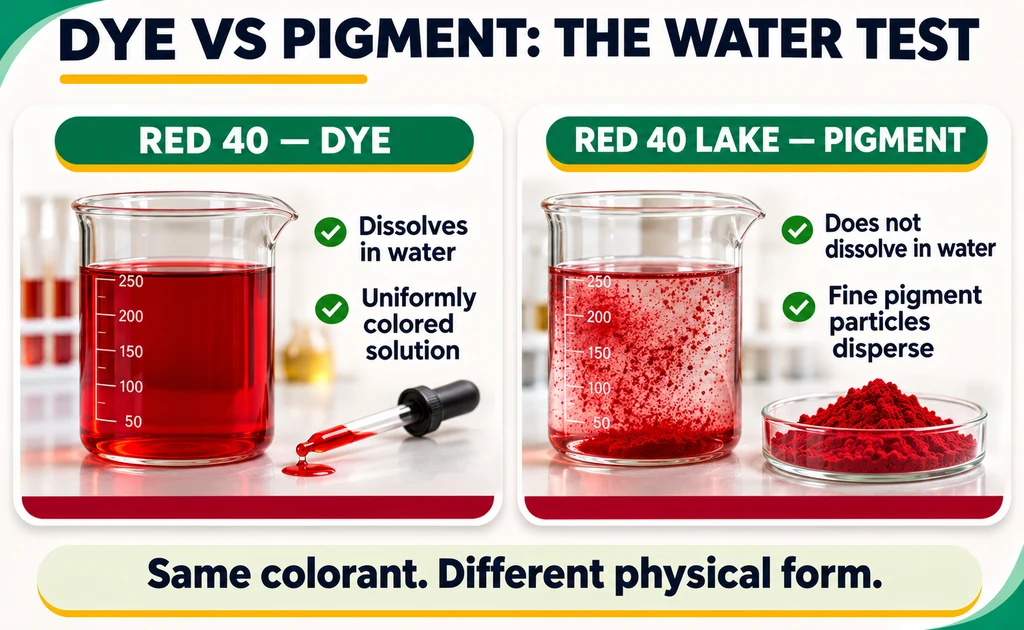
Red 40 Lake is the same Red 40 dye, locked onto a fine aluminum-based powder. Regular Red 40 dissolves in water. The lake form does not.
This matters for food makers, not for the source of the color. The red part is still the same lab-made dye, Allura Red AC. The FDA explains that lakes are made by reacting a “straight color” (the plain dye) with an aluminum compound, and that lakes for food must be made from certified batches of the dye (FDA). In other words, a lake is not a new color. It is a different form of a color you already know.
The word “lake” has nothing to do with water here. In color making, it simply means a dye fixed onto a mineral base.
Dye vs Pigment in Simple Terms
Think of sugar and sand.
- A dye is like sugar. Stir it into water and it disappears, coloring the whole glass. Regular Red 40 works this way.
- A pigment is like sand. Stir it into water and it spreads out, but it does not dissolve. Red 40 Lake works this way.
Because a lake stays as tiny solid specks, it colors by spreading through a food, not by dissolving into it. That is why it works well in dry or oily foods, where there is little water to dissolve a dye. It also stays in place, so the red does not run into the white part of a candy.
Names You Will See on Labels
In the US, the word “Lake” must appear on the label when the lake form is used (21 CFR 101.22). You may see:
- Red 40 Lake
- FD&C Red No. 40 Lake
- FD&C Red No. 40 Aluminum Lake or Red 40 Aluminum Lake
- Allura Red AC Aluminum Lake (mostly on technical sheets)
Outside the US, labels usually show the code E129, often without saying whether it is the lake form. For halal purposes, as you will see below, that makes no difference. For other codes you are unsure about, check our ingredient list.
Red 40 vs Red 40 Lake: Key Differences
The only real difference is form: one dissolves, the other spreads as tiny specks. The source of the color, and so the halal reasoning, stays the same.
| Red 40 | Red 40 Lake | |
|---|---|---|
| What it is | The plain dye (Allura Red AC) | The same dye fixed onto an aluminum base |
| Form | Dye | Pigment |
| Dissolves in water? | Yes | No, it spreads as fine specks |
| Bound to | Nothing | Aluminum, on an aluminum hydroxide (alumina) base |
| Typical uses | Drinks, gelatin desserts, syrups, water-based foods | Candy coatings, icings, oil-based foods, tablets |
| US label name | Red 40, FD&C Red No. 40 | Red 40 Lake, FD&C Red No. 40 Aluminum Lake |
| Code outside the US | E129 | Usually E129 |
| Halal reasoning | Lab-made dye, no animal source | Same dye plus a mineral base, no animal source |
How Is a Lake Made?
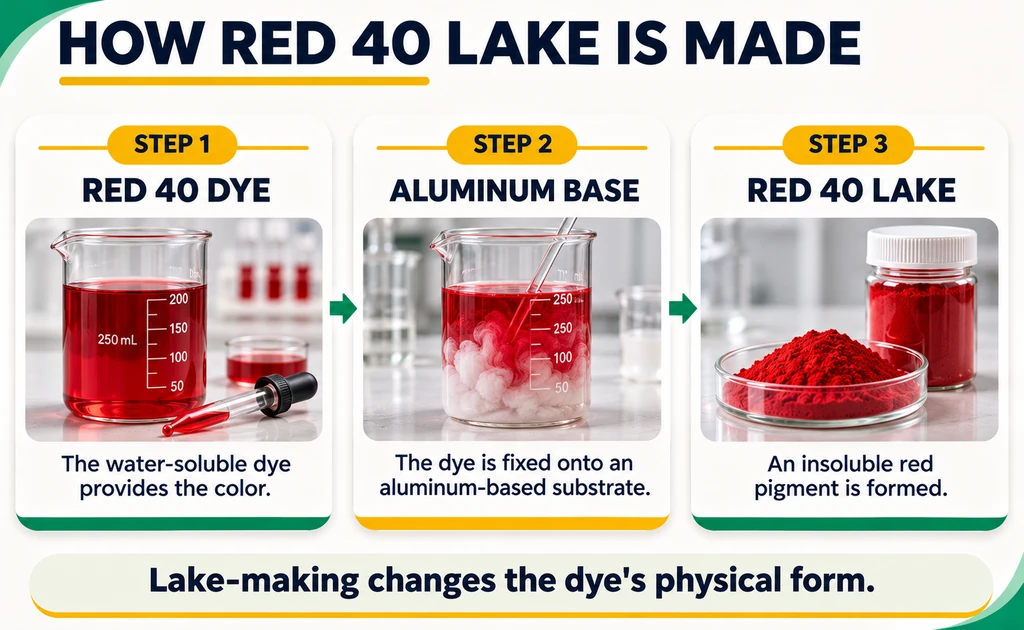
A lake is made in two simple steps. First, the plain Red 40 dye is made and certified. Then it is chemically joined to an aluminum compound and settled onto a mineral powder, which turns it from a dissolving dye into a solid pigment.
The key point for a Muslim reader is what gets added in that second step. According to US rules, a lake is defined as the dye plus aluminum (or calcium) on an alumina base, with only small limits on leftover salts and mineral matter.
The Aluminum Base
US federal rules describe FD&C lakes as made by combining a certified water-soluble dye “with the basic radical aluminum or calcium,” spread on “a substratum of alumina” (21 CFR 82.51). The FDA adds that lakes for food use are made with aluminum as the precipitant and aluminum hydroxide as the base (FDA).
In plain words:
- The dye gives the red color.
- Aluminum grips the dye so it no longer dissolves.
- Alumina, the white mineral base, holds it all as fine specks. In FDA’s rules, “alumina” means precipitated aluminum hydroxide suspended in water (21 CFR 82.3). In general chemistry the word can also mean aluminum oxide, so do not be confused if you see it used differently elsewhere.
Aluminum is a metal that comes from bauxite ore. Singapore’s halal authority, MUIS, lists aluminum used as a color as a “naturally occurring metallic colour from bauxite” (MUIS, 2016).
Is Anything Animal-Based Added?
No animal-based ingredient is part of the lake’s defined makeup. The US rule for FD&C lakes describes the lake as the certified dye combined with aluminum or calcium on an alumina base, and it allows only small amounts of leftover salts and insoluble mineral matter (21 CFR 82.51). None of these is animal-derived.
I want to be precise here. This tells us what a lake is defined to contain. It is not a guarantee about every processing aid a manufacturer might use, and it does not tell us what else a company mixed into the final candy, coating or tablet. That is a separate question, and I cover it below.
Is Red 40 Lake Halal?
The halal reasoning for Red 40 Lake is the same as for regular Red 40. The color is a lab-made dye, and the lake adds only aluminum and a mineral base. Neither comes from an animal, an insect or alcohol.
Here is what the published sources say:
- MUIS (Singapore), Food Additive Listing, last updated September 2016. It lists E129 as “synthetic red colouring” with no warning mark, and aluminum (E173) as a natural metallic color from bauxite, also with no mark. MUIS notes the list is “a general guideline” and not final. Not being marked doubtful in a list is not the same as halal certification of a product (MUIS).
- Lakes specifically. I could not find a named fatwa body or halal certifier that rules on lake colors as a separate issue. So the reasoning here rests on what a lake is made of: the dye plus a mineral base.
For the full discussion of the dye itself, including the views scholars and certifiers hold, read our halal reasoning for Red 40.
When the Halal Reasoning Is the Same
Turning a dye into a lake adds a mineral, not an animal product. In fiqh, minerals that come from the earth, like salt or metal, are pure by default. So the lake step adds nothing that raises a new halal question. If a scholar or certifier accepts Red 40, the same reasoning carries over to Red 40 Lake.
What Still Needs a Check
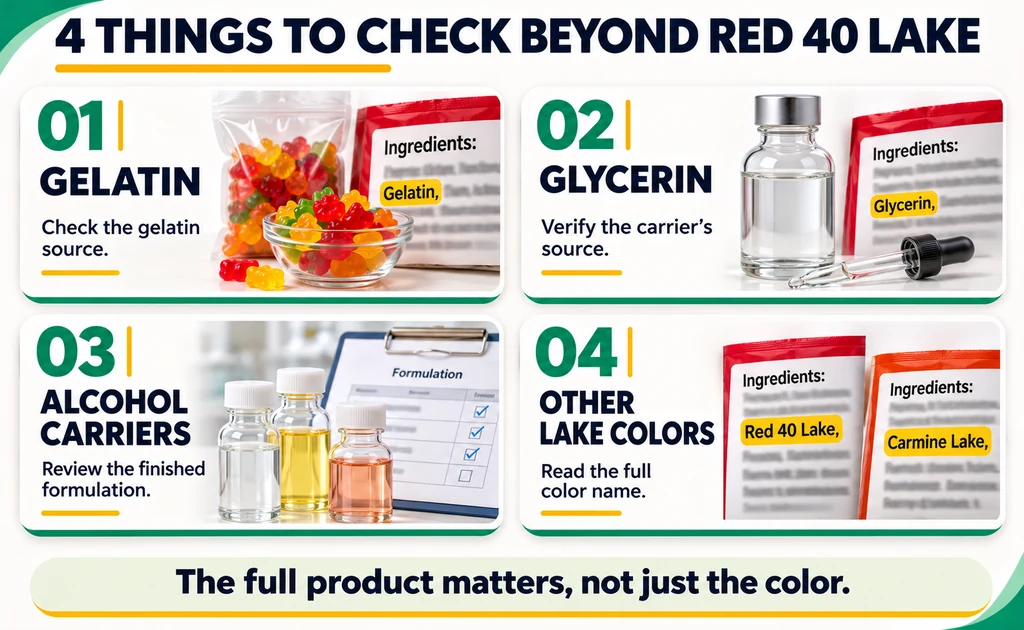
A lake can be clean while the product around it is not. These are product issues, not lake issues, but they are where I see most real problems:
- Gelatin. Many capsules, gummies and some tablet coatings use gelatin. If it comes from pork or from animals not slaughtered Islamically, the product is a concern, whatever color it uses.
- Glycerin. Glycerin is sometimes used as a carrier or softener. It can come from plants or from animal fat, so its source matters.
- Alcohol-based carriers. Some liquid colors and flavors are mixed in alcohol. Scholars and certifiers differ on alcohol used only in processing, especially when almost none remains, so ask the maker or follow your halal certifier.
- Other lakes. Not every lake is a Red 40 lake. The FDA notes that carmine, the insect-based red, is itself a lake made from cochineal extract (FDA). So always read the name before the word “lake.”
Where Red 40 Lake Is Used
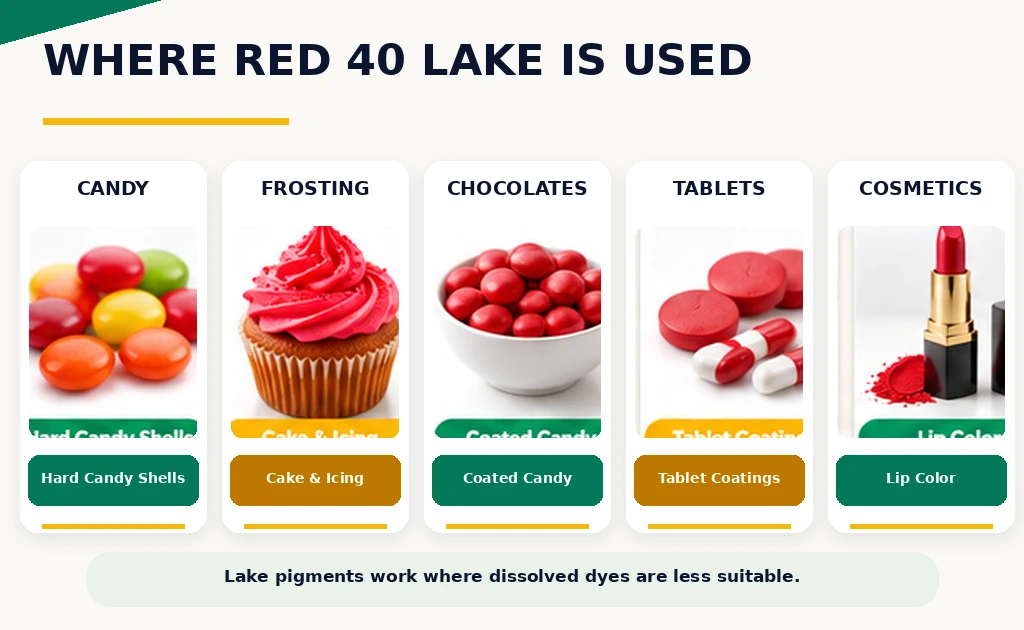
Companies choose the lake form wherever a dissolving dye would fail: in dry foods, oily foods, and anything where the color must stay put. You will mostly find it in candy, frosting and medicine.
Coatings, Icings and Oil-Based Foods
A plain dye needs water to spread. Fats, oils and dry sugar shells have very little water, so a dye can look patchy or streaky in them. A lake spreads evenly through fat and stays where it is placed, so the red on a candy shell does not bleed into the white center (Imbarex).
Common places include:
- Hard candy shells and coated chocolates
- Frostings, glazes and cake decorations
- Fat-based fillings and coatings
- Lipstick and other cosmetics
Tablets and Capsules
The FDA lists Red 40 Aluminum Lake among the lake colors allowed in medicines (FDA). You will often see it on the inactive ingredient list of colored tablets and capsule shells. Here the color is rarely the issue. Check the capsule itself for gelatin, as explained above.
How to Spot Red 40 Lake on a Label
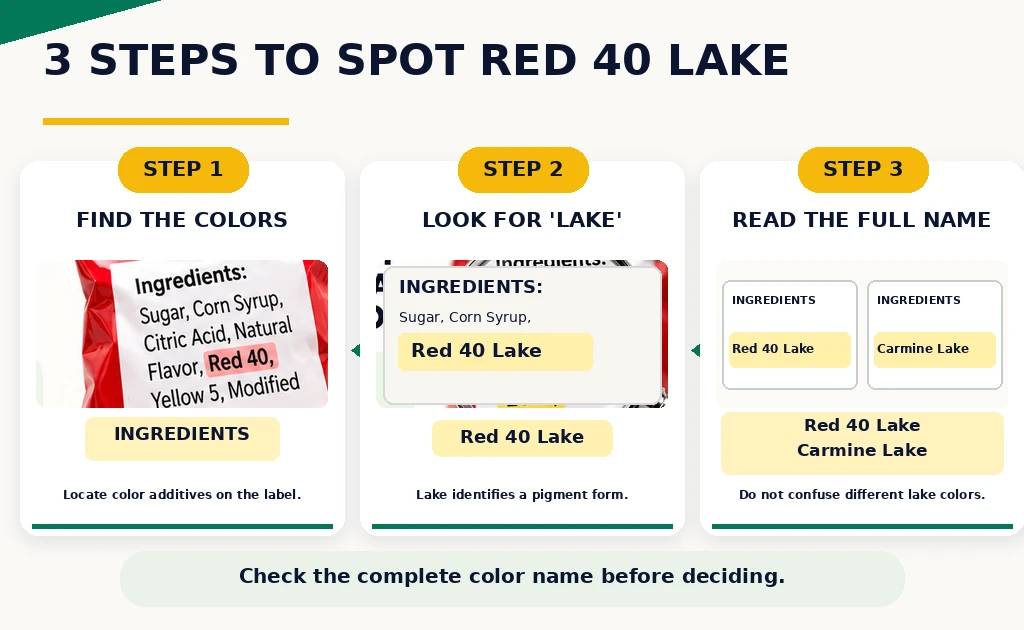
It takes three quick steps:
- Find the colors. Colors usually sit near the end of the ingredient list, after “contains 2% or less of.”
- Look for the word “Lake.” In the US it must be written out, as in “Red 40 Lake” (21 CFR 101.22). Outside the US, look for E129.
- Read the word before “Lake.” “Red 40 Lake” is the lab-made dye. “Carmine” is the insect-based red, even though it is also a lake.
Then read the rest of the label for gelatin, glycerin and alcohol. Red 40 and Red 40 Lake are both certified colors, which is why US law requires them to be named one by one.
Frequently Asked Questions
What is the difference between Red 40 and Red 40 Lake?
Red 40 is a dye that dissolves in water. Red 40 Lake is the same dye bound to aluminum on a mineral base, so it does not dissolve. It spreads as tiny specks instead. The color source is identical. Only the form, and where it works best, changes.
Is Red 40 Lake halal?
The halal reasoning is the same as for regular Red 40. The dye is lab-made, and the lake adds only aluminum and a mineral base, with no animal or alcohol source. Still check the finished product for gelatin, glycerin or alcohol, and follow the scholar or certifier you trust.
Is Red 40 Lake the same as Allura Red AC?
Almost. Allura Red AC is the chemical name of the Red 40 dye. Red 40 Lake is Allura Red AC fixed onto an aluminum base, so on technical sheets it may appear as “Allura Red AC Aluminum Lake.” The red coloring part is the same compound.
Why do some products list Red 40 Lake instead of Red 40?
Because the product has little water or contains fat. Candy shells, frostings, coated tablets and oily fillings need a color that spreads evenly and does not run. A lake does that. A plain dye works better in drinks, gelatin desserts and other water-based foods.
Does a lake change how a color looks?
A little. Because a lake is a solid pigment, it gives a more opaque, even color and stays in place without bleeding. A dissolved dye looks clearer and more see-through, like a red drink. The shade is close, but the finish and coverage differ.
The Bottom Line
Lake or not, Red 40 is a lab-made color. The lake form only adds aluminum and a mineral base, so it does not change the halal reasoning. What deserves your attention is the rest of the label: gelatin, glycerin, alcohol, and any other lake, such as carmine. If you prefer to avoid synthetic colors altogether, look for products made with natural red food coloring from plants.
And Allah knows best.
Sources
- FDA: Color Additives, FDA’s Regulatory Process and Historical Perspectives
- FDA: Regulation of Color Additives in Drug Products (presentation)
- 21 CFR 82.51: Lakes (FD&C)
- 21 CFR 101.22: Declaring colors and lakes on food labels
- MUIS: Food Additive Listing (last updated Sep 13, 2016)
- Imbarex: What does “lake” mean in food coloring? (industry source for uses)