
When people first read “azo dye” on a label or in the news, the word sounds strange and a little worrying. I understand that. But “azo” is only a chemistry name, like calling a building “brick” because of what holds it together. It tells you nothing about animals, alcohol or anything else a Muslim needs to avoid. In this article I will explain what azo dyes are in simple words, which food colors belong to this group, and how to judge them from a halal point of view. For the best-known azo dye, see our main guide: is Red 40 halal.
What Are Azo Dyes?
Azo dyes are a large family of man-made colors that all share one small feature in their structure, called the azo group. They are also called azo dyestuffs. “Dyestuff” is simply the trade word for a dye sold as a raw material, so the two terms mean the same thing.
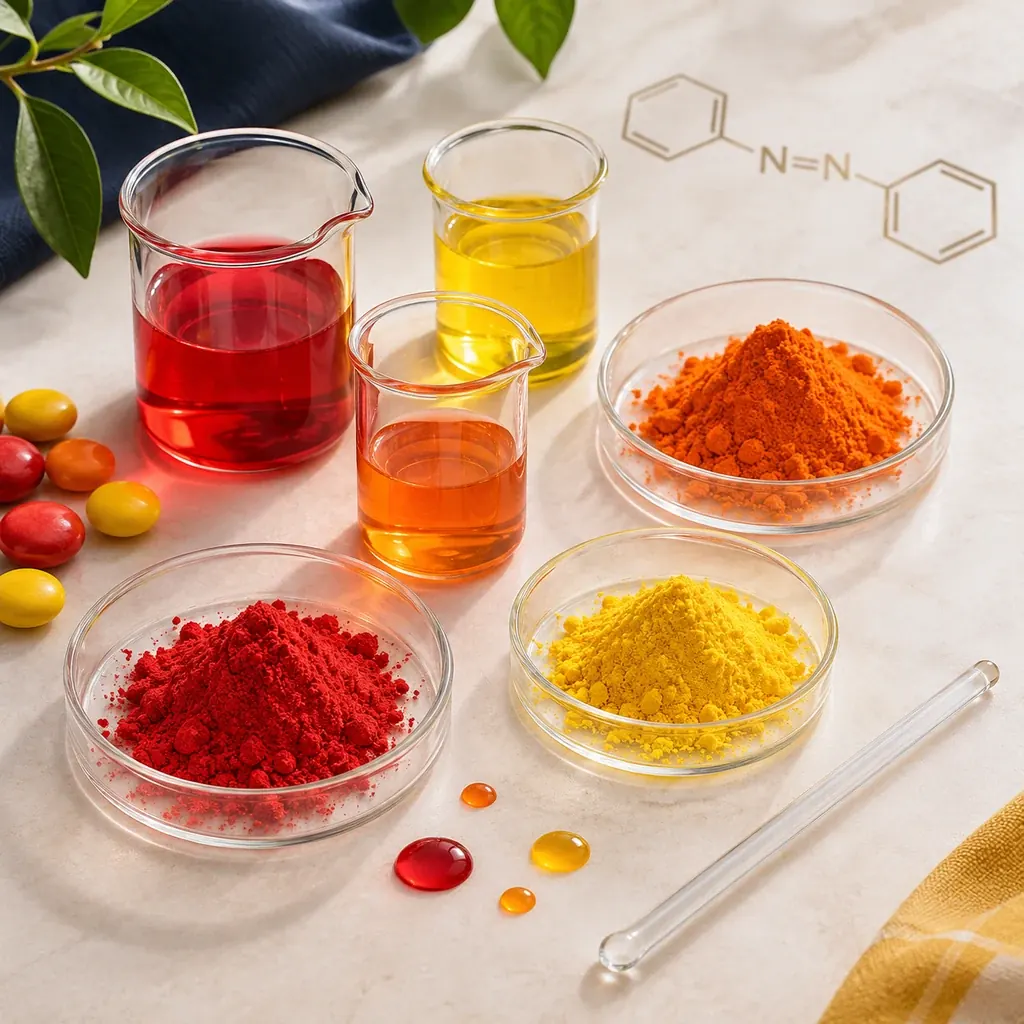
Azo dyes are made in factories, not taken from plants or animals. They give many of the bright reds, oranges and yellows you see in candy, drinks and snacks. They are also used widely on clothing and leather, but on this site I will keep to food, since that is where the halal question comes up.
The Simple Chemistry
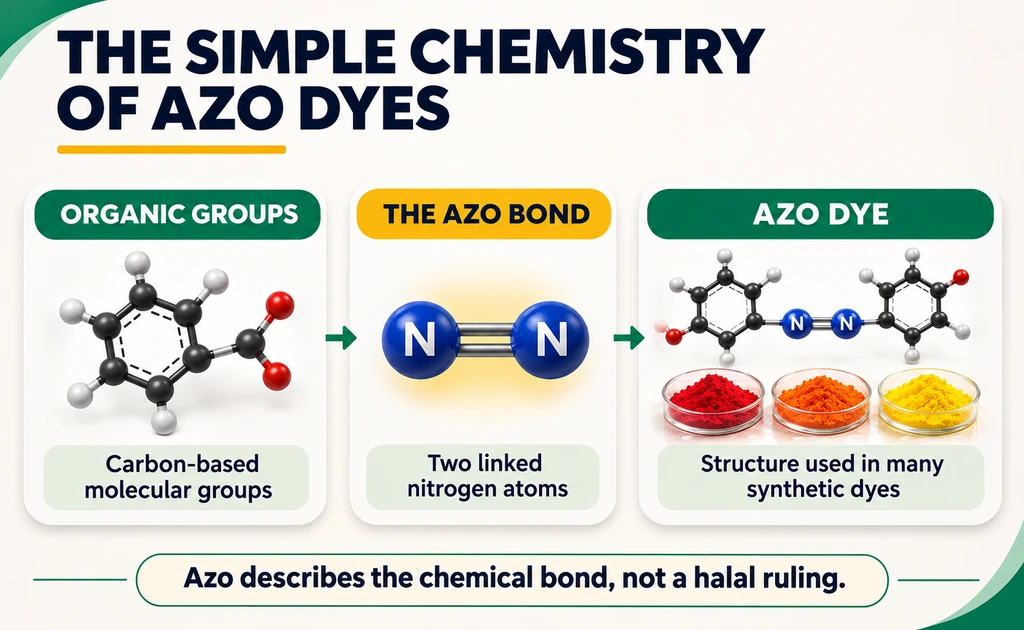
Picture a dye as two building blocks joined by a small bridge. In an azo dye, that bridge is made of two nitrogen atoms linked together. Chemists write it as –N=N– (Wikipedia).
That nitrogen bridge is what lets the molecule catch light in a special way. As a result, azo compounds show strong, vivid colors, especially reds, oranges and yellows. Change the building blocks on each side, and you get a different shade.
That is all “azo” means: a dye with this nitrogen bridge. The word does not mean animal, insect or alcohol.
Why They Are So Common
Azo dyes make up about 60 to 70 percent of all dyes used in foods and textiles combined, not a figure for food alone (EBSCO). There are three main reasons:
- Strong color. A small amount gives a bright, even shade.
- Many shades. By changing the building blocks, makers can produce yellows, oranges, reds and more. Yellow azo dyes are among the easiest colors to produce.
- Stability. Good dyes must hold up to light and processing, so the color stays the same on the shelf.
Which Food Colors Are Azo Dyes?
The most common azo food colors are Red 40, Yellow 5, and Yellow 6. Not every food color is azo, though. Blue 1 and carmine, for example, belong to completely different families. The table shows the main ones you will meet on labels.
| Color | Other names | Azo dye? | Source |
|---|---|---|---|
| Red 40 | Allura Red AC, FD&C Red No. 40, E129 | Yes | Wikipedia |
| Yellow 5 | Tartrazine, FD&C Yellow No. 5, E102 | Yes | Wikipedia |
| Yellow 6 | Sunset Yellow FCF, FD&C Yellow No. 6, E110 | Yes | Wikipedia |
| Carmoisine | Azorubine, E122 | Yes | EBSCO |
| Ponceau 4R | Cochineal Red A, E124 | Yes | EBSCO |
| Blue 1 | Brilliant Blue FCF, FD&C Blue No. 1, E133 | No (triarylmethane dye) | Wikipedia |
| Carmine | Cochineal extract, E120 | No (natural, from insects) | Wikipedia |
E122 and E124 are used mainly outside the United States. You will find azo colors most often in candy, soft drinks, sports drinks, cereals, snacks, desserts and frostings. If you meet a code that is not in this table, look it up in our ingredient list.

Are Azo Dyes Halal?
Being azo does not make a dye halal or haram. What matters is where its ingredients come from and what is mixed with it in the final product. The nitrogen bridge is a chemical shape, not a source.
Why Source Matters More Than Structure
In Islamic law, food is judged by what it is made from and whether anything impure or intoxicating is in it. A chemical shape inside a molecule is not one of those questions.
The scholars also gave us a base rule: things are permitted unless there is evidence to forbid them. In Arabic, al-asl fil-ashya’ al-ibahah. The Hanafi jurist Ibn Abidin records this maxim in Radd al-Muhtar, and it rests on verses like “It is He who created for you all that is on the earth” (Surah Al-Baqarah, 2:29).
The azo food colors approved in the US and EU, such as Red 40, Yellow 5 and Yellow 6, are made in factories from chemical raw materials, with no animal, insect or alcohol source in the dye itself. So the question is never “Is it azo?” but “What is it made from, and what is it mixed with?” That is the same source-based halal reasoning we use for Red 40.
What Scholars and Halal Bodies Say
I could not find a fatwa that rules on azo dyes as one group. Scholars rule on specific colors, and here is what they say about the main azo ones:
- Darul Ifta Birmingham (Hanafi), fatwa 07858, January 2025, updated June 2026. Tartrazine (Yellow 5), which it describes as a synthetic azo dye, is “considered halal for consumption.” It cites the base rule of permissibility from Radd al-Muhtar (Darul Ifta Birmingham).
- Mufti Faisal al-Mahmudi, IlmHub. Yellow 5, Yellow 6 and Red 40 are made synthetically from petroleum and are “Halaal Suitable.” He also reports that SANHA, the South African National Halal Authority, classifies Red 40 as halal (IlmHub).
- MUIS (Singapore), Food Additive Listing, last updated September 2016. It lists E102, E110, E122, E124 and E129 as “synthetic” colorings, and none carries its “doubtful” mark. MUIS says the list is “a general guideline” and not final. Not being marked doubtful in a general list is not the same as halal certification of a finished product (MUIS).
In the sources I reviewed, no scholar treated the azo structure itself as a reason for concern.
Where a Real Concern Can Appear
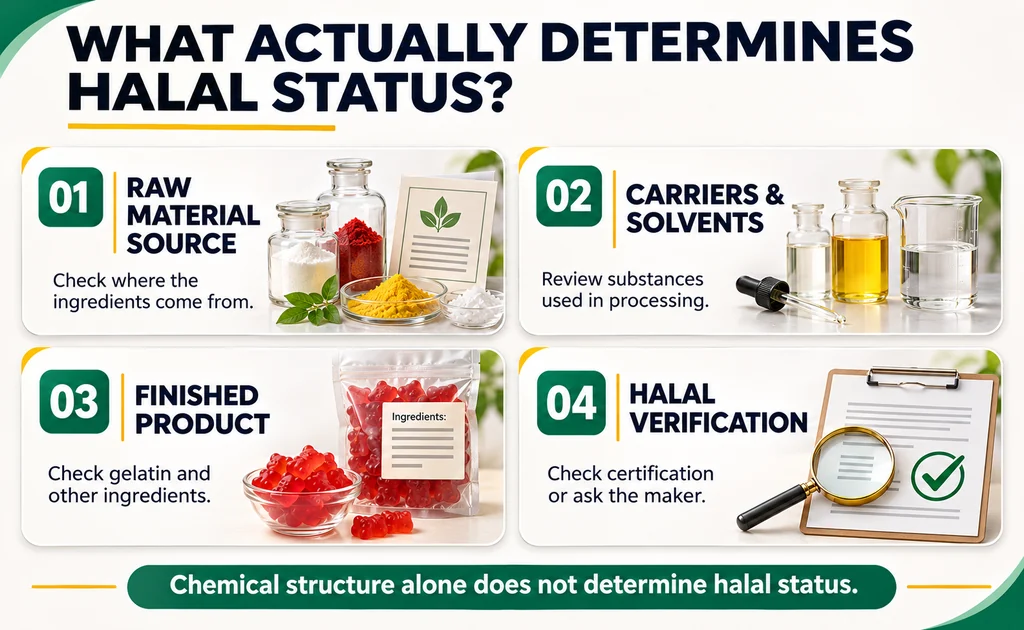
The real halal questions sit around the dye, not inside it:
- Liquid color blends. Some liquid colors are dissolved in a carrier. If that carrier is alcohol, or glycerin from animal fat, the blend needs checking. Scholars and certifiers differ on alcohol used only in processing, especially when almost none remains, so follow your certifier.
- The finished product. A halal dye in a gummy made with pork gelatin does not make the gummy halal.
- Unclear labels. When a color is not named, you cannot judge it. Ask the maker or look for halal certification.
We go through these product checks in more detail in our guide: is Red 40 halal.
Are All Red Dyes Azo Dyes?
No. Many red food dyes are azo, such as Red 40, carmoisine (E122) and Ponceau 4R (E124). But carmine, the red made from cochineal insects, is not an azo dye. Its color comes from carminic acid, a natural compound from a completely different chemical family (Wikipedia). Plant reds like beet juice are not azo either.
One name causes real confusion. Ponceau 4R is sometimes sold as “Cochineal Red A” (MUIS). Despite the name, it is a synthetic azo dye, not an insect color. So read the E-number: E124 is the synthetic dye, while E120 is the insect-based one.
How to Check a Color on a Label
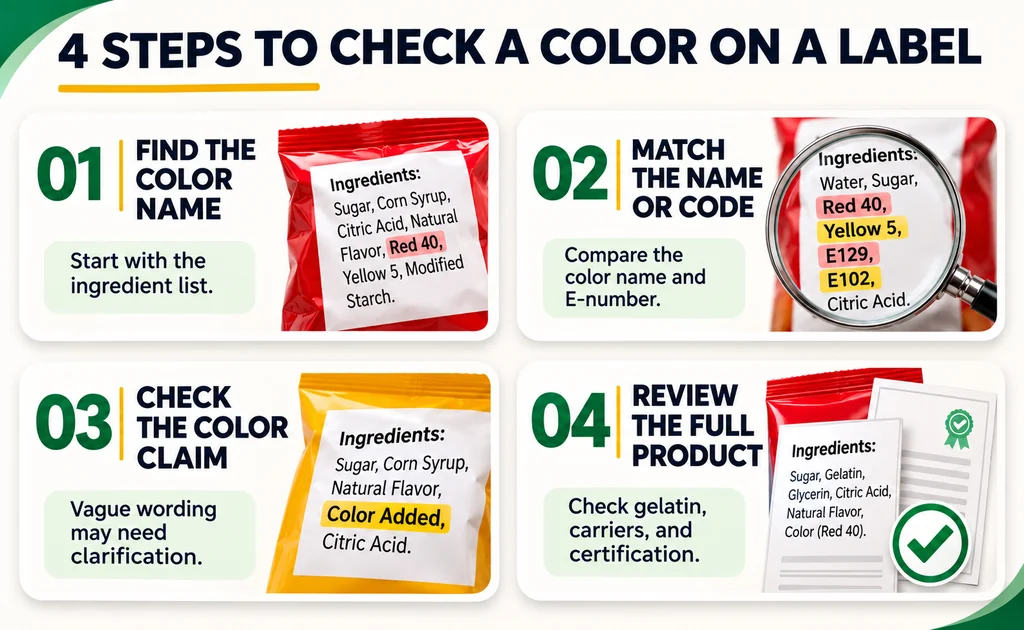
You do not need to know chemistry to check a color. Four steps are enough:
- Find the color’s name. Colors usually sit near the end of the ingredient list.
- Match the name or code. In the US you will see names like “Red 40” or “Yellow 5.” Elsewhere you will see E-numbers like E129 or E102. Check any code you do not know in our ingredient list.
- Watch for “color added.” Synthetic azo colors such as Red 40 and Yellow 5 are certified colors, so US law requires them to be named one by one. A vague term like “color added” points to a color that is exempt from certification, often a natural one, so look further or ask.
- Check the rest of the product. Look for gelatin, glycerin, alcohol and any halal certification mark.
If the label names an azo dye and nothing else on the list is a concern, the azo dye itself is not the problem.
Azo Dyes Outside Food
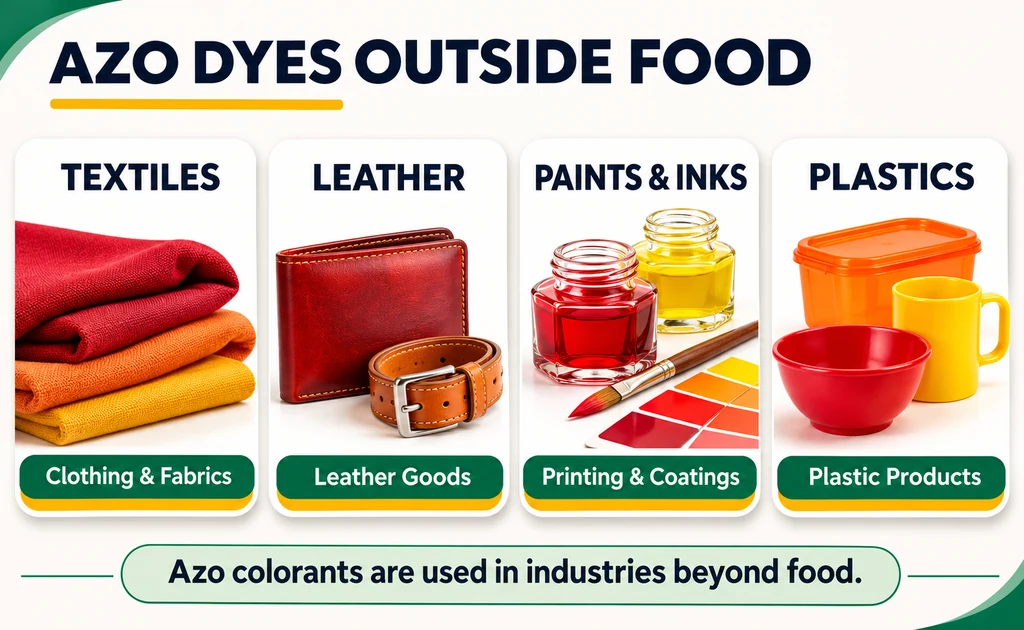
Most azo dyes are not used in food at all. They color clothing, leather goods, plastics and paints, and some tattoo inks (EBSCO). Those uses fall outside this site’s focus. The same principle still applies: the azo structure alone adds no halal concern. What matters is what a product is made from and what it contains.
Frequently Asked Questions
What is an azo dye in simple words?
An azo dye is a man-made color whose molecule has a small bridge of two linked nitrogen atoms. That bridge helps give strong reds, oranges and yellows. Red 40, Yellow 5 and Yellow 6 are common examples. “Azo” names the chemical shape, not where the dye comes from.
Are azo dyes halal?
Being azo does not make a dye halal or haram. Halal status depends on the source and on what is mixed in. Darul Ifta Birmingham and IlmHub accept the common synthetic azo colors, and the MUIS listing does not mark them doubtful. Still check the finished product for gelatin, glycerin or alcohol.
Is Red 40 an azo dye?
Yes. Red 40, also called Allura Red AC or E129, is an azo dye made in a lab. It is the most common azo red in American foods. For the full halal discussion of this one color, see our guide on whether Red 40 is halal.
Are all food dyes azo dyes?
No. Azo dyes make up a large share of food and textile dyes, but many food colors belong to other families. Blue 1 is a triarylmethane dye. Carmine comes from insects. Beet red and paprika come from plants. None of these is an azo dye.
Does “azo” mean the dye comes from animals?
No. “Azo” refers only to the nitrogen-nitrogen link inside the molecule. The common azo food dyes, such as Red 40, Yellow 5 and Yellow 6, are made in factories from chemical raw materials, not from animals or insects. If you want to avoid animal sources, look for names like carmine or E120, which are a different issue.
The Bottom Line
“Azo” is a chemical label, not a halal ruling. It describes a nitrogen bridge inside the dye, not an animal or alcohol source. Judge a color by what it is made from and what the finished product contains. If you prefer to skip synthetic colors altogether, choose products made with natural red food coloring from plants.
And Allah knows best.
Sources
- Wikipedia: Azo dye (definition and structure)
- EBSCO Research Starters: Azo compound / azo dye
- Wikipedia: Allura Red AC
- Wikipedia: Tartrazine
- Wikipedia: Sunset Yellow FCF
- Wikipedia: Brilliant Blue FCF
- Wikipedia: Carminic acid
- MUIS: Food Additive Listing (last updated Sep 13, 2016)
- Darul Ifta Birmingham: Is tartrazine halal? (fatwa 07858)
- IlmHub: Are Yellow 5, Yellow 6 and Red 40 halal?