
I have seen many sincere people read “certified” on a label and assume a halal body approved the product. That is an easy mistake, and it is worth correcting. In this guide I will explain what certified colors are, how they differ from “exempt” colors, which colors deserve a second look, and how to read a color label in a few seconds. For the best-known certified color, see our main guide: is Red 40 halal.
What Are Certified Colors?
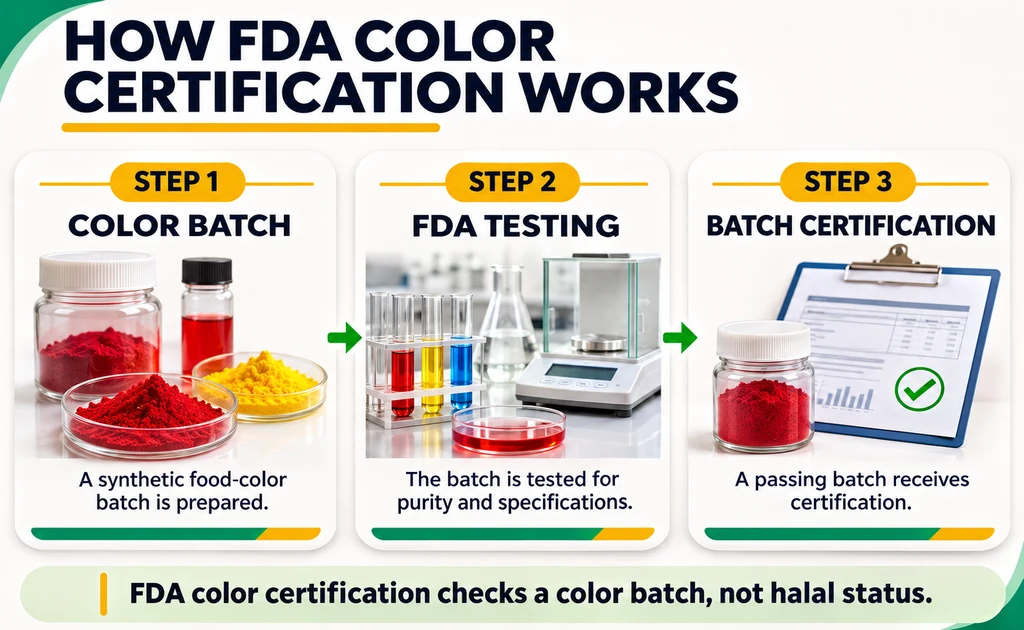
Certified colors are man-made food colors that must pass an FDA lab test before every batch can be sold. The FDA describes them as “synthetically produced (or human made)” colors (FDA). They are typically made from petroleum-derived raw materials (FDA).
You will know a certified color by its FD&C name, such as “FD&C Red No. 40.” FD&C stands for the Federal Food, Drug, and Cosmetic Act, the US law these colors are approved under. On food labels the name is often shortened to “Red 40” or “Yellow 5.”
All azo food dyes sold in the US, like Red 40 and Yellow 5, are certified colors. You can read more about that chemical family in our guide to azo dyes.
Which Colors Are Certified in the US
The FDA certifies seven main colors for general food use. All seven were certified in the April to June 2026 quarter (FDA certification report).
| FD&C name | Short name on labels | Common name | E-number |
|---|---|---|---|
| FD&C Blue No. 1 | Blue 1 | Brilliant Blue FCF | E133 |
| FD&C Blue No. 2 | Blue 2 | Indigo carmine (indigotine) | E132 |
| FD&C Green No. 3 | Green 3 | Fast Green FCF | — |
| FD&C Red No. 3 | Red 3 | Erythrosine | E127 |
| FD&C Red No. 40 | Red 40 | Allura Red AC | E129 |
| FD&C Yellow No. 5 | Yellow 5 | Tartrazine | E102 |
| FD&C Yellow No. 6 | Yellow 6 | Sunset Yellow FCF | E110 |
A few notes. The FDA has revoked Red 3’s authorization: makers must remove it from foods by January 15, 2027, and from ingested drugs by January 18, 2028 (Husch Blackwell; Wikipedia). Two narrow-use colors, Orange B and Citrus Red No. 2, are also on their way out: the FDA revoked Orange B in July 2026 and has proposed removing Citrus Red No. 2 (FDA). Most of these colors also come in a lake form, such as Red 40 Lake, which is the same certified dye fixed onto a mineral base. E-numbers are from the MUIS listing.
Certified vs Exempt Colors
Every approved US food color falls into one of two groups:
- Certified colors are synthetic. The FDA tests each batch before sale.
- Exempt colors are “exempt from certification,” meaning they skip the batch test. The FDA says they “generally include dyes and pigments derived from natural sources such as vegetables, minerals, or animals” (FDA).
Examples of exempt colors include beet powder, annatto, grape skin extract, beta-carotene and caramel. Carmine, the red made from insects, is also an exempt color. This is important for a Muslim reader: “exempt” does not automatically mean plant-based. It does not always mean natural or unprocessed either. Beta-carotene, for example, may be “prepared synthetically or obtained from natural sources” (21 CFR 73.95), and the exempt list also includes synthetic iron oxide (21 CFR Part 73). And exempt from certification never means halal.
Outside the US: the EU and UK do not use the word “certified.” They approve additives and give them E-numbers, and labels list a color by its category and name or E-number, such as “Colour: E129” (EU).
Does “Certified” Mean Halal Certified?
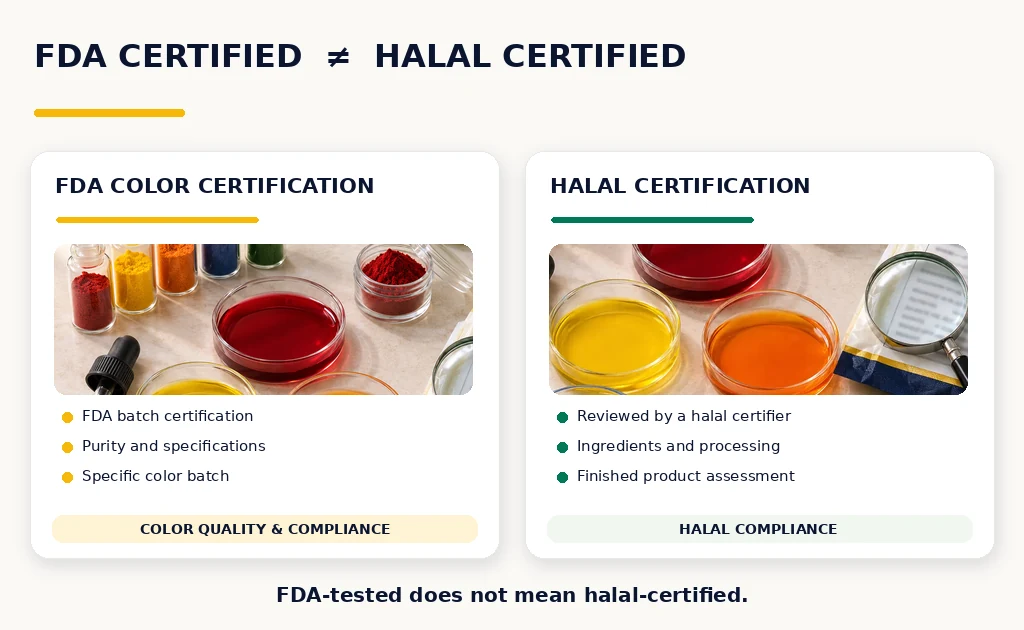
No. These are two different uses of the same word. FDA certification tells you a batch of synthetic dye is pure and meets US specifications. Halal certification tells you a halal body has reviewed the whole product against Islamic rules. One says nothing about the other.
| FDA color certification | Halal certification | |
|---|---|---|
| Who does it | FDA chemists | A halal certifying body |
| What it covers | One batch of one synthetic color | The whole product and how it is made |
| Main question | Is this batch pure and to spec? | Is everything in it, and the process, halal? |
| Looks at religious rules? | No | Yes |
| Where you see it | In the color’s FD&C name on the label | A halal logo on the package |
What FDA Certification Checks
The FDA tests a sample from each batch for purity and composition. Its chemists check the amount of color, moisture, leftover salts and by-products, other impurities, and heavy metals such as lead, arsenic and mercury. If the batch passes, it gets a certificate and a lot number. If it fails, it is rejected (FDA).
That is all it does. The FDA does not ask whether a product contains pork, alcohol or insects, and it does not review the color from a religious point of view.
What Halal Certification Checks
A halal certifier looks at the whole picture, not one ingredient. According to the American Halal Foundation, an audit typically reviews (AHF):
- Every ingredient, with halal certificates from suppliers
- The production process, to confirm no alcohol or pork derivatives are used
- Cleaning and storage, so halal and non-halal materials stay apart
- Cross-contamination risk from shared equipment
So if you want an answer for the whole product, look for a trusted halal logo, not the word “certified” next to a color.
Are Certified Colors Halal?
Certified colors are lab-made, so the dye itself brings no animal, insect or alcohol source into the food. That is why the scholars and halal bodies I reviewed accept the common ones:
- MUIS (Singapore), Food Additive Listing, last updated September 2016. All six certified colors that have an E-number (E102, E110, E127, E129, E132 and E133) are listed as “synthetic” colorings, and none carries the “doubtful” mark. MUIS calls the list “a general guideline” (MUIS).
- Darul Ifta Birmingham (Hanafi), 2025. Tartrazine (Yellow 5) is “considered halal for consumption,” based on the rule that things are permitted by default (Darul Ifta Birmingham).
- Mufti Faisal al-Mahmudi, IlmHub. Yellow 5, Yellow 6 and Red 40 are synthetic and “Halaal Suitable” (IlmHub).
For the full halal reasoning on the most common certified color, read our Red 40 guide.
When you read any halal guide, including this one, keep three ideas separate:
- Generally halal by source: the ingredient comes from a source scholars generally accept, like a lab-made dye or a vegetable.
- Not marked doubtful: a halal body’s general list does not flag the ingredient. That is all it means.
- Halal certified: a halal body has checked a specific product, its process and its production line.
The first two describe an ingredient. Only the third covers the product in your hand.
The Part That Still Needs a Check
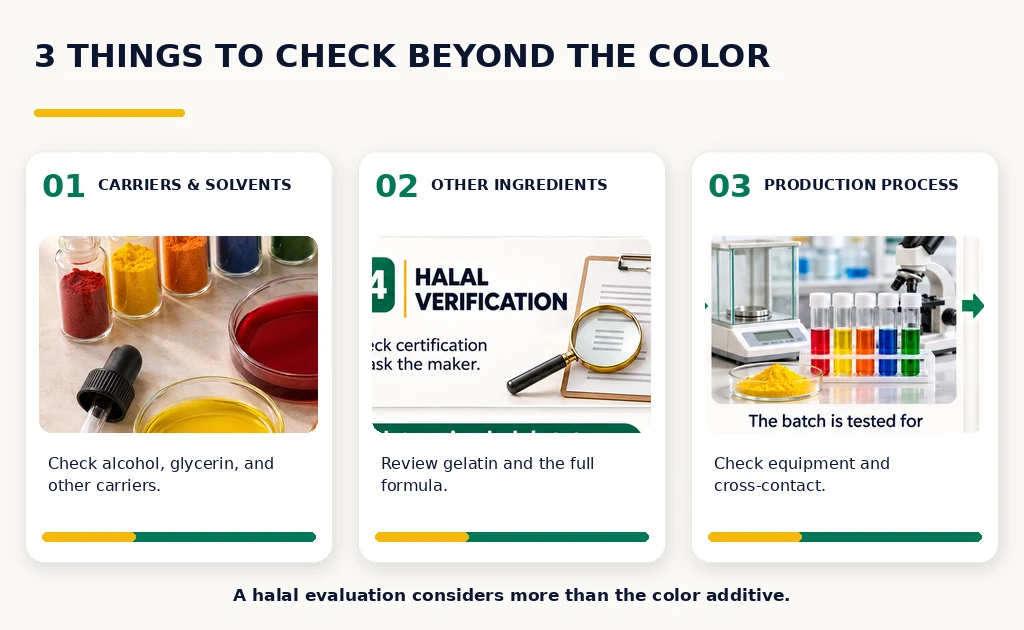
The dye is rarely the problem. What surrounds it can be:
- Liquid color blends. Some colors are sold dissolved in a carrier. If that carrier is alcohol, or glycerin from animal fat, the blend needs checking. Scholars and certifiers differ on alcohol used only in processing, especially when almost none remains, so follow your certifier.
- The rest of the product. A halal color inside a gummy made with pork gelatin does not make the gummy halal.
- Shared production lines. Only a halal certifier checks for cross-contamination.
When in doubt, ask the maker or choose a product with a halal logo you trust.
Which Colors Need a Second Look?
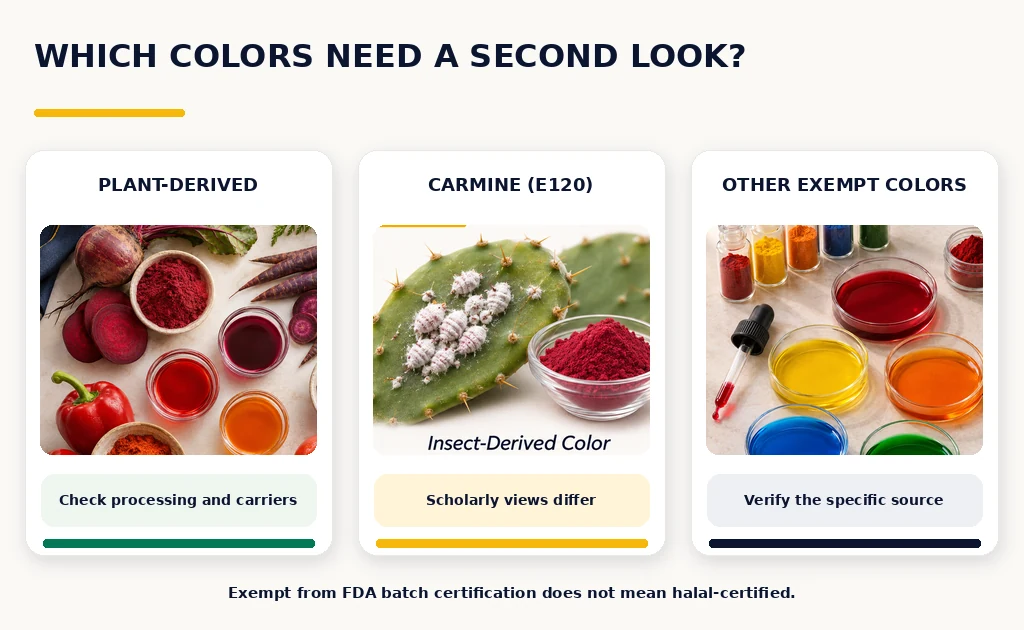
Mostly the exempt colors. Because “exempt” covers colors from plants, minerals and animals, the source can vary. That is where a Muslim reader should slow down.
Carmine and Cochineal
Carmine, also called cochineal extract or E120, is an exempt color made from insects (FDA). Scholars differ on whether it is permissible. US law requires it to be named on food labels, so it cannot hide behind “color added” (21 CFR 73.100).
Other Exempt Colors
Plant colors such as beet red, paprika and grape skin extract are generally not a concern, and MUIS lists beet red (E162) with no warning mark. Four plant colors do carry MUIS’s “doubtful” mark: annatto (E160b), paprika extract (E160c), lycopene (E160d) and anthocyanins (E163) (MUIS). MUIS says only that the doubt comes “either by way of its source or manufacturing process,” without naming the reason for each. For plant colors, one possible reason is the solvent or carrier used, so check for halal certification on those. For a full list, see our guide to natural red food coloring.
How to Read a Color Label: A Quick Guide
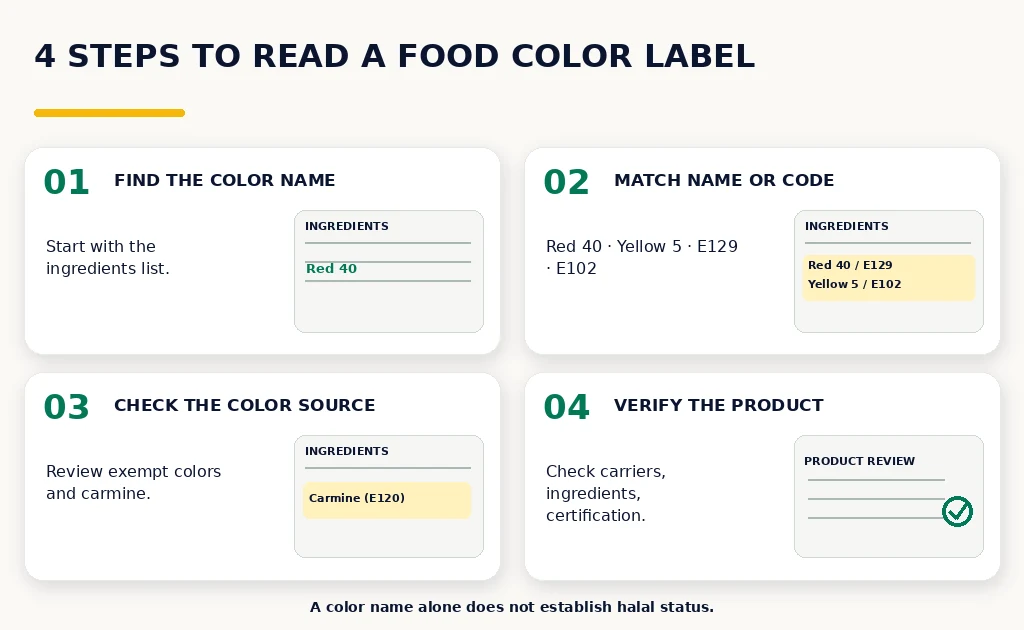
Use this table when you are standing in the aisle. Find the words on the package in the first column, then follow the last column.
| What the label says | What it usually means | What to do |
|---|---|---|
| FD&C Red No. 40, FD&C Yellow No. 5, etc. | A certified synthetic color | The color is not the concern; check the rest of the label |
| Red 40, Yellow 5, Blue 1 | The same certified colors, short names | Same as above |
| Red 40 Lake, Blue 1 Lake | A certified color on a mineral base | Same as above |
| Allura Red AC | The chemical name of Red 40 | Same as above |
| E129, E102, E110 (outside the US) | Synthetic colors by E-number | Same as above; look up other codes in our ingredient list |
| “Artificial color” or “color added” | Usually an exempt color, which US rules let makers group under these words | Source unknown; ask the maker or look for a halal logo |
| “Natural color” | A marketing phrase; US label rules do not define it for added color | Look for the specific name; it could be plant or insect |
| “Colored with beet juice,” “paprika color” | An exempt color named by source | Plant sources are generally fine |
| Carmine, cochineal extract, E120 | An insect-based exempt color | Scholars differ; see our carmine guide |
| Caramel color | An exempt color made by heating sugars and other carbohydrates (21 CFR 73.85) | Generally not a concern; MUIS lists it with no warning mark |
The “artificial color” row surprises many people. In US label rules, the words “artificial color” often point to an exempt color, while certified synthetic colors must be named one by one (21 CFR 101.22).
One more tip: butter, cheese and ice cream do not have to list added colors at all, except carmine, which must always be named. For those three foods, a halal logo is the most reliable check.
“No artificial colors” on the front of the pack: since February 5, 2026, the FDA has said it will not object to this claim on foods that contain no certified colors, even if they use colors from natural sources (Wiley). So the claim tells you there is no Red 40 or other certified color. It does not tell you the product is halal, and a product colored with carmine can carry it.
Frequently Asked Questions
What does “certified colors” mean on a label?
It means synthetic colors that the FDA tested batch by batch before sale, such as Red 40, Yellow 5 and Blue 1. FDA chemists check each batch for purity and impurities. On labels these colors appear by their FD&C name or a short form like “Red 40.”
Are certified colors halal?
The common certified colors are lab-made, with no animal, insect or alcohol source in the dye. Scholars such as Darul Ifta Birmingham accept them, and MUIS’s general listing does not mark them doubtful. Still check liquid carriers and the rest of the product.
Is “certified” the same as “halal certified”?
No. FDA certification checks one batch of one synthetic color for purity. It does not look at religious rules. Halal certification is done by a halal body that reviews every ingredient, the process and cross-contamination. Look for a trusted halal logo, not the word “certified.”
What does “color added” mean?
It usually means an exempt color, one that skips FDA batch testing, such as beet, annatto or caramel. US rules let makers group these under “color added” or “artificial color.” The exact source is not shown, so ask the maker or rely on a halal logo.
Is caramel color a certified color?
No. Caramel color is exempt from certification. US rules describe it as a dark brown color made by carefully heating food-grade carbohydrates, such as sugar, malt syrup or molasses. MUIS lists caramel color with no warning mark, so it is generally not a halal concern.
The Bottom Line
“Certified” on a US color means FDA-tested, not halal certified. The certified colors themselves are lab-made and accepted by the sources I reviewed. The colors that deserve a second look are the exempt ones, especially carmine, and the carriers and other ingredients around any color. Read the color name, then read the rest of the label, and when in doubt, choose a halal logo you trust.
And Allah knows best.
Sources
- FDA: Color Additives in Foods
- FDA: Color Certification FAQs
- FDA: Report on Certification of Color Additives, Q3 FY2026 (Apr–Jun 2026)
- FDA: Removing outdated authorizations for color additives (July 22, 2026)
- 21 CFR 101.22: Declaring colors on food labels
- 21 CFR 73.85: Caramel
- 21 CFR 73.100: Cochineal extract; carmine
- Wikipedia: Erythrosine (Red 3 status)
- EU: Food additives labelling
- MUIS: Food Additive Listing (last updated Sep 13, 2016)
- American Halal Foundation: What is a halal audit?
- Darul Ifta Birmingham: Is tartrazine halal?
- IlmHub: Are Yellow 5, Yellow 6 and Red 40 halal?