
Natural Red Food Coloring: Which Are Halal?
Quick Answer Most natural red food colorings come from plants, such as beet, red cabbage, paprika and tomato, and are generally considered halal by source.
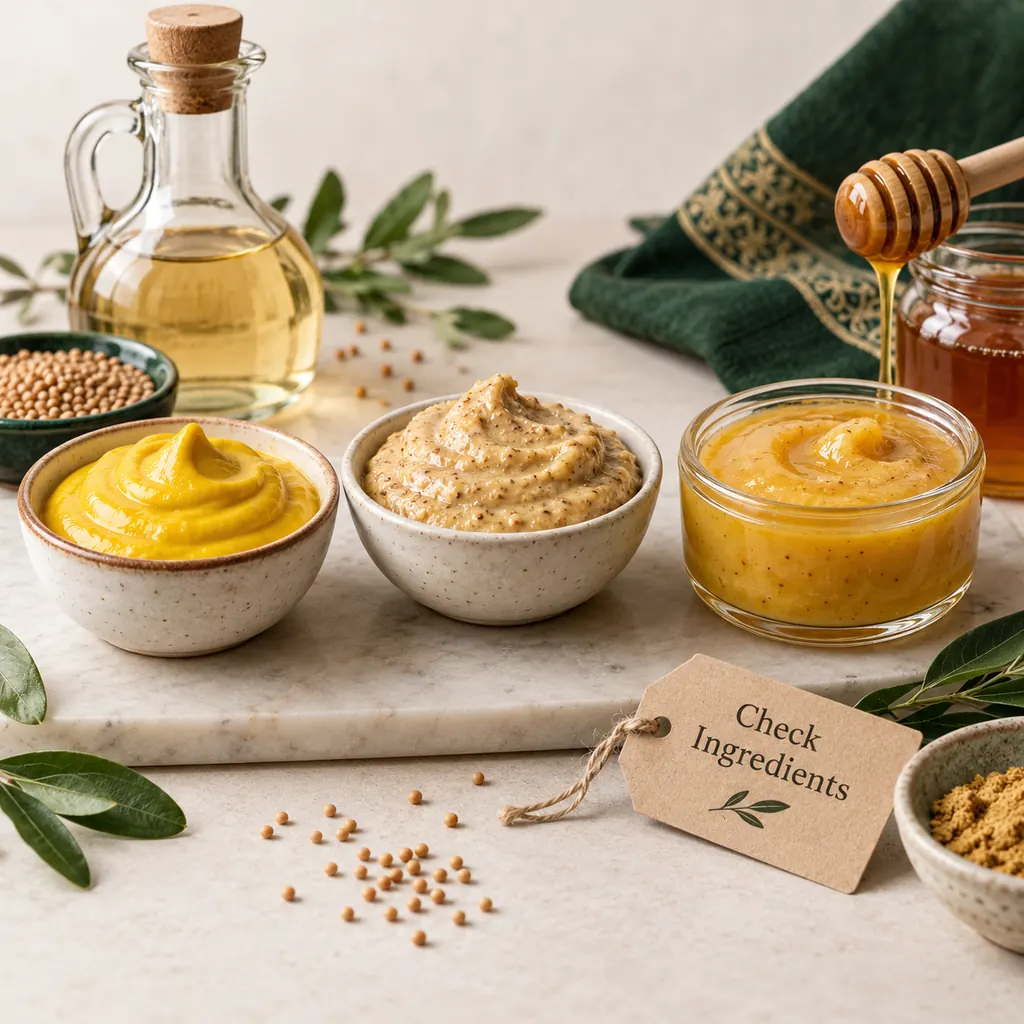
I get this question often, usually from someone standing in a grocery aisle with a jar of Dijon in one hand and their phone in the other. So let me give you the answer first.
Plain mustard is halal. It is made from plant seeds, vinegar, water, and salt, and none of these is forbidden in Islam. The main halal concern in mustard is added wine or spirits, although certain flavorings and additives may also need checking.
In this guide, I will walk you through what mustard is made of, what the ruling is, how each type of mustard compares, what the popular US brands put in their jars, and how to choose a halal mustard in under a minute.
Quick Answer : Yes, plain mustard is halal. Mustard seeds, vinegar, water, salt and turmeric are all permissible. The main concern is added wine or spirits: many Dijon mustards list white wine, and the scholars I cite treat added wine as haram in any amount. Read the label, or choose a halal-certified jar.
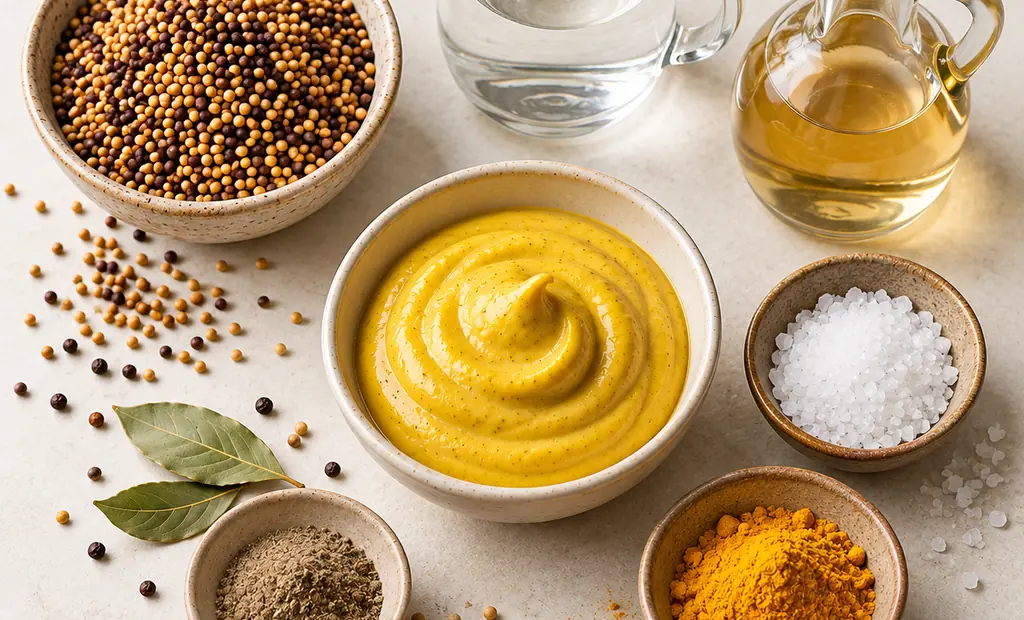
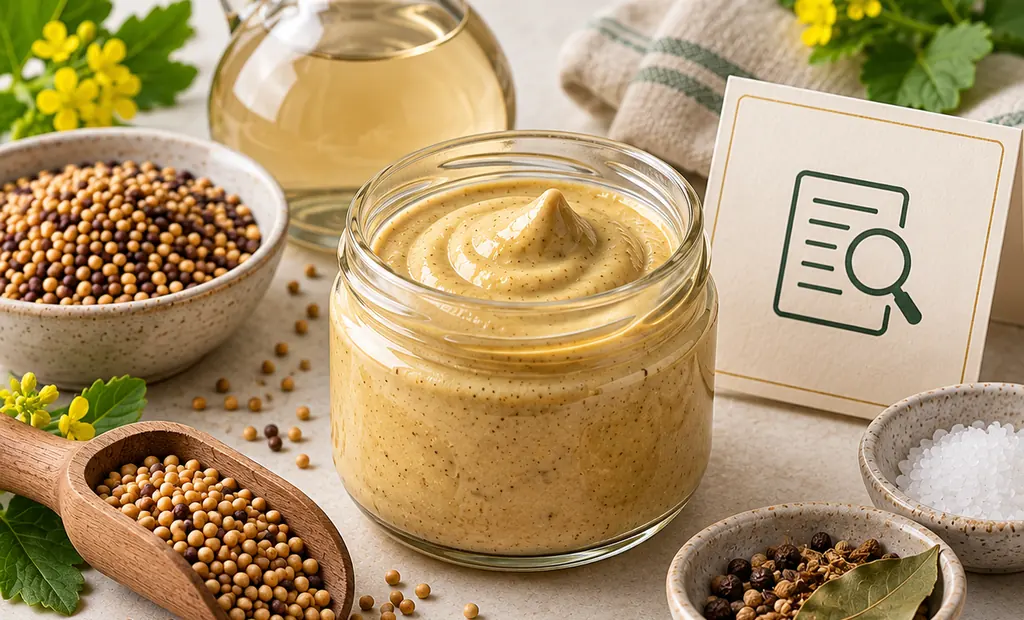
Mustard is made of four simple things: mustard seeds, a liquid, salt, and sometimes spices or a sweetener. Of these, the liquid is what decides whether a jar is halal.
The seeds. Mustard comes from the seeds of the yellow or white mustard plant (Sinapis alba), the brown mustard plant (Brassica juncea) or the black mustard plant (Wikipedia). All three are plants, so the seed itself is halal.
The liquid. The seeds are crushed or ground and mixed with water, vinegar, lemon juice, wine or other liquids, along with salt and spices (Wikipedia). Water, vinegar and lemon juice raise no concern. Wine does.
The colour and heat. Turmeric is often added to give commercial mustard its bright yellow colour. The sharp heat comes from a natural enzyme reaction that starts when crushed seed meets liquid (Wikipedia). In other words, the heat does not come from alcohol.
Here is how the common ingredients on a mustard label look from a halal point of view:
| Ingredient | What it is | Halal status |
|---|---|---|
| Mustard seed, water, salt | Plant and mineral | Halal |
| Turmeric, paprika, spices, garlic | Plants | Halal |
| Distilled, spirit or malt vinegar | Alcohol that has fully turned into acetic acid | Accepted by most scholars |
| Wine vinegar | Vinegar made from wine | Scholars differ |
| Verjuice | Juice of unripe grapes, not wine | Halal |
| White wine, Chardonnay, beer, whisky, brandy, cognac | Alcoholic drinks | Avoid |
| Honey, sugar | Sweeteners | Halal |
| Natural flavor(s) | Source not shown on the label | Ask the maker |
| Citric acid, sulphites, pectin | Acid, preservative, thickener | Generally halal |
| Tartaric acid | Acid, often taken from winemaking by-products | Check with your scholar or certifier |
| Egg yolk, cream, mayonnaise (in mustard sauces) | Animal or dairy | Halal if no haram additives |
One word on “natural flavor”. Under US rules, a natural flavor can come from a plant or an animal source, and the label does not have to say which (21 CFR 101.22). Liquid flavors may also be carried in alcohol. I explain this in more detail in my article on Worcestershire sauce.
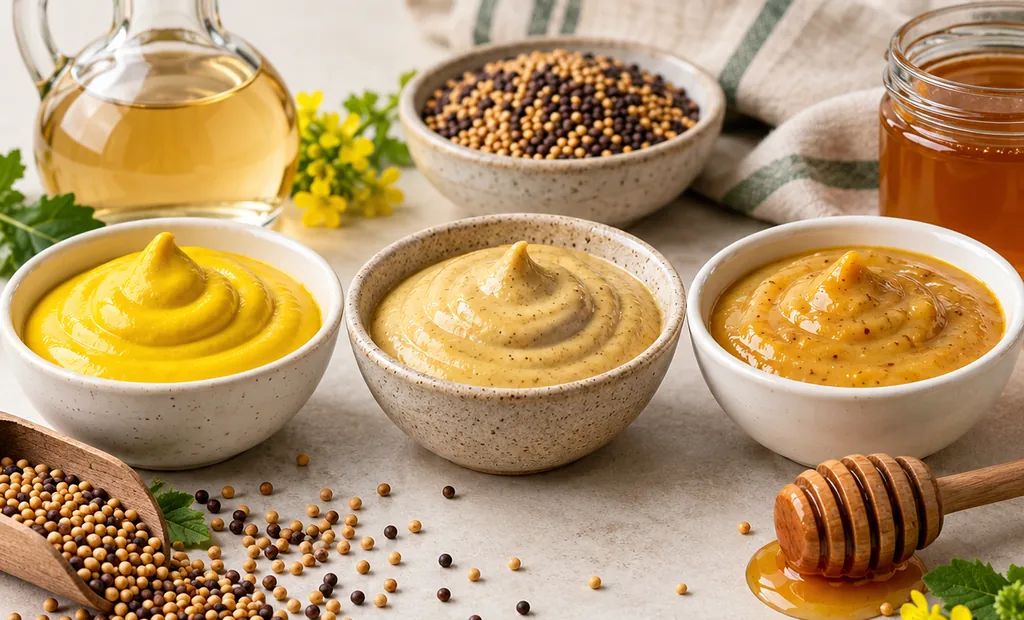
Yes. Mustard is halal in Islam by default, because it is a plant food, and plant foods are halal unless something forbidden is added to them.
The starting point in Islamic law is that food is permissible. Allah tells us to eat from what is lawful and good on the earth (Qur’an 2:168). Nothing about the mustard seed changes that.
What can change it is khamr, meaning wine and any intoxicant. The Qur’an calls it a filth from the work of Shaytan and tells the believers to avoid it (Qur’an 5:90). The Prophet ﷺ said that every intoxicant is khamr, and every khamr is haram (Sahih Muslim 2003). He ﷺ also said that whatever intoxicates in a large amount, a small amount of it is also haram (Abu Dawud 3681; Tirmidhi 1865).
So when you ask whether a mustard is halal, the question is never the seed. The question is what was added to the jar.
Dijon mustard is not haram as a type. Its status depends on the label: many Dijon jars add white wine, while others use only vinegar or verjuice.
Dijon mustard began in the French city of Dijon. In 1856, a mustard maker there replaced vinegar with verjuice, the sour juice of unripe grapes. Today, most Dijon mustard uses white wine together with vinegar instead (Wikipedia: Dijon mustard). Verjuice is not wine, so a Dijon made with verjuice or plain vinegar raises no alcohol concern.
The US shelf shows both kinds. Grey Poupon Dijon and French’s Dijon list wine on their labels, while Maille Dijon Originale lists none. You will find the full ingredient lists in the brand section below.
The scholars below treat wine added to food as haram, regardless of the amount. I am reporting their views here, with their names, so you can see who says what:
You may see some diet and nutrition websites say Dijon is “generally halal” while listing white wine as one of its usual ingredients. That reasoning does not hold. Wine is the one ingredient in Dijon that the scholars above name as the problem.
No. According to the scholars cited above, white wine added to mustard makes it impermissible, even in a small amount. A Dijon or honey mustard is halal by ingredients only when its label lists no wine, champagne or other alcoholic drink.
We cannot assume it does. I could not find any published figure for how much alcohol remains in a finished jar of Dijon. As I wrote in my Worcestershire sauce article, “not listed” is not the same as “zero”, and processing alone does not prove the alcohol is gone. More importantly, the scholars above rule on the wine as an ingredient, not only on whether you can taste or feel it.
Yes, in most jars. Distilled, spirit and malt vinegar are accepted by most scholars. Scholars differ on wine vinegar, mainly when wine is deliberately turned into vinegar.
People often mix up three different things on a mustard label. This table keeps them apart:
| On the label | What it is | Halal status |
|---|---|---|
| White wine, Chardonnay | Wine added as wine | Avoid |
| Wine vinegar | Wine that has been turned into vinegar | Scholars differ |
| Distilled, spirit or malt vinegar | Alcohol that has fully turned into acetic acid | Accepted by most scholars |
The key idea here is istihalah. It means a complete change, in which a substance turns into something new with a new ruling. When alcohol fully becomes acetic acid, the result is vinegar, not an intoxicant.
The Prophet ﷺ praised vinegar and called it the best of condiments (Sahih Muslim 2051). Yet when he ﷺ was asked whether wine could be made into vinegar, he said no (Sahih Muslim 1983). This is why scholars differ on wine vinegar:
Most American yellow mustards use distilled vinegar, so this difference rarely matters for them. It matters more for some Dijon and gourmet mustards that use wine vinegar. My advice: follow the scholar or certifier you trust. If you are unsure, remember the hadith, “Leave what makes you doubt for what does not make you doubt” (Tirmidhi 2518).
For the full discussion of vinegar and istihalah, see my article Is Worcestershire Sauce Halal?
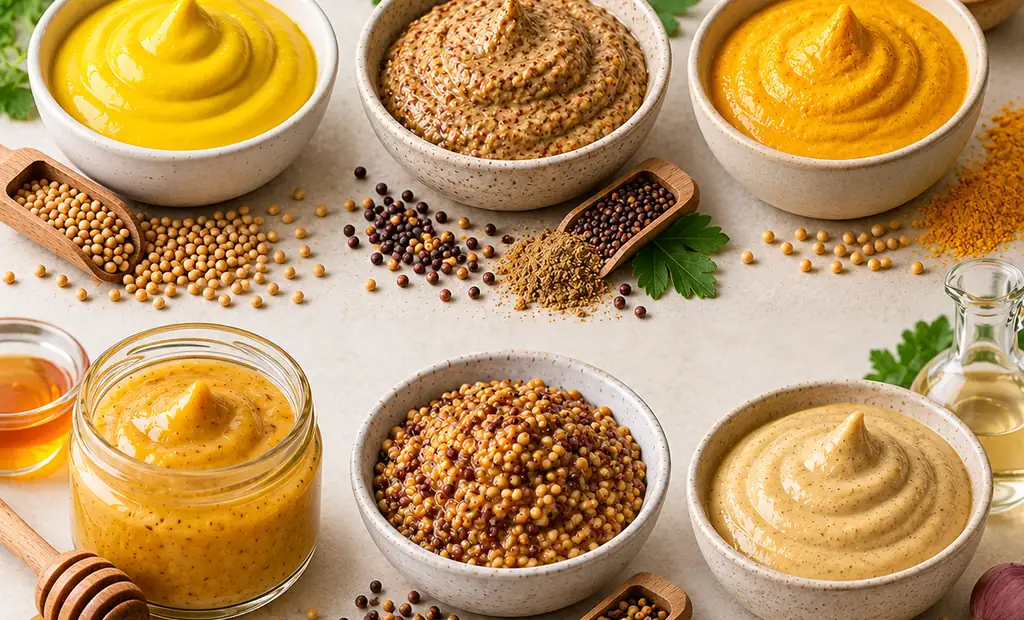
Most mustards are halal based on their typical ingredients. Dijon, whole-grain, honey, and fruit mustards depend on the label. Beer and spirit mustards are not halal.
The table below covers the mustard types you are most likely to meet. The descriptions follow Wikipedia’s list of varieties; recipes change from brand to brand, so the label always has the final word.
| Type | Usual ingredients | Halal concern | Verdict |
|---|---|---|---|
| American yellow | Yellow seed, distilled vinegar, turmeric | Natural flavor(s) | Generally halal |
| Spicy brown / deli | Coarse brown seed, spices, sometimes horseradish | Few | Generally halal |
| English | Yellow and brown seed, low acid; also sold as powder | Few | Generally halal |
| Chinese hot / Karashi | Mustard powder mixed with water | Few | Generally halal |
| Hot pepper mustard | Any mustard plus chili or hot sauce | The base mustard | Check the label |
| Honey mustard | Mustard and honey | Some recipes add white wine | Check the label |
| Whole-grain / stone-ground | Whole seeds with vinegar or wine | Wine in some jars | Check the label |
| Dijon | Brown seed with white wine, vinegar or verjuice | White wine in many jars | Depends on the label |
| French mustard (UK) | Dark, mild and sweet | Recipe varies | Check the label |
| Sweet (Bavarian) | Sweetened with sugar | Recipe varies | Check the label |
| Creole | Very coarse brown mustard | Recipe varies | Check the label |
| Fruit mustards (mostarda) | Fruit in hot mustard syrup | Wine in some recipes | Check the label |
| Beer mustard | Made with beer | Beer | Not halal |
| Spirit mustards | Made with whisky, brandy or cognac | Added spirits | Not halal |
A few notes on the types people ask me about most:
Yellow mustard is the safest everyday choice. It is usually made with distilled vinegar, and none of its usual ingredients is haram. The only item worth a question is “natural flavor”.
Honey mustard is halal when it is simply mustard and honey. Some brands and restaurant sauces add white wine, so read the label before you buy.
Dry mustard powder is just ground mustard seed. It is halal, and you can mix it with water yourself to make English-style or Chinese-style hot mustard.
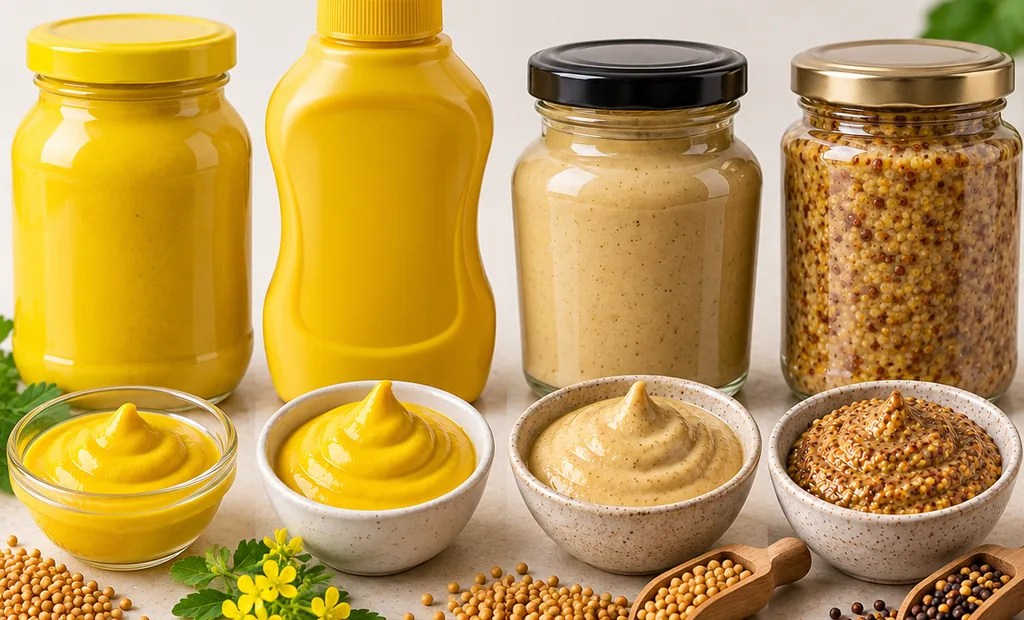
Heinz Yellow, French’s Classic Yellow and Maille Dijon Originale list no wine on their US labels. French’s Dijon and Grey Poupon Dijon do list wine. None of the five shows a halal certification mark in the sources I checked.
Here is what each US label says, as checked in October 2026:
| Product (US) | Wine or alcohol listed? | Ingredients on the label |
|---|---|---|
| Heinz Yellow Mustard | No | Distilled white vinegar, mustard seed, water, salt, turmeric, spices, natural flavor (Food Lion) |
| French's Classic Yellow Mustard | No | Distilled vinegar, water, mustard seed, salt, turmeric, paprika, spice, natural flavors, garlic powder (Giant) |
| Maille Dijon Originale | No | Water, mustard seeds, vinegar, salt, citric acid, sodium metabisulfite (Maille US) |
| French's Dijon Mustard with Chardonnay | Yes, Chardonnay wine | Distilled vinegar, water, mustard seed, salt, Chardonnay wine, spices and turmeric (Giant) |
| Grey Poupon Dijon Mustard | Yes, white wine | Distilled white vinegar, mustard seed, water, salt, white wine, citric acid, tartaric acid, fruit pectin, sugar, spices (ShopRite) |
One independent reviewer has also looked at two of these brands in Canada. AskHalal (IlmHub) rated Heinz Yellow Mustard “Halal Suitable” in August 2024 and French’s Prepared Dijon Mustard “Haram” in June 2024 (AskHalal: Heinz; AskHalal: French’s Dijon).
Please keep three levels of evidence apart when you read this table:
Also, the same brand can use a different recipe in another country. If you live outside the US, check the jar sold where you live.
Four beliefs come up again and again, and each one can send you the wrong way.
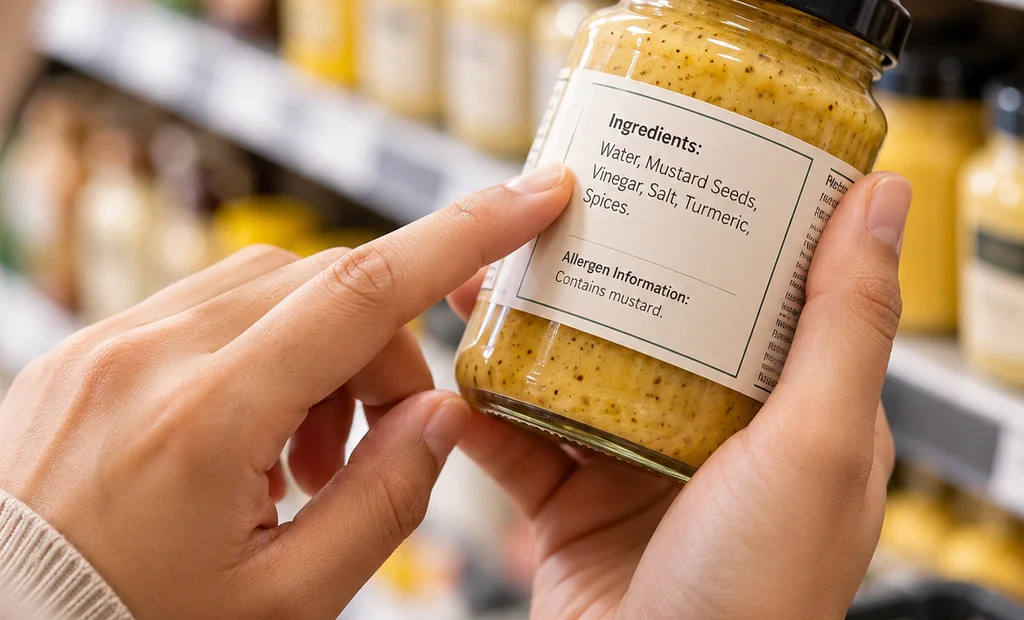
Look for a halal mark first. If there is none, five quick label checks will tell you almost everything, and they take less than a minute.
Wine-free swaps. If a recipe calls for Dijon, choose a Dijon whose label lists no wine, or use yellow mustard with a pinch of chili flakes for extra heat. If you make mustard at home, verjuice or white grape juice can take the place of the wine.
No. Mustard is made from plant seeds, vinegar, water and salt, and none of these is haram. A jar becomes a concern only when wine, beer or spirits are added, or when an additive comes from a doubtful source. Plain yellow and spicy brown mustards are generally halal.
Honey mustard is halal when it is made only from mustard, honey, vinegar and spices. Some brands and restaurant sauces add white wine, which scholars such as Mufti Ebrahim Desai treat as forbidden. Read the label, and ask about the sauce when you eat out.
Yes, yellow mustard is generally halal. It is usually made from yellow mustard seed, distilled vinegar, salt and turmeric. The one ingredient worth a question is "natural flavor", because the label does not show its source. A halal mark removes that doubt.
Heinz Yellow Mustard in the US lists no wine or alcohol, and its ingredients are halal by source, with natural flavor the only unknown. AskHalal rated the Canadian jar "Halal Suitable" in 2024. It is not halal certified, so check the jar in your country.
It depends on the product. French's Classic Yellow Mustard lists no wine, so it is halal by ingredients. French's Dijon Mustard lists Chardonnay wine, so the scholars cited in this article would not permit it. Always read the label of the exact French's product.
Maille Dijon Originale sold in the US lists water, mustard seeds, vinegar, salt, citric acid and sodium metabisulfite, with no wine. That makes it halal by ingredients. Other Maille mustards and other markets may differ, and the label shows no halal mark.
It depends on what is mixed into it. A mustard sauce can contain cream, mayonnaise, wine, beer or anchovies. Cream, eggs and fish are halal, but wine and beer are not. Ask the restaurant or check the label before you eat it.
Yes. Mustard oil comes from mustard seed, which is a plant, so it is halal by source. As with any oil, a product is a concern only if something haram is added to it. Plain mustard oil, as used across South Asia, raises no halal issue.
Yes. Dry mustard powder is simply ground mustard seed, so it is halal. You can mix it with cold water to make a hot English-style or Chinese-style mustard at home. This is also an easy way to avoid any doubt about wine or flavorings.
No, not for most vinegars. Distilled, spirit and malt vinegar are accepted by most scholars, because the alcohol has fully turned into acetic acid. Wine vinegar is debated. Some scholars permit it and others do not, so follow the scholar you trust.
Mustard is halal by default. Its seeds, vinegar, water, salt and turmeric are all permissible. The main thing to watch for is added wine or spirits, which appear in many Dijon mustards and in beer and spirit mustards. Read the label or choose a halal-certified jar, and on wine vinegar, follow the scholar or certifier you trust.
And Allah knows best.
Quick Answer Most natural red food colorings come from plants, such as beet, red cabbage, paprika and tomato, and are generally considered halal by source.
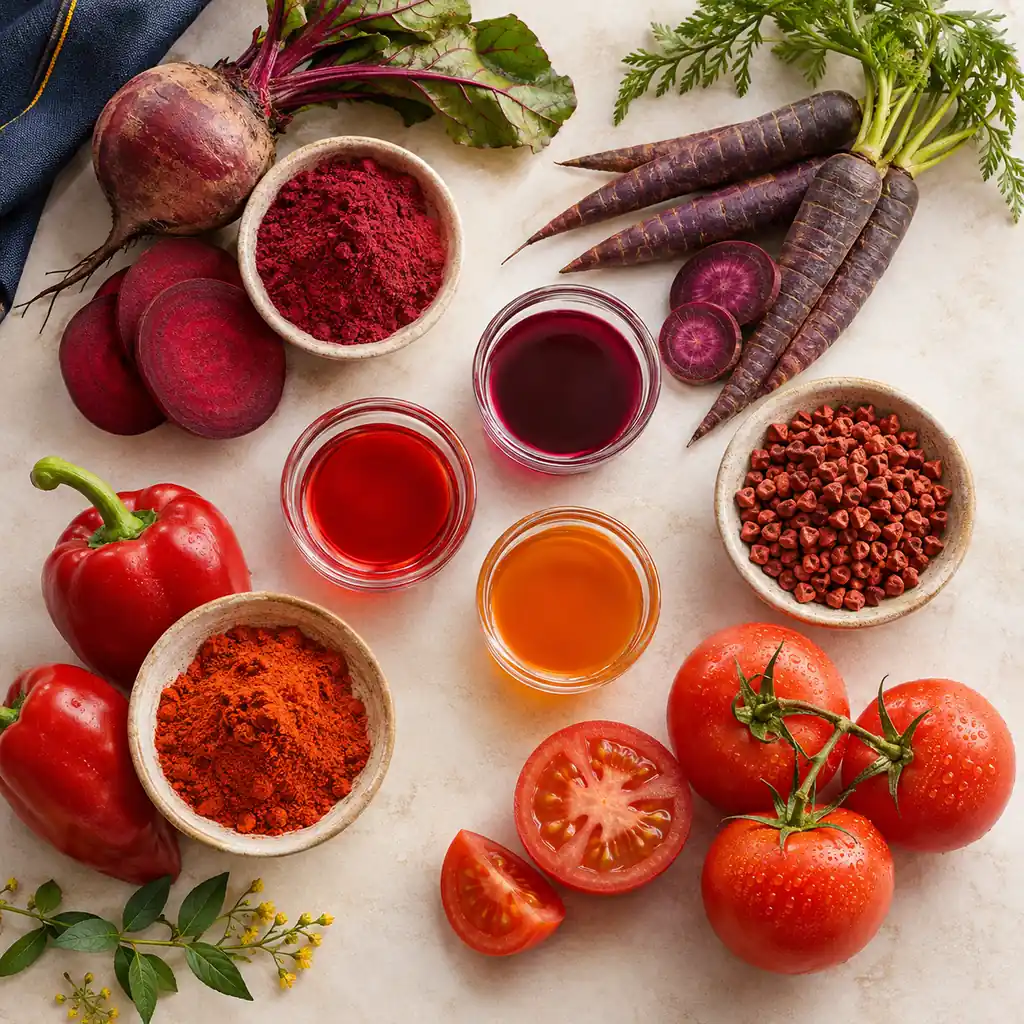
Quick Answer Quick Answer: Plant-based colors such as beet, paprika, purple carrot and tomato lycopene are common replacements for Red 40. They are generally halal
Plain mustard is made from plant seeds, vinegar and salt, so it is halal. The real question is what else goes in the jar: many Dijon and specialty mustards add white wine or spirits. Here is how to tell which jars are safe.
