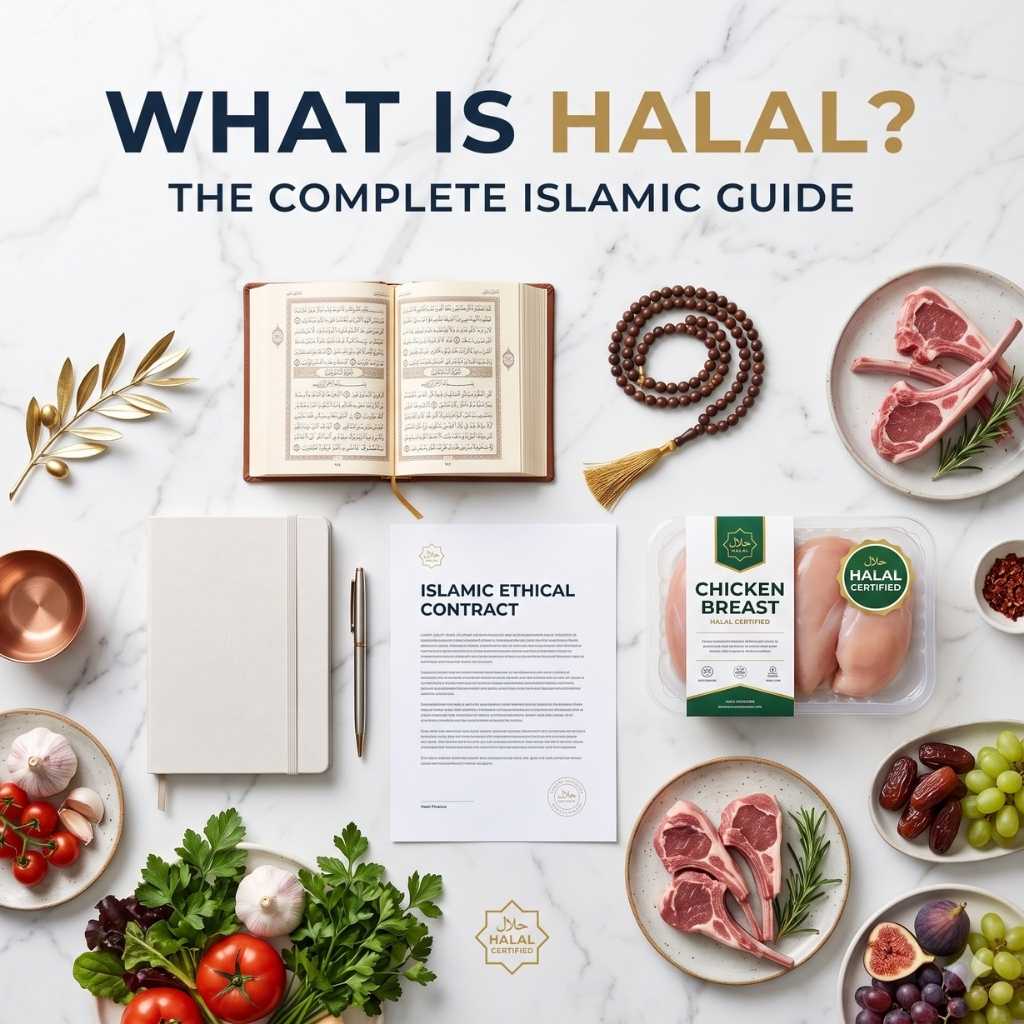
What is Halal? — The Definition
A. The Arabic Meaning of Halal
The word “halal” comes from the Arabic language. It literally means “permissible” or “lawful.” The opposite word is “haram,” which means “forbidden” or “unlawful.”
In Arabic, halal (حَلَال) is the opposite of haram (حَرَام). These two words together form the foundation of Islamic guidance on what a Muslim may or may not do in daily life.
B. Halal in Islamic Law (Sharia)
In Islam, halal is not just one simple category. Islamic scholars have divided human actions into five groups based on how Allah and His Prophet (peace be upon him) view them:
- Wajib (Obligatory) — Actions that Muslims must do, such as the five daily prayers.
- Mandub (Recommended) — Good actions that are encouraged but not required, such as extra voluntary prayers.
- Mubah (Permissible) — Actions that are neutral — allowed, but neither rewarded nor punished.
- Makruh (Disliked) — Actions that are discouraged but not forbidden.
- Haram (Forbidden) — Actions that are strictly prohibited.
When people use the word “halal,” they usually mean everything that falls under the first three categories — things that are obligatory, recommended, or simply allowed. In short, halal covers anything that Islam does not forbid.
C. A Simple Definition
Halal means anything that is permitted and lawful in Islam — whether it is food, drink, business, behavior, or any other part of daily life.
It is that simple. Halal is not just a food label. It is a complete way of living that covers everything a Muslim does from morning to night.
Halal vs. Haram — What's the Difference?
A. What is Haram?
Haram refers to everything that Islamic law clearly forbids. A Muslim who commits a haram act is sinning. But a Muslim who avoids haram out of obedience to Allah is rewarded by Him.
Haram is not a judgment invented by humans. It comes from the Quran and the teachings of Prophet Muhammad (peace be upon him). Only Allah has the authority to declare something haram — no human scholar, government, or institution can add to this list without clear proof from Islamic sources.
B. Halal vs. Haram — A Quick Comparison
C. The Gray Area — Makruh and Mashbooh
Not everything in life fits neatly into halal or haram. There are two important middle categories that every Muslim should know:
Makruh (Disliked): These are actions that Islam discourages but does not completely forbid. Doing them is not a sin, but avoiding them is better. For example, eating with your left hand is makruh in most scholarly opinions.
Mashbooh (Doubtful): These are things where it is unclear whether they are halal or haram. The Prophet (peace be upon him) advised Muslims to avoid doubtful matters to protect their faith and conscience. When in doubt, it is always safer to leave it.
Understanding these categories helps Muslims make wiser and more informed daily choices.
The 3 Core Principles of Halal
Islamic scholars have derived important principles from the Quran and Sunnah to help Muslims understand halal and haram. Here are the three most important ones for everyday life:
Principle 1: Everything is Halal by Default
This is one of the most important and comforting principles in Islam. Allah created this world and everything in it for human beings. The default ruling is that everything is permitted — unless Allah or His Prophet specifically declared it forbidden.
This means a Muslim does not need to look for a “halal” label on every single thing. The real question to ask is: has this been specifically prohibited? If not, it is halal.
The Quran says: “It is He who created for you all that is on earth.” (Quran 2:29). This verse shows that the earth and its benefits are given to us — the exceptions are only what has been clearly forbidden.
Principle 2: Only Allah Has the Right to Permit or Prohibit
No human being — no scholar, king, or religious leader — has the authority to declare something halal or haram based on their personal opinion alone. This authority belongs only to Allah.
When a person or group makes up religious rules without any basis in the Quran or Sunnah, they are stepping beyond their authority. Islam warns strongly against this. It is why Muslims always look for evidence — a Quranic verse or an authentic hadith — before accepting a ruling.
Principle 3: For Every Haram, There is a Halal Alternative
Islam is not meant to make life difficult. Whenever Allah forbids something, He always provides a lawful and pure alternative. This shows the wisdom and mercy of Islamic law.
- Alcohol is forbidden — but clean, refreshing drinks are halal.
- Interest (riba) is forbidden — but honest trade and profit-sharing are fully allowed.
- Gambling is forbidden — but lawful competitions with fair prizes are permitted.
Islam does not close a door without opening another. This principle gives Muslims confidence that following halal does not mean missing out on the good things in life.
Halal in Different Areas of Life
Many people think halal only applies to food. But halal is a complete way of life. It covers every major area of a Muslim’s daily existence. Here is a simple overview of each area:
A. Halal Food and Drink
This is the area most people are familiar with. The general Islamic rule for food is simple: all food is halal unless specifically prohibited.
Foods that are haram include:
- Pork and its by-products
- Blood
- Animals that were not slaughtered in the name of Allah
- Animals that died on their own (not slaughtered)
- Alcohol and intoxicating drinks
For meat to be halal, the animal must be slaughtered in a specific way — by a Muslim (or a person of the Book in some scholarly opinions), while saying the name of Allah. This is called “zabiha” slaughter.
Seafood is generally halal for most schools of Islamic thought, though some scholars differ on certain types of sea creatures.
B. Halal Finance and Business
Islam places great importance on earning money in a clean and honest way. A Muslim’s income should come from halal sources.
In halal finance, interest (riba) is strictly forbidden. Instead, Islam encourages profit-sharing, partnership contracts, and honest trade. Halal business also means being truthful in dealings, giving correct weights and measures, and avoiding fraud or deception.
C. Halal in Family and Marriage
Marriage in Islam is a sacred and lawful contract. A halal marriage follows the guidelines of Islam — with the consent of both parties, a mahr (dowry) for the bride, and witnesses present.
Islam sets clear boundaries in family life — how spouses should treat each other with kindness, how to raise children with good values, and how to handle divorce fairly if it becomes necessary.
D. Halal in Social Conduct
Halal is not just about what you eat or earn. It also covers how you treat others. Islam forbids behaviors that hurt people or damage the social fabric:
- Backbiting (talking about others behind their back)
- Spreading false rumors or lies
- Mocking or making fun of others
- Spying on people’s private lives
- Breaking promises
A Muslim who eats only halal food but speaks harshly, lies, or treats others badly is not truly living a halal life. Character and conduct matter just as much.
E. Halal Entertainment
Islam does not forbid joy and fun. Lawful recreation and enjoyment are fully permitted. Muslims can enjoy sports, travel, food, humor, and time with family and friends.
The limits are around entertainment that involves haram elements — such as content that promotes indecency, involves gambling, or encourages harmful behavior. But wholesome, clean entertainment is considered a blessing from Allah.
What is Halal Certification?
A. Why Halal Certification Exists
In the past, when most people lived in small communities and knew their local butcher personally, it was easy to verify whether food was halal. Today, food is produced in large factories, processed with dozens of ingredients, and shipped across the world.
This is why halal certification was created. It is an official process where a trusted Islamic organization inspects and approves food products, restaurants, or businesses to confirm they meet halal standards.
B. How Halal Certification Works
A halal certification body reviews the ingredients, the production process, the cleaning methods, and the source of the meat. If everything meets the Islamic requirements, they issue a halal certificate and the product can display a halal logo.
For a consumer, seeing a recognized halal logo means they can trust the product without needing to check every ingredient themselves.
C. Halal Certification Around the World
Different countries have their own halal certification bodies. Some well-known ones include:
- ISNA (Islamic Society of North America) — United States
- HFA (Halal Food Authority) — United Kingdom
- JAKIM — Malaysia
- MUI — Indonesia
When traveling or shopping, look for a recognized halal logo from a trusted certifying body in that country.
Why Halal Matters for Muslims Today
In today’s world, halal is more relevant than ever. The global halal industry is estimated to be worth trillions of dollars, covering not just food, but also cosmetics, pharmaceuticals, finance, travel, and fashion.
But beyond the business side, halal matters because it connects a Muslim to their Creator in every moment of daily life. When a Muslim chooses halal food, earns halal income, or speaks kind words, they are not just following rules — they are expressing their faith.
The Prophet Muhammad (peace be upon him) said: “Seeking halal earning is an obligation after the other obligations.” This shows how seriously Islam views the pursuit of halal in every area of life.
As a scholar with training in Hadith, Fiqh, and Tafsir, I can say with confidence: halal is not a burden. It is a gift — a clear, merciful framework that guides Muslims toward what is good, pure, and beneficial in this life and the next.
What to Check on Labels
- Halal certification marks: Look for symbols from recognized bodies (see below)
- Ingredient list: Check for added alcohol, wine, animal extracts, or questionable additives
- Production method: “Naturally brewed” indicates fermentation and potential alcohol; “hydrolyzed” suggests no fermentation
- Alcohol content: Some brands explicitly state “alcohol-free” or list the percentage
- Country of origin: Products from Muslim-majority countries (Malaysia, Indonesia) often have stricter halal standards
Conclusion
So, what is halal? At its core, halal is simply what Allah has permitted for us. It is not complicated, and it is not meant to make life hard. It is a clear, merciful, and complete guide for how to live well — in the way that pleases Allah.
Halal covers your food, your money, your relationships, your speech, and your intentions. Living a halal life means making conscious, faith-based choices in everything you do — big or small.
Whether you are new to Islam or have been a Muslim your whole life, understanding halal is one of the most important steps toward a life of purpose and peace.
Explore the articles on this site to learn more about specific halal and haram rulings — from food ingredients to financial transactions. Every article is written with care, based on authentic Islamic sources, to help you make informed and confident choices in your daily life.