The Islamic Ruling on Seafood: Basic Evidence
Before looking at crab specifically, it helps to see the two main texts scholars draw on when discussing the permissibility of sea creatures in general.
The first is a verse from the Qur’an:
“Lawful to you is the pursuit of water-game and its use for food, for the benefit of yourselves and those who travel; but forbidden is the pursuit of land-game, as long as you are in the sacred precincts or in pilgrim garb. And fear Allah, to Whom you shall be gathered back.” (Surah Al-Ma’idah 5:96)
The Prophet Muhammad (ﷺ) reinforced this when he said: “Whatever intoxicates in large quantities, a small quantity of it is also forbidden.” (Sunan Ibn Majah, 3392)
The second is a hadith narrated from Abu Hurairah, in which the Prophet , when asked about performing ablution with seawater, replied:
“It is the pure water, and its dead meat is lawful.” (Sunan Abu Dawud; Sunan al-Tirmidhi)
Both texts are foundational, but the schools differ on how they interpret them. One of the central questions is whether “water-game” and “its dead meat” cover every creature living in the sea, or only fish (samak) in the linguistic and fiqhi sense. A second, separate question — raised specifically for crab — is whether it should be classed as khabith or mustakhbath (repugnant), a category the Qur’an excludes from lawful food regardless of habitat. A third question, relevant mainly to the Hanbali position, is how a creature that can survive on land as well as in water should be treated. These distinct questions, not a single one, are what produce the differing rulings below.
Is Crab Halal According to the Four Sunni Madhhabs?
Hanafi School
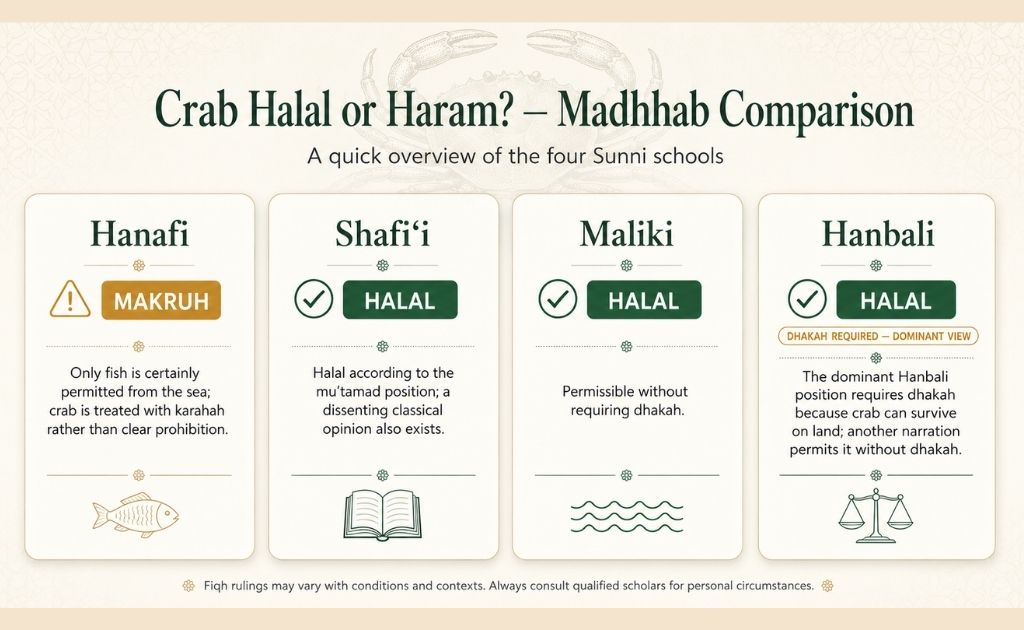
According to the Hanafi madhhab, crab is makruh (disliked) rather than outright haram. Hanafi jurists hold that only fish (samak) is permitted from the sea without reservation, and that other sea creatures — including crab — are approached with karahah (dislike) rather than a clear, direct prohibition.
This position draws support from a hadith in which the Prophet ⹌ is reported to have said:
“Two types of animals which have died a natural death have been permitted to us: fish and locust.” (Sunan Ibn Majah 3218)
Classical Hanafi sources describe this position. Imam al-Marghinani, as cited in al-Binayah Sharh al-Hidayah by Imam Badr al-Din al-Ayni, states that nothing from marine animals is permitted except fish without reservation, and names crab, turtle, and frog among the creatures Hanafi scholars disliked consuming from the sea.
Shafi'i School
The mu’tamad (relied-upon) position within the Shafi’i madhhab is that crab is halal. This is the position reflected in al-Majmu’ (9/32) and followed in practice and fatwa within the school. A dissenting opinion exists as well: Imam al-Nawawi states in Rawdat al-Talibin (3/275) that the frog and the crab are forbidden according to what he describes as the well-known (mashhur) view in that particular text, and al-Mughni al-Muhtaj similarly notes a position classing crab as mustakhbath (repugnant). Because the school’s scholars record both positions, and the relied-upon fatwa position followed in the school is permissibility, crab should be treated as halal according to Shafi’i fiqh, while the existence of the dissenting view is worth noting for anyone consulting the classical texts directly.
Maliki School
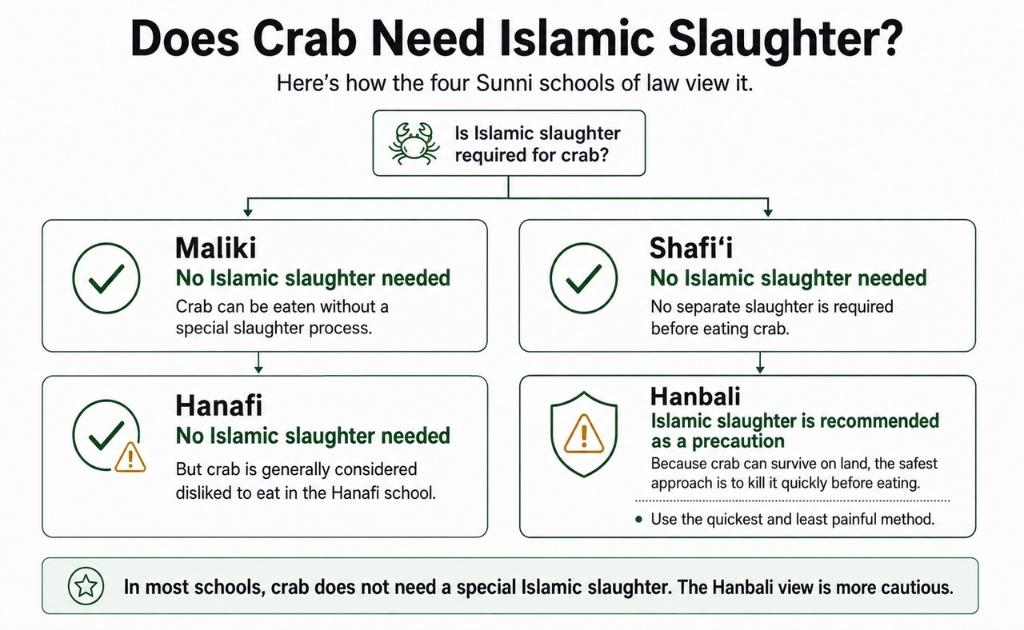
The Maliki school holds that crab is permissible without requiring Islamic slaughter (dhakah).
Ibn Bazizah, as summarized in Sharh al-Talqin (1/243), discusses creatures whose life extends on land — such as the turtle and crab — as a disputed category: should they follow the ruling for sea animals, since the sea is their origin, or the ruling for land animals, given how long they can survive there? According to Imam Malik’s position, such creatures are pure and lawful without requiring dhakah. A dissenting view attributed to Ibn Nafi’ holds that crab is impure if it dies of natural causes.
Hanbali School
The Hanbali school permits crab, but the dominant position within the school requires dhakah (Islamic slaughter) first. Al-Bahuti, in Kashaf al-Qina’ (6/204), classifies crab — alongside the turtle and the “water dog” (otter) — among creatures capable of surviving on land, and states that such creatures are not permitted unless slaughtered, because their ability to live on land attaches them to land animals as a precaution (ihtiyatan). He describes the method of dhakah for crab as doing whatever causes its death, wounding it in any location that ends its life.
A separate narration from Imam Ahmad ibn Hanbal holds that crab is lawful without dhakah at all, reasoning that since it has no flowing blood, the purpose of slaughter — releasing blood and purifying the meat — does not apply to it. Al-Mubdi’ (8/22) records both positions and identifies the dhakah-requiring view as al-sahih fi’l-madhhab, the position considered correct within the school, while noting the alternate narration exists on the strength of certain reports.
Summary of the Ruling
Taken together, crab is halal according to the relied-upon position in the Shafi’i, Maliki, and Hanbali schools, each with its own conditions, and with a small number of dissenting scholars within some of these schools. The Hanafi school stands apart in its general approach: crab is treated as makruh rather than haram, since Hanafi fiqh certainly permits only fish from the sea and approaches everything else, including crab, with dislike rather than clear prohibition. Where dhakah is relevant — principally in the Hanbali school’s dominant view — the more cautious approach is to slaughter the crab using the easiest and quickest method available, such as rapid chilling, while avoiding cutting its limbs while it is still alive.
Crab Halal or Haram: Comparison Table
Does the Ruling Change by Crab Species or Preparation?
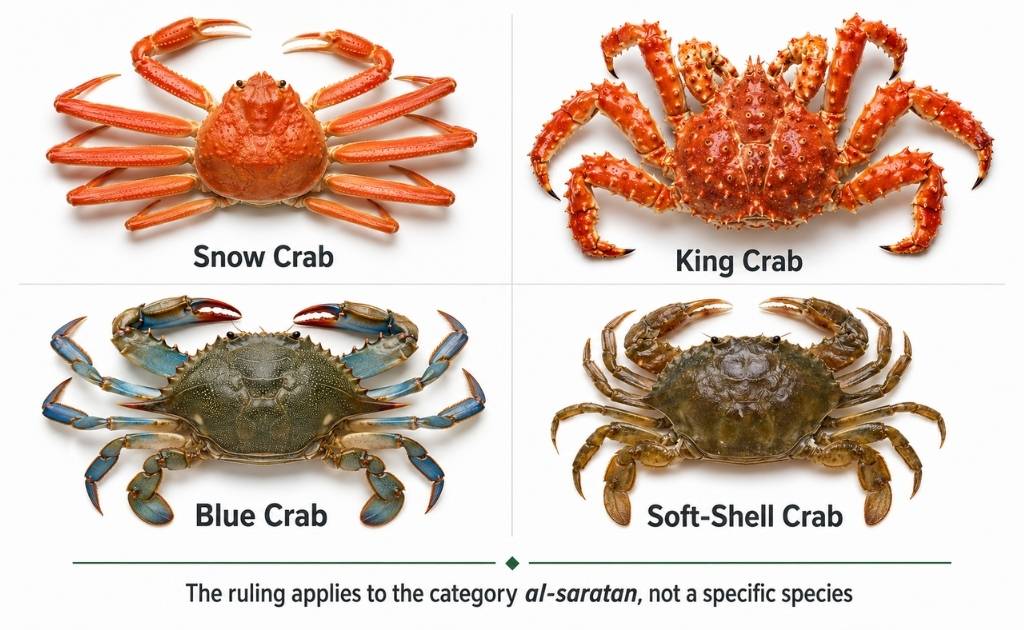
Questions often come up about specific types of crab — snow crab, king crab, blue crab, soft-shell crab — or about whether eating it raw changes anything. The rulings above apply to crab as a category (the crustacean itself), not to a particular species or cooking method. Snow crab, king crab, blue crab, and soft-shell crab all fall under the same crustacean classification discussed by the four madhhabs, so the applicable ruling is the same across these varieties.
Whether the crab is served raw, steamed, boiled, or grilled does not change its underlying permissibility status under a given madhab — it only affects the separate question of dhakah discussed above, since a raw or freshly killed crab is where a slaughter method, if required, would actually be applied. Once a school’s position on crab and dhakah is established, that position applies regardless of how the meat is later prepared or cooked.
Why Do the Madhhabs Differ About Crab?
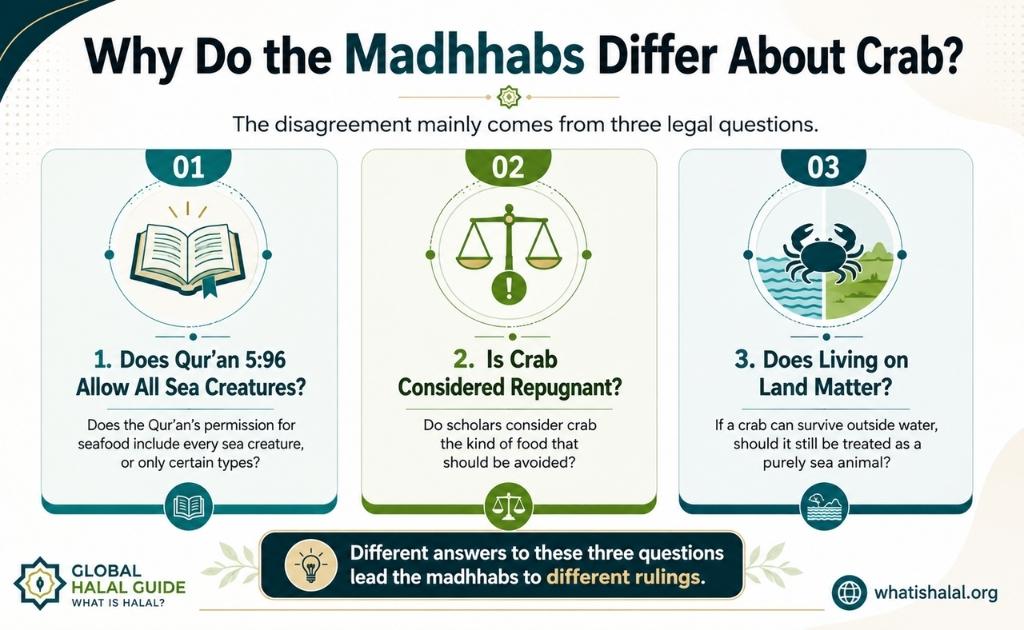
The disagreement does not come from different hadith or different verses — all four schools draw on largely the same core texts. It comes from how those texts are interpreted, and in particular from three distinct questions:
- How broadly Qur’an 5:96 is read — whether “water-game” covers every sea creature, or only fish specifically. This is the basis for the Hanafi school’s karahah toward crab and other non-fish sea creatures.
- Whether a creature is classed as khabith or mustakhbath (repugnant) — a classification some Shafi’i texts raise for crab as a dissenting view, even though the school’s relied-upon position holds it permissible.
- Whether a creature that can survive on land as well as in water should follow the ruling for sea animals or land animals is the question most central to the Maliki and Hanbali discussions on dhakah.
Does Crab Need Islamic Slaughter (Dhakah)?
This is a distinct question from whether crab is halal in the first place, and the answer depends on madhab:
- Maliki: No dhakah is required, per Imam Malik’s position as recorded in Sharh al-Talqin.
- Hanbali: The dominant, correct-in-the-madhhab (sahih fi’l-madhhab) position requires dhakah, applied as a precaution since crab can survive on land. A separate narration from Imam Ahmad holds that no dhakah is needed, since crab has no flowing blood.
- Shafi’i: The relied-upon position permits crab without a specific dhakah requirement beyond what generally applies to sea catch.
- Hanafi: The question does not arise in the same way, since the school’s position is one of karahah (dislike) toward crab generally, rather than a conditional permissibility that a slaughter method could satisfy.
- Where dhakah is relevant — principally under the Hanbali view — it is generally recommended by the easiest and quickest method available, as a precaution.
What About Boiling Crab Alive?
Whether crab as a species is halal and how it should be killed are two separate questions. A creature being lawful to eat does not by itself settle the permissibility of a specific killing method.
Where dhakah is required or recommended — as in the dominant Hanbali position, or in the precautionary approach some contemporary fatwas suggest — the method described is to cause death by the easiest and quickest means available, such as rapid chilling or piercing, rather than by drawn-out methods. Classical guidance on the slaughter of animals for food generally emphasizes ihsan (doing well) in killing and avoiding unnecessary suffering, and discourages killing an animal by burning, drowning, or other prolonged means where a quicker method is available.
Muslims with specific concerns about a particular preparation method, especially those following the Hanbali position, should raise the question with a qualified scholar rather than rely on general online discussion for a specific ruling.
Is Imitation Crab Halal?
Imitation crab — also sold as “krab,” surimi, or crab sticks — is a manufactured product, not the crustacean itself, so the question is different from “is crab halal.” It is typically made from processed white fish (often pollock or similar species), combined with starch, egg white, flavoring, coloring, and sometimes a small amount of real crab extract for taste.
Because the base ingredient is fish, and fish is agreed to be halal across all four Sunni madhhabs, imitation crab is generally treated as permissible on that basis — including, notably, within the Hanafi school, since the product is predominantly samak (fish) rather than crab. This applies as long as the remaining ingredients are free of alcohol-based flavorings, non-halal gelatin, or other non-halal additives, which do appear in some commercial formulations.
Where a small amount of crab extract is used purely as a flavoring component within an otherwise fish-based product, scholars who hold crab itself to be impermissible would generally still want that trace component checked — in practice, this is exactly what halal certification is designed to verify, since formulations vary significantly by brand and region. Muslims who want certainty rather than a general default should check the ingredient label or look for halal certification rather than assume.
The same reasoning extends to related products built on imitation crab, such as crab sticks and dishes like crab rangoon, which commonly use imitation crab rather than real crab meat — though crab rangoon in particular often also involves cream cheese and a fried wonton wrapper, so its overall halal status depends on those ingredients and the oil used, not on the crab component alone.
For Shia Muslims, since the Ja’fari school (discussed below) generally permits fish with scales, a fish-based imitation crab product would be assessed on similar grounds — but because rulings on specific ingredients and products can vary between maraji’ (religious authorities), Shia Muslims should check with their own marja’s office for a product-specific ruling rather than assume a single standard answer applies.
The Ja'fari School
Outside the four Sunni schools, the Ja’fari school, followed by many Shia Muslims, generally permits only fish with scales, along with shrimp, as halal seafood.
Other shellfish, including crab, are generally considered not permissible under this school. As with the Sunni madhhabs, specific rulings and their conditions are best confirmed with a scholar or marja’ familiar with Ja’fari fiqh, since summaries on general Islamic websites are not a substitute for that school’s own primary sources.
Practical Guidance
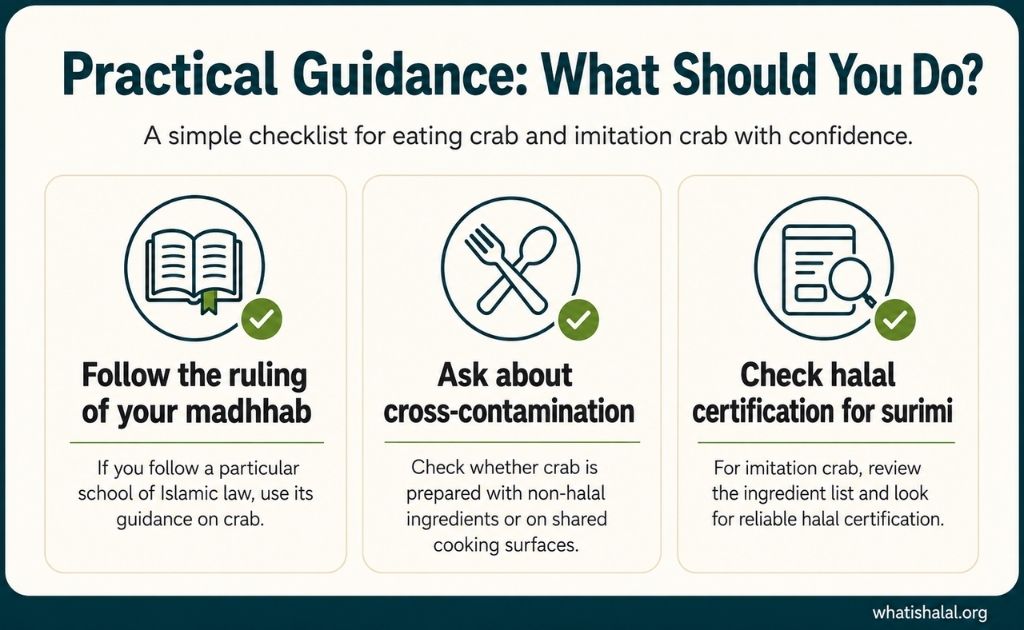
- Follow the position of the madhab you adhere to, and consult a knowledgeable, qualified scholar for guidance specific to your situation — particularly on dhakah, where genuine differences exist even within a single school.
- When eating prepared dishes such as crab cakes, crab rangoon, or seafood boils at a restaurant, check the ingredients and preparation rather than assuming: alcohol-based cooking wine, non-halal stocks or sauces, and shared cooking equipment with non-halal items can all affect a dish’s status.
- For any specific restaurant or seafood chain, look for that outlet’s own halal certification or ask directly about ingredients and sourcing — this article covers the underlying fiqh ruling on crab, not the practices of any particular restaurant brand.
- Taking a rukhsah (dispensation) from another madhab on this question is something some scholars permit in specific circumstances of need, but the relevant concepts — following another school (taqlid of another madhab), seeking out concessions (tatabbu’ al-rukhas), and combining positions from different schools in one act (talfiq) — are treated differently by scholars and should be raised with someone qualified rather than applied casually.
Frequently Asked Questions
Conclusion
Crab is generally halal according to all four Sunni madhhabs, with some exceptional opinions within certain schools. The relied-upon (mu’tamad) position in the Shafi’i, Maliki, and Hanbali schools is permissibility, each with its own conditions — the Maliki school without requiring dhakah, and the Hanbali school’s dominant view requiring dhakah as a precaution, since crab can survive on land.
The Hanafi school stands apart in its general character: crab is treated as makruh (disliked) rather than outright haram, since Hanafi fiqh certainly permits only fish from the sea and approaches other sea creatures with karahah rather than a clear prohibition. Given the conditions and dissenting opinions within each school, the most reliable approach for any individual Muslim is to follow the position of their madhab and consult a qualified scholar for questions specific to their circumstances.