Introduction: Every Click Is a Deed
Facebook itself is neither halal nor haram — it is simply a medium. What matters is how we use it. Every action we take on it — a like, a comment, a share — is recorded and will be accounted for before Allah.
Allah says in the Quran:
“Man does not utter any word except that with him is an observer prepared [to record].” (Surah Qaf: 18)
And He also says:
“So whoever does an atom’s weight of good will see it, and whoever does an atom’s weight of evil will see it.” (Surah Az-Zalzalah: 7-8)
These two verses make it clear: even the smallest actions on Facebook are being written into our record of deeds. Below are some common areas of Facebook use, examined in light of the Quran and Hadith.
1. Controlling the Gaze, and Liking/Commenting on Non-Mahram Photos
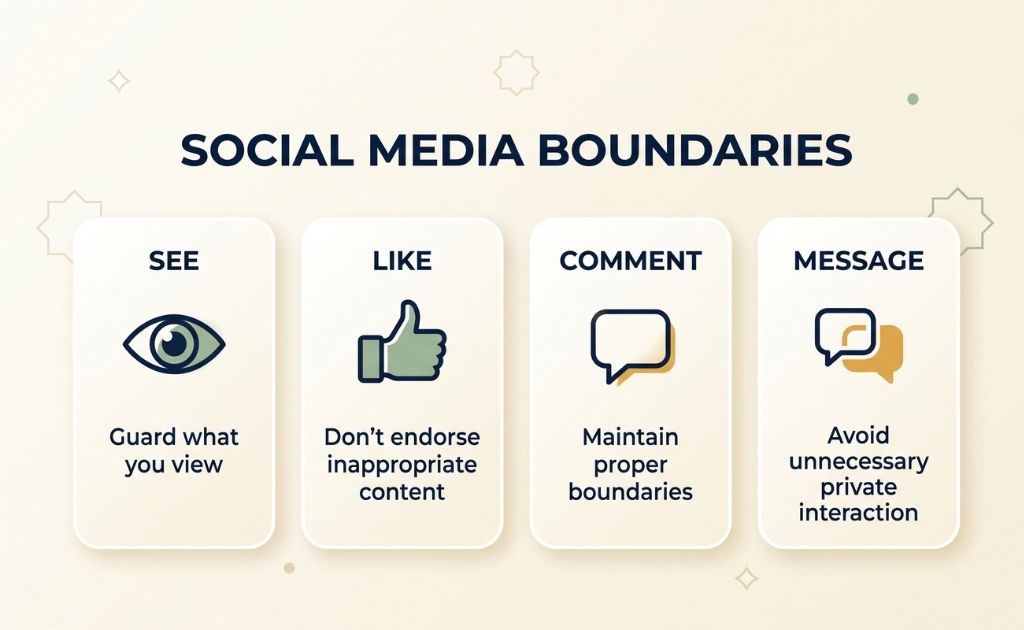
One of the biggest sources of fitnah (temptation) on Facebook is looking at photos of non-mahram men and women and reacting to them.
Allah commands both men and women to lower their gaze:
“Tell the believing men to reduce [some] of their vision and guard their private parts… And tell the believing women to reduce [some] of their vision and guard their private parts.” (Surah An-Nur: 30-31)
The Prophet (peace be upon him) described an unlawful glance as “the zina (fornication) of the eyes” — looking at a non-mahram with desire is itself a sin. When someone goes further and likes such a photo, the matter is no longer simple viewing; it becomes an expression of personal admiration, a signal of interest, and a contribution to the spread of that image. Merely seeing something and seeing-then-publicly-approving-it are not the same — the latter involves both consent and encouragement.
Guideline: Avoid liking, reacting with hearts, or leaving admiring comments (like “beautiful” or “MashaAllah” used in a personal/romantic tone) on photos of non-mahrams. It is best to avoid visiting such profiles altogether unless there is a genuine need.
2. Not Contributing to the Spread of Indecency
Liking or sharing an immodest or indecent photo/video means participating in spreading that content.
Allah warns sternly:
“Indeed, those who like that immorality should be spread [or publicized] among those who have believed will have a painful punishment in this world and the Hereafter.” (Surah An-Nur: 19)
The phrase “those who like that immorality should be spread” is significant — one doesn’t have to create indecent content to fall under this warning; simply helping it circulate or encouraging it can be enough. On Facebook, a single like helps an algorithm push that content to more people — meaning one becomes complicit in the sin.
3. Crossing Limits in Comments and Inbox Messages
Many inappropriate relationships don’t begin with an outright romantic proposal; they begin with what seems like an innocent greeting, a compliment, or casual conversation.
Allah, addressing the wives of the Prophet, said:
“Then do not be soft in speech [to men], lest he in whose heart is disease should covet, but speak with appropriate speech.” (Surah Al-Ahzab: 32)
Though this verse was revealed regarding the Prophet’s wives, its underlying principle is universal — the tone and manner of speech should not create temptation in another’s heart. The Prophet (peace be upon him) also said that whenever a man and a woman who are not mahram to each other are alone together, Shaytan is the third among them. Private inbox conversations can be compared to this same principle — they are a form of seclusion in which boundaries can gradually erode.
Guideline: Keep necessary conversations brief, clear, and professional; avoid exchanges that build emotional or personal intimacy.
4. Liking or Commenting on Backbiting Posts
Even without writing backbiting (gheebah) oneself, one can still participate in spreading it by liking or commenting on a post that defames someone’s character.
The Quran presents a vivid and powerful image of backbiting:
“Would one of you like to eat the flesh of his dead brother? You would detest it.” (Surah Al-Hujurat: 12)
When the Prophet (peace be upon him) was asked what backbiting is, he explained it as saying something about your brother that he would dislike; and if what you say isn’t true, it becomes slander. Liking a backbiting post, or reacting with “haha,” is a form of participating in and endorsing that sin — even without having written it oneself.
5. Mockery and Laughing at Insulting Content
Reacting with laughter to memes, edited images, or humiliating videos made about someone may feel like harmless entertainment, but it often involves the dishonoring of another human being.
Allah says:
“O you who have believed, let not a people ridicule [another] people; perhaps they may be better than them… And do not insult one another and do not call each other by [offensive] nicknames.” (Surah Al-Hujurat: 11)
Taking pleasure in someone’s humiliation — even without directly participating — cultivates a mindset that runs contrary to this instruction. Islam takes an especially firm stance when the person being mocked is a specific, identifiable individual:
Allah says:
“And those who harm believing men and believing women for [something] other than what they have earned have certainly borne upon themselves a slander and manifest sin.” (Surah Al-Ahzab: 58)
6. Sharing Unverified Information
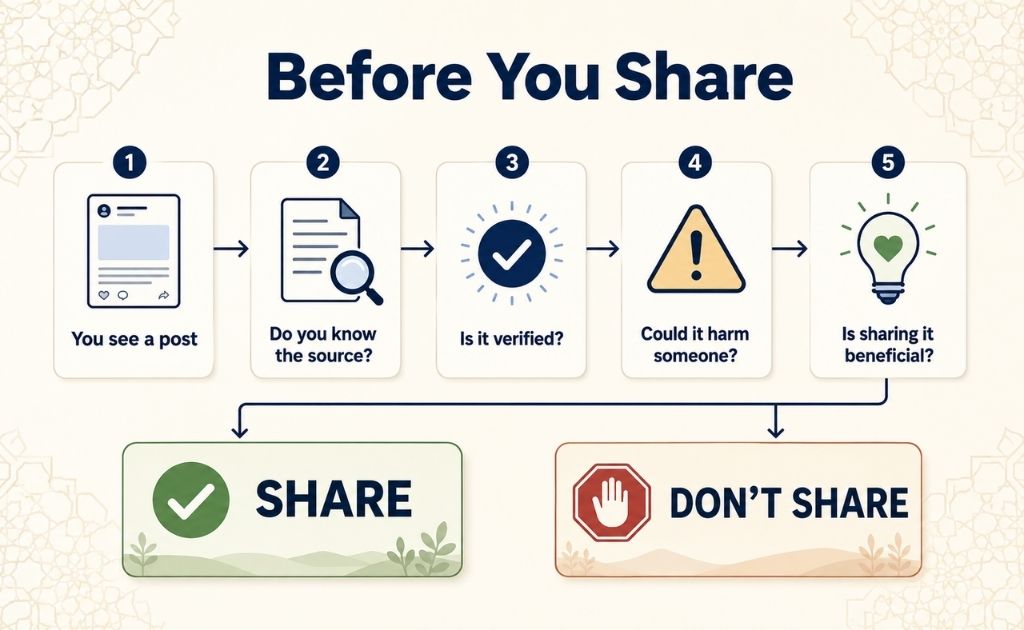
News, religious claims, political posts, or accusations against someone often spread rapidly on Facebook — and if shared without verification and later found to be false, the person who shared it becomes part of spreading that falsehood.
Allah commands:
“O you who have believed, if there comes to you a disobedient one with information, investigate, lest you harm a people out of ignorance and become, over what you have done, regretful.” (Surah Al-Hujurat: 6)
The Prophet (peace be upon him) said that it is enough to make a person a liar that he relates everything he hears without verifying it. Before pressing “share” on Facebook, verifying the source and accuracy of information is therefore not merely caution — it is a religious responsibility.
7. Secretly Watching Haram Content
Watching indecent, explicit, or immodest videos alone — without showing anyone else — still violates the command to lower one’s gaze, and it is never hidden from Allah.
Allah says:
“He knows that which deceives the eyes and what the breasts conceal.” (Surah Ghafir: 19)
Watching something secretly only hides it from people, not from Allah. The Prophet (peace be upon him) warned that some deeds appear good to people but will be rendered like scattered dust on the Day of Judgment because a person’s private life contradicts their public one. Watching haram content privately on Facebook or YouTube has become a common modern form of this kind of hidden sin.
8. The Influence of Who You Follow
The accounts people follow regularly shape their thinking and taste over time. The Prophet (peace be upon him) said that a person follows the religion of his close friend, so each of us should carefully consider who we take as companions. A Facebook follow list functions as a kind of digital companionship — the content one views regularly indirectly shapes one’s thoughts and outlook. Following an account that routinely posts immodest images, music, or content that promotes fitnah means repeatedly opening a door to temptation in one’s own newsfeed.
9. Liking Islamic Posts Without Practicing Them
We often feel satisfied simply liking a Quranic verse, a hadith, or an inspirational Islamic post, or writing “MashaAllah” in the comments — without actually applying that guidance in our own lives.
Allah strongly disapproves of this kind of disconnect between words and actions:
“O you who have believed, why do you say what you do not do? Great is hatred in the sight of Allah that you say what you do not do.” (Surah As-Saff: 2-3)
The core lesson here is that words and actions must align. Liking Islamic content is good, but it should not distract from one’s own practice, nor should it become a substitute for actually living by that guidance.
10. Sharing Sinful Content of the Deceased
Even after someone passes away, people continue to share their indecent videos, songs, or other sinful content. The Prophet (peace be upon him) said:
The Prophet (peace be upon him) said:
“Whoever introduces a bad practice in Islam will bear its sin and the sin of all who act upon it after him, without any decrease in their sins.”
We usually think of sadaqah jariyah (ongoing charity) in the context of good deeds continuing to benefit someone after death, but this hadith shows the reverse is also true: if sinful content someone leaves behind continues to be watched and shared after their death, the chain of sin continues on their record. And those who circulate it also accrue sin of their own.
Frequently Asked Questions
Summary: Core Principles for Using Facebook
A few core principles emerge from the discussion above, worth keeping in mind while using Facebook:
- Every action is a deed: Likes, comments, shares, and reactions are all being recorded.
- Restraint in gaze and interaction: Maintain boundaries in how you look at, speak to, and communicate with non-mahrams.
- Caution in what you help spread: Avoid contributing to the spread of indecency, backbiting, slander, or misinformation of any kind.
- Verify before sharing: Confirm accuracy before sharing information.
- Choose your company carefully: Be intentional about who you follow and whose content you regularly consume.
- Align words with actions: Practice what you engage with on Islamic posts, rather than treating likes as a substitute for action.
- Think about your legacy: What you post will outlive you — make sure it becomes ongoing charity, not a source of continuing sin.
Facebook itself is neither good nor bad; its ruling depends entirely on how it is used. Pausing before every click to ask, “Will this action make my record of deeds heavier or lighter?” is the kind of awareness that can help a Muslim navigate digital life responsibly.