What Is Istikhara? Meaning, Purpose & Authentic Hadith
The word istikhara comes from the Arabic root kh-y-r, meaning “to seek what is good.” In Islamic practice, it refers to asking Allah to guide you toward the better of two or more permissible options when you are genuinely unsure which path to take.
The practice is a recommended, voluntary act of worship — not an obligation. Its direct basis comes from a hadith narrated by Jabir ibn Abdullah (RA), who said the Prophet ﷺ used to teach the companions istikhara for all matters, just as he taught them chapters of the Qur’an [1,2].
Principles like consulting others (shura) and placing trust in Allah after taking action (tawakkul) are part of the broader Islamic approach to decision-making, and istikhara fits naturally within that mindset — but these Qur’anic principles are general guidance, not direct textual evidence for the specific two-rak’ah prayer and dua described here; that evidence comes from the hadith itself.
Istikhara and Seeking Advice (Istishara) Work Together
Istikhara is not a replacement for doing your own research or asking people with relevant knowledge and experience for advice. The safest general guidance is simply this: gather the information you reasonably can, consult people whose judgment you trust, and pray istikhara — using it to seek Allah’s involvement in a decision you have already thought through, rather than as a substitute for thinking it through at all.
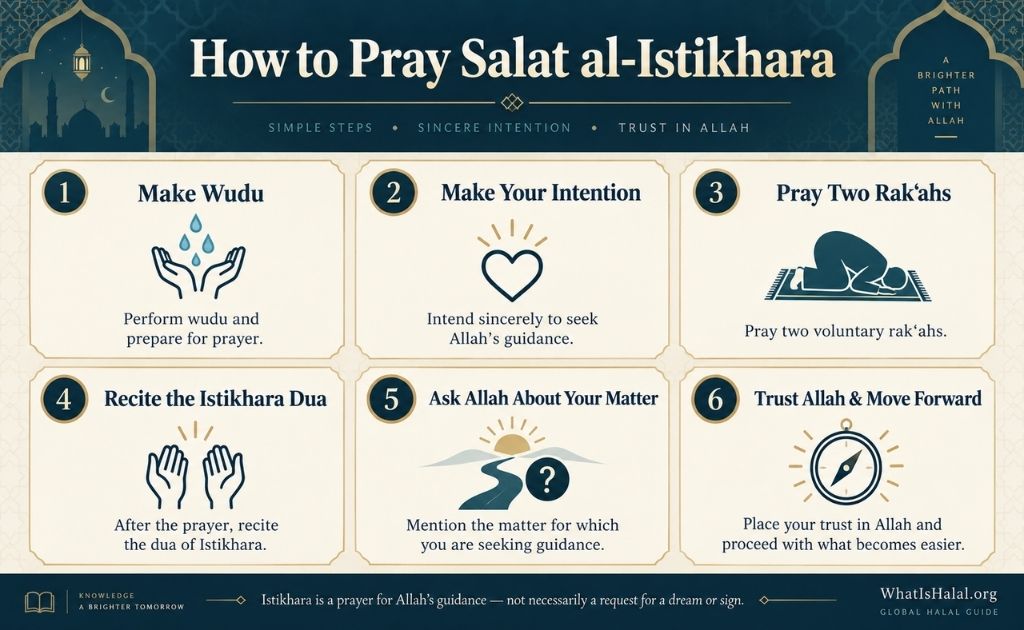
How to Pray Salat al-Istikhara — Step by Step
Praying istikhara does not require any special preparation beyond what you’d do for any other voluntary prayer:
- Make the intention (niyyah) in your heart to pray istikhara for a specific matter.
- Perform wudu as you would before any prayer.
- Pray two rak’ahs of voluntary (nafl) prayer, just as you would any other optional prayer — reciting Surah al-Fatihah followed by any portion of the Qur’an you know in each rak’ah[1,2].
- Complete the prayer with tashahhud and salam as normal.
- Recite the istikhara dua, mentioning your specific matter where indicated.
A Note on Hadith vs. Fiqh — Which Surah Should You Recite?
This is worth being precise about, since it’s often blurred: the authentic hadith describing istikhara does not specify any particular surah to recite in either rak’ah
[1,2]. That part of the narration simply says to pray
“two rak’ahs other than the obligatory ones.”Separately, as a matter of juristic preference (fiqh) rather than hadith text, a number of Hanafi, Maliki, and Shafi’i scholars considered it mustahabb — recommended, not required — to recite Surah al-Kafirun in the first rak’ah and Surah al-Ikhlas in the second, by analogy with other voluntary prayers. You’re free to follow this if you’d like, but reciting any other surahs after al-Fatihah is equally valid and complete.
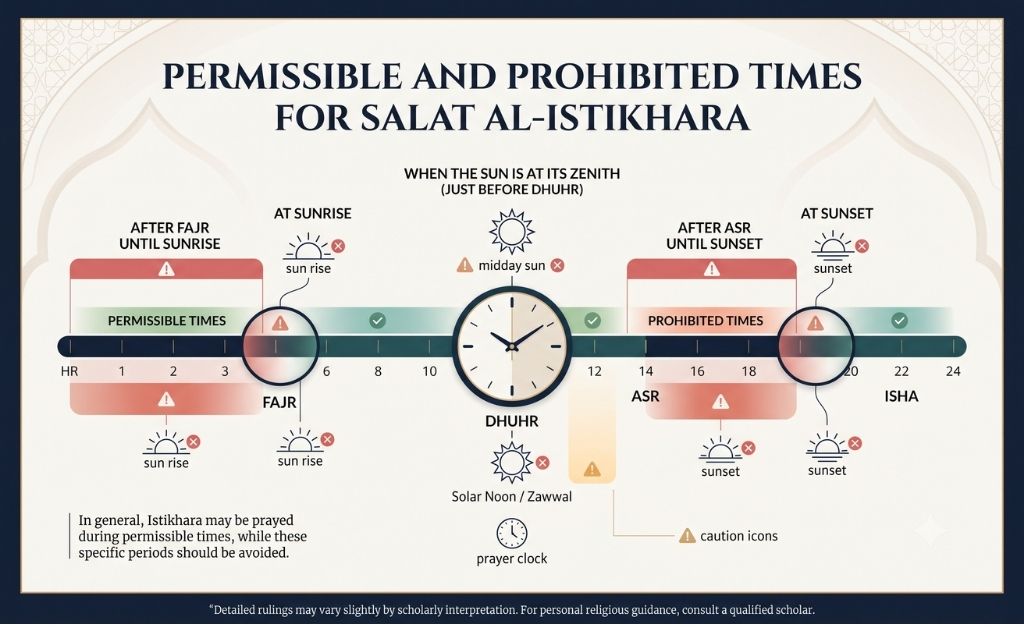
When Should You Pray Istikhara? (Permissible & Prohibited Times)
Istikhara can be prayed at almost any time of day or night, with the exception of the times when voluntary prayer is generally disliked or prohibited:
- Immediately after the Fajr prayer, until the sun has fully risen
- At the moment of sunrise itself
- At exact midday (zawal), just before the sun begins to decline
- After the Asr prayer, until sunset
- At the moment of sunset itself
Outside of these windows, you can pray istikhara whenever the need arises. The last third of the night (during Tahajjud or Qiyam al-Layl) is generally considered an especially blessed time for voluntary prayer and dua of any kind — it’s a good time for istikhara too, but it isn’t a specific requirement or a uniquely prescribed “best time” for this particular prayer.
Should You Recite the Dua Before or After Salam?
The most common and clearest approach — held by Ibn Baz, Ibn Uthaymeen, and the Standing Committee for Academic Research and Ifta, and described as the view of the majority of scholars — is to complete the two rak’ahs, say the salam, and then recite the istikhara dua afterward, since the hadith’s wording (“let him pray two rak’ahs… and then say”) suggests the dua follows the prayer[3].
That said, this isn’t universally agreed upon. Separately from istikhara specifically, some scholars — including Ibn Taymiyyah — held the general position that supplications at the end of a prayer are better said before the taslim (salam), while one is technically still inside the prayer[4].
Applying that general principle, some contemporary teachers extend it to the istikhara dua as well, treating recitation before salam as permissible too. Either approach is acceptable; reciting it after salam is simply the more commonly cited practice.
What Happens After Istikhara? Signs & the Outcome
This is one of the most misunderstood parts of istikhara, so it’s worth being direct about it: you are not guaranteed a dream, a vision, or any particular feeling after praying istikhara. Nothing in the authentic hadith promises this.
According to Egypt’s Dar al-Ifta, “the result of the istikhara does not necessarily comprise seeing something [in a dream] or feeling pleased. The most important result of istikhara is whether or not a person is enabled to do a given matter.”[5]
In other words, if Allah makes the path forward easy, that ease is itself part of His answer. If instead you meet real, ongoing difficulty pursuing it despite genuine effort, that too may be part of the answer. Either way, after praying istikhara you are still expected to use sound judgment, take practical steps, consult others where helpful, and then commit to a decision and trust Allah with the result.
A Common Myth: Interpreting Dream Colors
You may come across the idea that seeing white or green in a dream after istikhara signals a good outcome, while seeing red or black signals a bad one. This is a widely circulated popular belief, but it is not established in any authentic hadith — there is no reliable religious basis for a “color code” attached to istikhara [5].
If you do happen to see a dream, you’re free to reflect on it, but it should not be treated as a required or guaranteed part of the process.
Istikhara for Marriage
Marriage is one of the most common reasons people turn to istikhara, and it works the same way here as with any other decision — it complements your own due diligence rather than replacing it.
- Continue doing the practical groundwork: assessing the person’s character and religious commitment, getting to know their background, and involving family where appropriate.
- Seek advice from people you trust who know both you and the situation well.
- Pray istikhara specifically about the proposal or decision in front of you, once you’ve done this groundwork — not as a substitute for it.
As covered above, don’t expect a dream or a specific feeling to confirm the answer. If the path toward the marriage keeps opening up with reasonable ease, that’s generally a good sign in itself; if it keeps closing down despite genuine effort, that’s worth taking seriously too — but neither should be read as a mystical, one-time signal.
Special Cases: When You Cannot Pray the Two Rak'ahs
A few situations come up often enough to be worth addressing directly:
Can I recite the dua without praying two rak’ahs first?
The Prophet ﷺ explicitly described praying two rak’ahs before the dua, so this remains the complete and recommended method [1,2].
That said, in a genuinely urgent situation, or for someone who is currently unable to pray, reciting the dua on its own is considered valid and better than not turning to Allah for guidance at all.
Can a woman pray istikhara during her menstrual period?
The same principle applies here as above: since she is unable to pray the two rak’ahs during this time, she may recite the istikhara dua on its own without the accompanying prayer.
Can I read the dua from my phone or a piece of paper?
Yes. There’s no requirement to recite it from memory. Reading it from a screen or paper is completely valid, and doing so is far better than avoiding istikhara because you haven’t memorized it yet.
Can I recite it in English if I can’t read Arabic?
Yes. If you’re not yet able to read the Arabic, reciting the English translation (or a translation in any language you understand) is valid.
Allah understands every language, and sincerity in your supplication matters more than the specific language it’s spoken in — though many people choose to work toward learning the Arabic wording over time, since these are the words the Prophet ﷺ himself taught.
Can Someone Else Perform Istikhara for You? What About Online or Paid Istikhara Services?
This is a genuine point of scholarly disagreement, so it’s worth presenting both sides rather than picking one as the only correct answer.
- One view — reflected in an IslamQA answer citing Ibn Uthaymeen — holds that istikhara cannot be validly performed on someone else’s behalf, since it is a personal supplication tied to the person actually facing the decision [6].
- Another view — reflected in a Dar al-Ifta Egypt fatwa, and in a Hanafi answer from Shaykh Faraz Rabbani — holds that there is nothing wrong with a trusted family member or pious person performing istikhara on someone else’s behalf, treating it as a form of helping that person toward what is good[7,8].
Given this difference of opinion, the safer and more commonly practiced approach is for the person actually facing the decision to pray istikhara themselves whenever they are able to, while still welcoming the general dua and support of people close to them.
Separately — and this applies regardless of which scholarly view you follow — be cautious of anyone offering “istikhara readings” online or for payment, promising a definite yes-or-no answer about your future. Authentic istikhara is a private act of worship between you and Allah, not a service that produces a verdict on someone else’s behalf. Anything presented as fortune-telling or divination, paid or otherwise, falls outside what istikhara actually is.
Is There a Short Istikhara Dua If I Haven't Memorized the Full One?
There is no separate, authenticated “short version” of the istikhara dua that replaces the one taught by the Prophet ﷺ — the wording given earlier in this article is the complete, established formula[1,2], and it isn’t especially long once you’ve read it through a few times.
If you haven’t memorized it yet, you have reasonable options in the meantime: read it from your phone or a printed card during the prayer, or — if you’re in an urgent situation and don’t have access to the wording at all — sincerely ask Allah for guidance in your own words while you work on learning the full dua. What matters most is sincerity, not reciting from memory.
How Many Times Should You Repeat Istikhara?
You’ll often see the claim that istikhara should be repeated exactly seven times. This comes from a separate narration attributed to Anas ibn Malik that hadith scholars including al-Nawawi, al-‘Iraqi, and Ibn Hajar al-‘Asqalani classified as having a very weak (da’if; in some assessments, “extremely weak”) chain of transmission — it is not part of the authentic Jabir ibn Abdullah hadith that forms the basis of the practice[9].
The authentic hadith doesn’t specify any fixed number[1,2]. In practice, this means you can pray istikhara once, or repeat it as many times as you need — over a single day or over a longer period — until you feel enough clarity or ease to move forward with a decision.
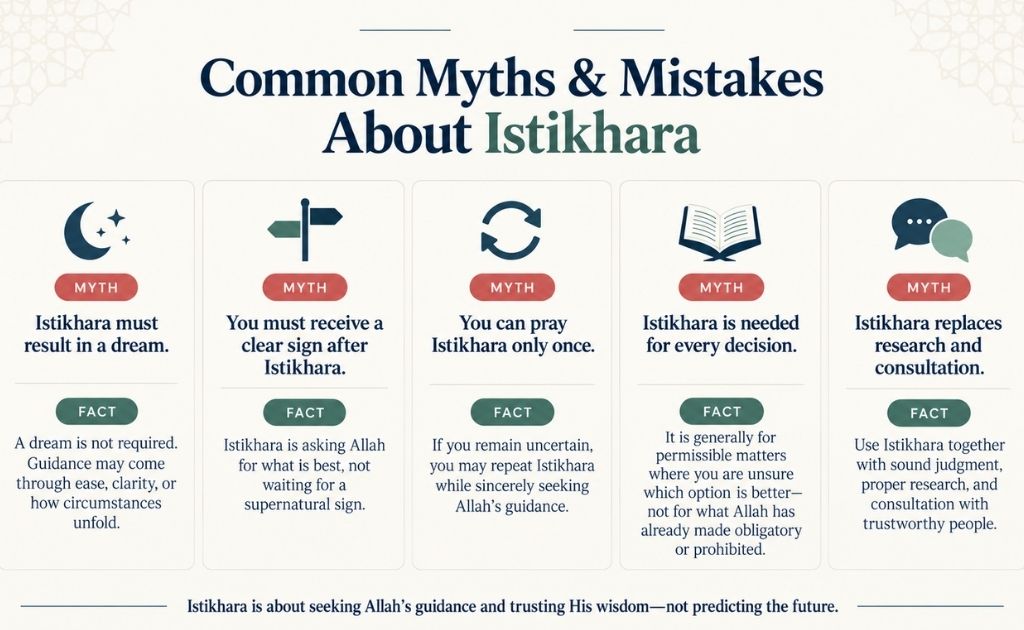
Common Myths & Mistakes About Istikhara
- It’s not a “dream generator.” You are not guaranteed to see anything in your sleep, and praying istikhara does not obligate Allah to send you a vision.
- It’s not a magical yes/no switch. The outcome is shown through how the matter unfolds over time and through your own continued good judgment — not a single lightning-bolt answer.
- It’s not reserved only for major life decisions. The companions are reported to have made istikhara even for small, everyday matters — there’s no need to “save it” only for big choices.
- Skipping it isn’t sinful. Not praying istikhara before a decision doesn’t make that decision invalid or wrong — it simply means you didn’t seek this particular means of blessing.
- It should never be treated as fortune-telling. Paid “istikhara reading” services or claims of predicting a guaranteed future outcome have no basis in the actual practice.
A Brief Note on the Benefits of Istikhara
Beyond the specific decision at hand, istikhara builds a habit of turning to Allah before acting, placing trust (tawakkul) in His knowledge rather than relying purely on your own certainty. Many people describe a genuine sense of peace that comes simply from having asked — regardless of how the matter eventually unfolds.
Teaching Children About Istikhara
You don’t need a complicated explanation for younger children — something as simple as, “When you’re not sure what to do, we ask Allah to help us choose,” introduces the concept in a way they can understand and gradually build on as they grow older.
Download Istikhara Dua (PDF)
Want to keep this close by — on your phone, printed out, or saved for later? This free printable guide includes everything on this page in one place: the full Arabic text, English transliteration, meaning, the step-by-step method, and the benefits of istikhara — designed to be easy to read during your prayer, whether you’re on your phone or holding a printed copy.
Download the Istikhara Dua Guide (PDF)
Frequently Asked Questions
Conclusion
At its core, istikhara isn’t about extracting a guaranteed answer from Allah before you’re willing to move forward — it’s about surrendering the outcome to Him after you’ve done your part. Make your intention sincere, do the research and consultation that’s within your ability, pray the two rak’ahs, recite the dua, and then take the next reasonable step with a settled heart. Whatever unfolds afterward, trust that you sought Allah’s involvement in it — and that, in itself, is the point.
References & Sources
Every numbered citation in this article corresponds to one of the sources below. Links were verified at the time of writing; scholarly fatwa sites occasionally restructure their URLs, so search the page title on the same site if a link ever breaks.
[1] Sahih al-Bukhari 6382, Book of Invocations, narrated by Jabir ibn Abdullah (RA) —
[2] Sahih al-Bukhari 1166, Book of Tahajjud, narrated by Jabir ibn Abdullah (RA) —
[3] IslamQA, “When to Say Du’a al-Istikharah?” — Ibn Baz, Ibn Uthaymeen, and the Standing Committee on reciting the dua after salam —
[4] troid.org, “Making Du’a and Dhikr at the End of the Prayer” — on the general position (including Ibn Taymiyyah’s) that end-of-prayer supplications may be said before taslim —
[5] Dar al-Ifta Egypt, “How to Recognize the Result of Istikhara Prayer” —
[6] IslamQA, “No One Can Pray Istikhaarah on Behalf of Another” — citing Ibn Uthaymeen, Liqa’ al-Bab al-Maftuh, no. 89
[7] Dar al-Ifta Egypt, “Performing the Istikhara Prayer on Behalf of Another” —
[8] IslamQA (Hanafi), Shaykh Faraz Rabbani, on asking someone else to perform istikhara on one’s behalf —
[9] IslamQA, “Istikharah Signs” — on the weak/very inauthentic chain of the “seven times” narration, citing al-Nawawi’s al-Adhkar and Ibn Hajar’s Fath al-Bari (11/223) —
Written and Reviewed by