Is saying Bismillah before eating obligatory or Sunnah?
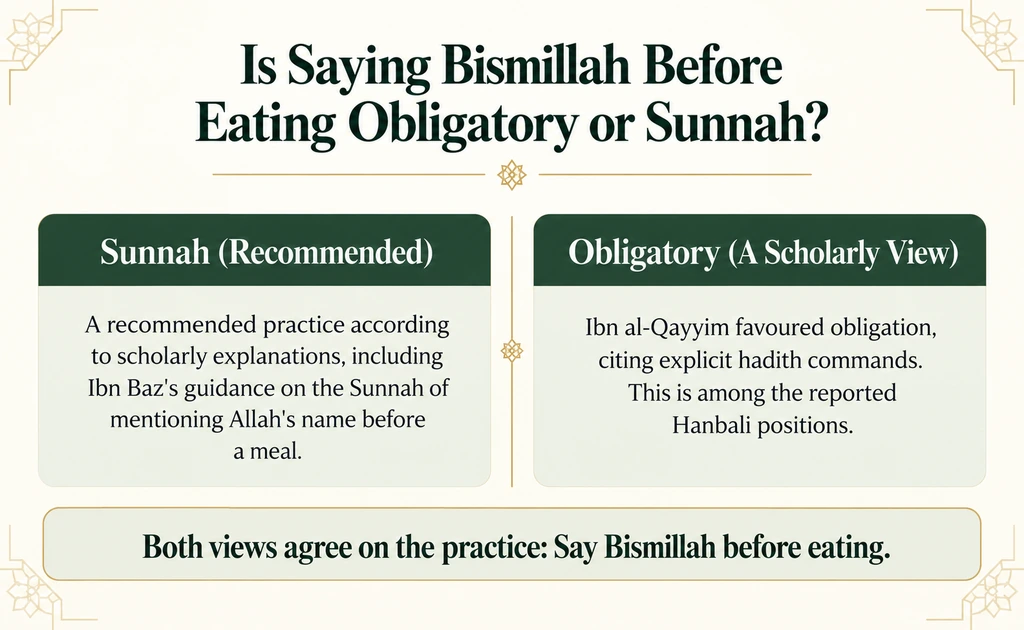
Most popular guides simply call it Sunnah, but the books record a real difference of opinion.
- It is a Sunnah (recommended). Ibn Baz speaks throughout in terms of “the Sunnah for the believer,” and does not discuss any obligation. A scholar-reviewed Islamic Relief guide also calls reciting the before-and-after duas recommended.
- It is obligatory. Al-Mubarakfuri’s Tuhfat al-Ahwadhi (his commentary on Tirmidhi) quotes Ibn al-Qayyim (called al-Hady, that is, Zad al-Ma’ad): “The correct view is the obligation of saying Bismillah when eating, and it is one of the two views of the companions of Ahmad [the Hanbalis]. The hadiths of command regarding it are sahih and explicit, with no contradicting text and no consensus (ijma’) that would permit opposing them and departing from their apparent meaning.” An IslamWeb fatwa cites this as “some scholars say it is obligatory” and does not itself pick a side.
So the Hanbali school is itself split into two views, with Ibn al-Qayyim favouring obligation. The sources reviewed here name no scholar who spells out the opposing “Sunnah only” argument, and a related fatwa titled “Schools of the jurists on saying Bismillah at meals” was listed but its text was not available.
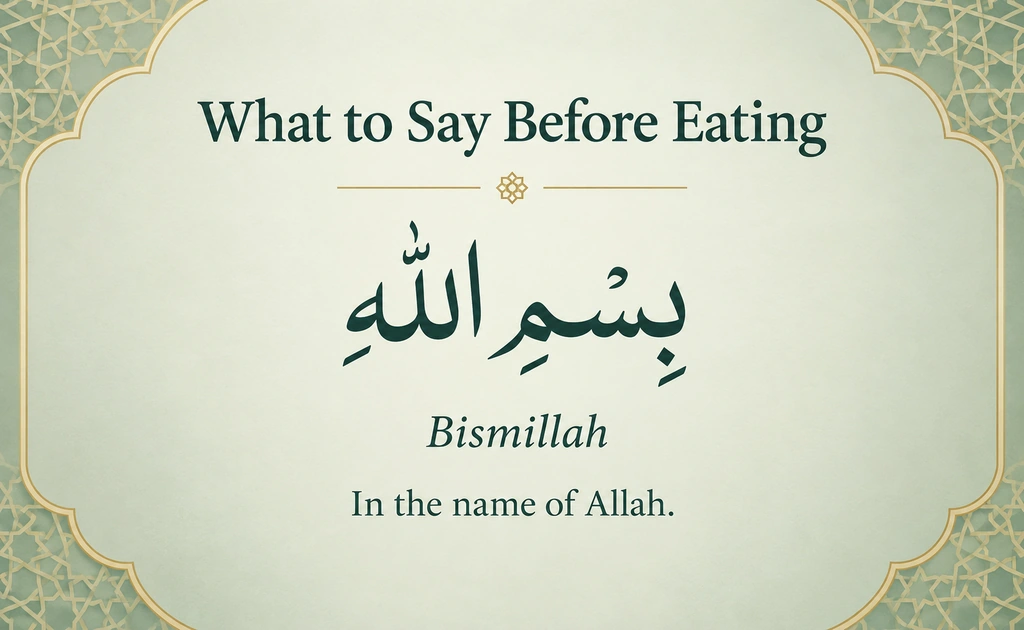
In daily practice the two views agree on the action: say Bismillah every time. If you do forget, see our guide to what to say and do when you forget Bismillah.
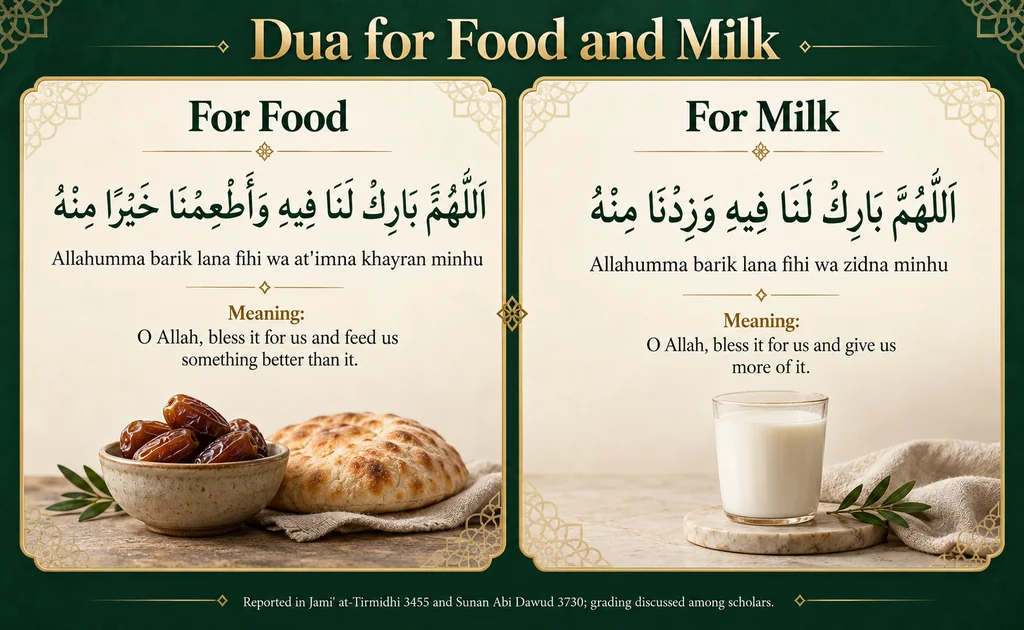
"Allahumma barik lana fihi": the dua for food and milk
This is the best-known reported dua that is not just Bismillah. It is for when Allah gives you food or milk.
For food
- Arabic: اللَّهُمَّ بَارِكْ لَنَا فِيهِ وَأَطْعِمْنَا خَيْرًا مِنْهُ
- Transliteration: Allahumma barik lana fihi wa at’imna khayran minhu
- Meaning: O Allah, bless it for us and feed us something better than it.
For milk
- Arabic: اللَّهُمَّ بَارِكْ لَنَا فِيهِ وَزِدْنَا مِنْهُ
- Transliteration: Allahumma barik lana fihi wa zidna minhu
- Meaning: O Allah, bless it for us and give us more of it.
Sources.
- Jami’ at-Tirmidhi 3455 and Sunan Abi Dawud 3730; Hisn al-Muslim no. 179.
The narration is from Ibn Abbas. In the wording preserved by Tirmidhi, the Prophet ﷺ taught it after he, Ibn Abbas, and Khalid ibn al-Walid went in to see Maymunah, and milk was brought.
The text says: “Whoever Allah feeds with food, let him say: O Allah, bless it for us and feed us better than it.
Whoever Allah gives milk to drink, let him say: O Allah, bless it for us and give us more of it, for nothing suffices in place of food and drink except milk.” Mulla Ali al-Qari took from this that nothing is better than milk, which is why an infant’s first nourishment is milk. Because milk already covers both food and drink, one asks for “more of it”, not for something better.
Another wording. Al-Munawi’s Fayd al-Qadir, commenting on a hadith in al-Jami’ al-Saghir, gives “Allahumma barik lana fihi wa abdilna khayran minhu” (bless it for us and replace it with something better), and says Ahmad, Tirmidhi and Abu Dawud narrated it.
Scholarly differences on its grading
Scholars disagree about this narration, which comes through the route of Ali ibn Zayd.
- Hasan: al-Tirmidhi himself; al-Albani, in at least some of his works (Hisn al-Muslim’s own footnotes refer readers to his Sahih al-Tirmidhi, and another catalogue of his gradings says he graded it hasan); Ahmad Shakir; Bashshar ‘Awwad.
- Weak (da’if): Zubayr ‘Ali Za’i. Al-Nawawi included it in al-Adhkar even though it has some weakness, as he does with reports about virtuous deeds.
- Mixed on al-Albani: one reference prints “hasan, al-Albani: da’if” on its card but says in its prose that al-Albani graded it hasan. That page does not resolve the contradiction, so check al-Albani’s own books before quoting him.
The same reference concludes: “It cannot be said it is sahih with no disagreement, nor da’if with no disagreement.”
That is why it is labelled mukhtalaf fihi (disputed), and why a careful writer says “reported” rather than “authentic”.
Before or after eating?
Hisn al-Muslim puts this dua in the chapter “Dua before food” (chapter 69).
But the Arabic idha akala, “when he eats”, can be read two ways. Al-Munawi says it can mean “when he intends to eat”, and also that it may be taken literally, meaning when he has finished eating, so the dua would come after the meal.
An IslamWeb fatwa (no. 60618) leans toward the second reading and supports it with Ibn Abd al-Barr in al-Istidhkar: “Supplication is abundant and cannot be counted, and the best is that said with sincerity and certainty of being answered. It is enough to say at the start of the meal Bismillahir-Rahmanir-Rahim and at the end Alhamdulillahi Rabbil-‘alamin.”
One article lists the same dua among its after-meal duas, while another source places it with the before-meal duas. In practice, you may say it when food or milk is first given to you, or when you finish, as long as you understand that its timing and its grading are both discussed.
One popular website also applies this dua to any tasty food, such as sweets and fruit, without giving a source. That broader use is not found in the narration itself.
Popular before-meal duas that are weak or have no source
The Islam Q&A answer to the question “Has any dua been established to be said before eating?” is plain: it knows of none in the authentic Sunnah beyond Bismillah. For its ruling on fixed or viral wordings, see our guide to the dua after eating.
"Bismillah, Allahumma barik lana fima razaqtana wa qina 'adhab an-nar"
- Arabic: بِسْمِ اللهِ، اللهُمَّ بَارِكْ لَنَا فِيمَا رَزَقْتَنَا وَقِنَا عَذَابَ النَّارِ
- Meaning: In the name of Allah. O Allah, bless us in what You have provided us and protect us from the punishment of the Fire.
- Status: weak, and not established as the Prophet’s words.
Here is what the sources say about it:
- Al-Nawawi, in al-Adhkar, narrated from Ibn al-Sunni’s book, from Abdullah ibn Amr ibn al-As, that when food was brought near the Prophet ﷺ he said it. Islam Q&A calls this report weak. IslamWeb agrees that it is weak and notes that al-Nawawi included it in the chapter anyway.
- Another source says the first half (“barik lana fima razaqtana”) is a saying of Ali ibn Abi Talib to a man called Ibn A’bad, not of the Prophet, reported in Musnad Ahmad (1313). The editors of the Musnad weakened it because Ibn A’bad is unknown (majhul). In that report Ali says the “right of food” is to say “Bismillah, Allahumma barik lana fima razaqtana”, and its “thanks” afterwards is “Alhamdu lillahi alladhi at’amana wa saqana”. Several websites present this report with no grading.
- The ending “wa qina ‘adhab an-nar” is not in Ali’s report, and one reference found no source for it and notes it is absent from Hisn al-Muslim.
- A site aimed at children prints a different, longer wording, “Bismillah, Allahumma barik lana fihi, wa barik lana fima razaqtana, wa qina ‘adhab an-nar”, and attributes it to Aisha with no collection, number, or grading. It is not the same text as the Ibn al-Sunni report above.
- One page cites it from Imam Malik’s al-Muwatta through the Tabi’i Urwah ibn al-Zubayr. That makes it a report from a follower of the Companions rather than a hadith of the Prophet.
Because of this, one reference says outright not to attach “waqina ‘adhab an-nar” to the dua as though it were a hadith. If you like it as a personal supplication, say it as a general dua and not as a Sunnah.
Other wordings found online
The following appear on popular pages with no hadith source, narrator or grading. None could be traced to authentic hadith.
A useful rule from all this: if a before-meal dua has no narrator and no collection named, treat it as someone’s wording, not the Prophet’s.
Hisn al-Muslim: chapter 69 and the dua numbers
Hisn al-Muslim (Fortress of the Muslim), compiled by Sa’id ibn Ali ibn Wahf al-Qahtani, gathers duas the Prophet ﷺ made in set situations. Its chapter 69, “The dua before food,” has two entries:
The references print volume and page numbers from the printed edition. The hadith numbers are Abu Dawud 3767, Tirmidhi 1858 and Tirmidhi 3455, as cited above.
When you are given the first fruits of the season
One more reported dua belongs in this chapter’s neighbourhood. When people brought the Prophet ﷺ the first fruit of the season, he made this dua and then gave the fruit to the youngest child present. It is Sahih Muslim 1373, narrated by Abu Hurayra, and it is Hisn al-Muslim no. 187.
اللَّهُمَّ بَارِكْ لَنَا فِي ثَمَرِنَا وَبَارِكْ لَنَا فِي مَدِينَتِنَا وَبَارِكْ لَنَا فِي صَاعِنَا وَبَارِكْ لَنَا فِي مُدِّنَا
- Transliteration: Allahumma barik lana fi thamarina, wa barik lana fi madinatina, wa barik lana fi sa’ina, wa barik lana fi muddina
- Meaning: O Allah, bless us in our fruit, bless us in our city, bless us in our sa’ and bless us in our mudd (the grain measures people live on).
In the full narration, the Prophet adds a longer dua for Madinah, which Hisn al-Muslim leaves out. The dua is made when the fruit is first brought to you, so it comes before you eat it.
Other occasions in the sources
The sources reviewed show no other authentic dua tied to the moment before eating.
A Shia source and other things to be careful with
A Shia source (clearly attributed). An Arabic radio page from Iran quotes the sixth Imam, Ja’far al-Sadiq, from a book titled al-Sahifa al-Sadiqiyya. It gives no chain, no hadith number and no grading, so it cannot be checked against the Sunni collections. For the start of a meal it says that when the tablecloth is set down one says “Bismillah”, which matches the Sunni practice, and that when hot food is brought one says “Astajiru billahi min an-nar, a’udhu billahi min an-nar” (I seek Allah’s protection from the Fire), which is not in the Sunni sources used here. Treat it as a Shia tradition, not as the Sunni Sunnah this guide follows.
Names to double-check when you see these hadith elsewhere.
- The boy in the “mention Allah’s name” hadith is Umar ibn Abi Salama. One Arabic blog names him as “Abdullah ibn Umar al-Asadi” and an Egyptian news page names him as Ibn Abbas; both look like slips.
- One page quotes Quran 16:114 in a non-standard wording; check any verse against a printed Quran.
A reminder on style, too: several pages mix authentic hadith, weak reports and freshly composed supplications on the same page without telling the reader which is which. When in doubt, look for a named narrator, a collection, a number and a grading.
Frequently Asked Questions
Written and Reviewed by