Introduction: Addressing a Theological Impossibility
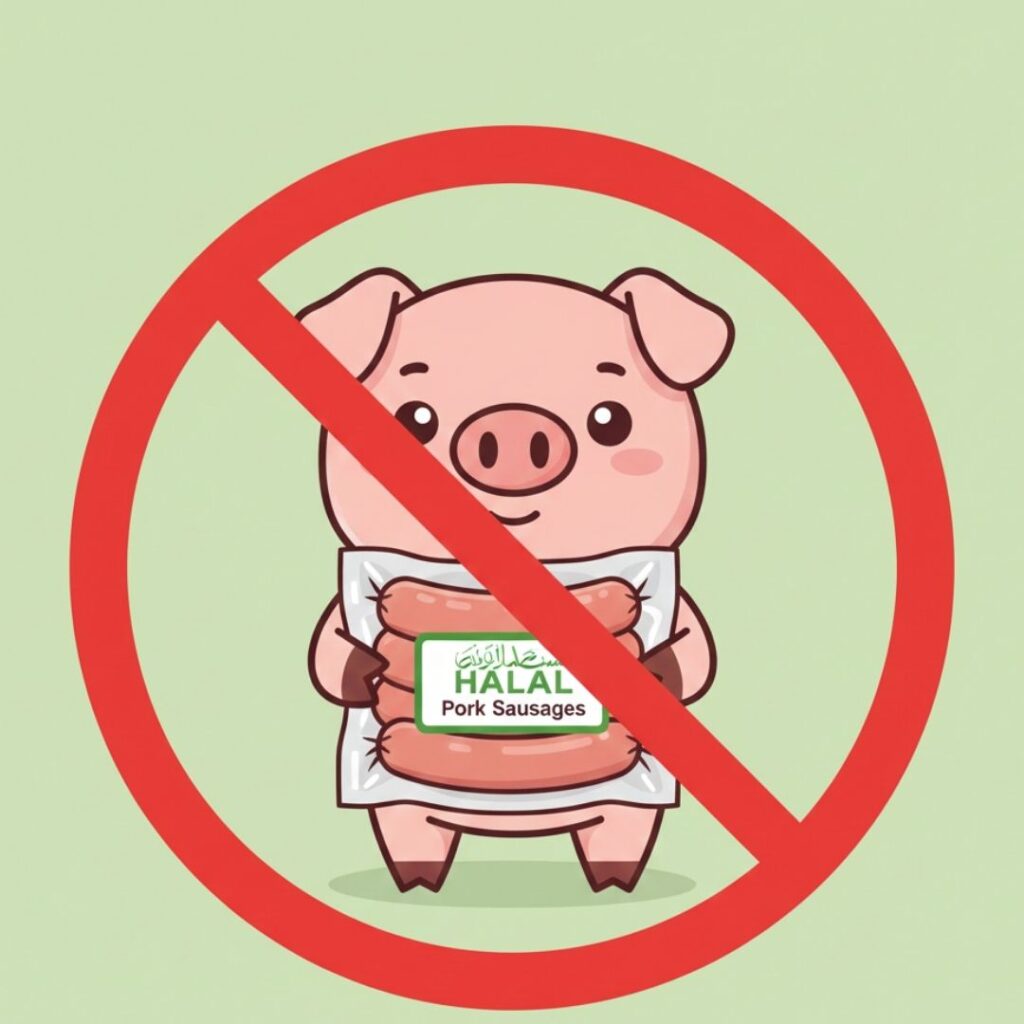
The phrase halal pork is searched frequently across the globe, indicating a widespread confusion that needs to be definitively addressed. In the context of Islamic jurisprudence (Shari’ah), the term “halal pork” is a complete impossibility—a theological contradiction that cannot be reconciled. The question of whether pork meat halal exists is unequivocally answered with a firm ‘No.’
This comprehensive guide is designed to clarify this absolute prohibition. We will dive deep into the foundations of Islamic law, explore the profound wisdoms behind the command, examine modern scientific confirmations, and discuss the complex legalities surrounding contemporary issues like hidden derivatives (such as in halal pork bacon substitutes) and medical use.
The Definitive Islamic Position: Can Pork Ever Be Halal?
A. Qur'anic Evidence
The prohibition of pork is established through multiple verses in the Qur’an, revealed at different times and in various contexts, demonstrating the absolute and unchanging nature of this ruling.
Surah Al-Baqarah (2:173): “He has only forbidden to you dead animals, blood, the flesh of swine, and that which has been dedicated to other than Allah. But whoever is forced [by necessity], neither desiring [it] nor transgressing [its limit], there is no sin upon him. Indeed, Allah is Forgiving and Merciful.”
This Madani verse establishes the categorical prohibition while simultaneously introducing the principle of darurah (necessity)—a concept we shall examine in detail later.
Surah Al-Ma’idah (5:3): “Prohibited to you are dead animals, blood, the flesh of swine, and that which has been dedicated to other than Allah, and [those animals] killed by strangling or by a violent blow or by a head-long fall or by the goring of horns, and those from which a wild animal has eaten, except what you [are able to] slaughter [before its death], and those which are sacrificed on stone altars…”
This verse, revealed near the end of the Prophet’s mission ﷺ, contains the phrase “al-yawma akmaltu lakum dinakum” (This day I have perfected for you your religion). The positioning of pork prohibition within this culminating revelation underscores its permanence.
Surah Al-An’am (6:145): “Say, ‘I do not find within that which was revealed to me [anything] forbidden to one who would eat it unless it be a dead animal or blood spilled out or the flesh of swine—for indeed, it is impure (rijs)—or it be [that slaughtered in] disobedience, dedicated to other than Allah.'”
Here, the Qur’an employs the term “rijs” (impurity, filth, abomination), elevating pork prohibition beyond mere dietary restriction to a matter of spiritual contamination.
Surah Al-Nahl (16:115): “He has only forbidden to you dead animals, blood, the flesh of swine, and that which has been dedicated to other than Allah. But whoever is forced [by necessity], neither desiring [it] nor transgressing [its limit]—then indeed, Allah is Forgiving and Merciful.”
The repetition across four different surahs—two Makki and two Madani—demonstrates the emphasis Allah places on this prohibition, reinforcing it throughout the prophetic mission.
B. Hadith Literature on the Prohibition
The Sunnah provides additional layers of understanding regarding pork prohibition:
In Sahih Muslim, the Prophet Muhammad ﷺ said: “Allah and His Messenger have forbidden the sale of alcohol, dead animals, pork, and idols.”
When asked about using the fat of dead animals for coating ships, he ﷺ responded: “No, it is haram.” This demonstrates that even derivative uses of prohibited substances carry prohibition.
Imam Al-Bukhari narrates that the Prophet ﷺ said: “When Allah forbids something, He forbids its price as well.” This principle, established by the scholars of usul al-fiqh, extends the prohibition to all forms of commercial benefit from pork.
C. The Consensus of Islamic Law (Ijma')
The four major Sunni schools of jurisprudence (Hanafi, Maliki, Shafi’i, Hanbali) and Ja’fari jurisprudence are in absolute agreement: pork consumption is haram (forbidden). This consensus, established since the time of the Prophet’s companions (Sahabah), makes the ruling unchallengeable.
D. The Categorical Answer
The question “Can pork be halal?” must be answered with absolute clarity: No. Pork can never be halal under normal circumstances.
This is not a matter subject to ijtihad (independent reasoning), cultural interpretation, or temporal modification. It is a qat’i (definitive) ruling based on explicit Qur’anic text. To claim otherwise is to reject clear divine legislation.
The only exception—which we will discuss in detail—is the case of genuine darurah (dire necessity) where life itself is threatened. Even in such cases, the pork does not become “halal” in the technical sense; rather, the sin of consumption is lifted due to the overriding principle of preserving life.
As Imam Ibn Taymiyyah stated: “The one who makes halal that which is known by necessity to be haram in the religion of Islam has disbelieved according to the consensus of Muslims.”
Conclusion: The only possible answer to whether halal meat pork can exist is no. Any discussion of halal pork meat is invalid from a legal and theological standpoint under normal circumstances.
The Wisdom Behind the Prohibition: Why Islam Made Pork Haram
Islamic law dictates that we obey God’s commands primarily as an act of submission (ta’abbudi), even if the reason is not immediately clear. However, scholars have identified profound wisdoms (hikam) behind the pork prohibition, which serve to strengthen a believer’s faith.
A. Spiritual and Ritual Impurity (Najis)
The pig is designated as najis (inherently impure) in Islam. This applies to its flesh, fat, skin, and bones.
Contamination (Rijs): The term rijs used in the Qur’an signifies that consuming pork is viewed as contaminating the spiritual state. Islam emphasizes a holistic approach where physical purity (taharah) is intrinsically linked to spiritual receptivity. Contamination by najis substances is believed to create barriers to the acceptance of worship and supplication (Du’a).
Dietary Habits: Classical scholars noted the pig’s indiscriminate nature—it is an omnivore that readily consumes carrion, filth, and waste. This habit, they argued, affects the purity and wholesomeness (tayyibat) of its flesh. This contrasts with permitted animals, whose diets and physiological processes are cleaner.
Physiological Observations: Observations centuries ago noted the pig’s lack of efficient sweat glands. Modern science confirms that pigs have relatively inefficient sweat glands compared to many mammals, leading classical scholars to suggest that toxins and waste products are retained in the body’s tissues rather than being expelled through perspiration.
B. Behavioral and Historical Context
Classical scholars also noted the pig’s lack of protective jealousy (ghayrah) regarding its mate—a trait highly valued in human moral and family structures in Islam. While caution is advised in drawing direct parallels between animal behavior and human morality, these observations reinforced the pig’s designation as something outside the category of tayyibat (wholesome things) permitted for believers.
Furthermore, the prohibition of pork is not unique to Islam; it was also a strict dietary law in Judaism, affirmed in the Old Testament (Leviticus 11:7-8). Islam affirms continuity with previous prophetic missions, restoring and finalizing the pure monotheistic law taught by all prophets.
The Scientific Confirmations of Divine Wisdom
A. Persistent Parasitic Dangers
Swine are known vectors for some of the most serious parasites transmissible to humans
Health Concern | Description for Mid-Level Technical Reader | Severity |
|---|
Trichinella spiralis (Trichinosis) | A parasitic roundworm whose larvae encyst in muscle tissue. Infection occurs from undercooked pork, causing muscular pain, fever, and in severe cases, cardiac and neurological complications. Although reduced in some industrialized nations, the parasite remains a risk in home-raised and wild boar meats. | Serious |
Taenia solium (Pork Tapeworm) | This parasite causes two diseases: intestinal infection (Taeniasis) and tissue infection (Cysticercosis). Ingesting tapeworm eggs (usually through fecal-oral contamination) leads to Neurocysticercosis, where cysts form in the brain. | Extreme |
Neurocysticercosis | A consequence of the Taenia solium parasite, it is identified by the World Health Organization (WHO) as a leading cause of acquired epilepsy globally, affecting millions in endemic regions. | Life-Threatening |
Toxoplasma gondii | Pork is a significant source of this parasite, which causes Toxoplasmosis. While often mild in healthy adults, it poses severe risks to pregnant women (causing birth defects) and immunocompromised individuals. | High Risk |
B. Bacterial and Viral Risks
Pork products are frequently implicated in various pathogenic infections:
Bacterial Contamination: Studies show pork products have high contamination rates with bacteria like Yersinia enterocolitica (causing acute gastroenteritis and pseudoappendicitis) and various pathogenic strains of Salmonella and E. coli. There is also concern about antibiotic-resistant strains, such as MRSA, increasingly found in industrial pig farming.
Viral Risks: The Hepatitis E Virus (HEV) is a zoonotic disease transmissible through contaminated pork products, posing high risk, particularly to pregnant women. Furthermore, pigs are known to serve as “mixing vessels” for different strains of Influenza viruses, capable of hosting both avian and human strains, and potentially leading to new pandemic strains through genetic reassortment.
C. The Carcinogen Classification
The health concerns extend beyond infectious agents to long-term consumption:
Fat Content: Pork typically contains high levels of saturated fats and the pro-inflammatory omega-6 fatty acid, Arachidonic Acid.
Carcinogens (Processed Meats): In 2015, the WHO’s International Agency for Research on Cancer (IARC) classified processed meats (which includes products derived from swine, such as ham, sausages, and many items marketed as halal pork bacon substitutes if made from pork) as a Group 1 Carcinogen—the highest risk category—citing sufficient evidence that consumption causes colorectal cancer. Each 50g portion consumed daily increases the risk by approximately 18%.
Toxin Accumulation: Due to the pig’s omnivorous diet and physiology, its body tends to bioaccumulate toxins, heavy metals, and persistent organic pollutants (POPs) from its feed and environment more readily than selective herbivores.
Note: While modern science confirms the wisdom of the prohibition, it is essential for Muslims to understand that the command remains absolute even if all health risks were hypothetically eliminated. Obedience to divine command is the primary reason for abstinence.
The Fiqh of Modern Life: Navigating Hidden Derivatives
The complexity of modern food processing means that pork derivatives can be found in unexpected places. For Muslims committed to maintaining halal food pork-free diets, vigilance is critical.
A. Pork Derivatives and the Question of Istihala (Chemical Transformation)
Many food ingredients are derived from animal sources, and pork is a common raw material:
Derivative | Example in Products | Islamic Legal Discussion |
|---|
Gelatin | Capsules (medication), candies, marshmallows, yogurt. | If the gelatin undergoes complete chemical transformation (istihala) into a new, distinct compound, some major legal schools (Maliki and Hanafi) permit its consumption. However, piety (wara’) dictates seeking non-pork alternatives (fish, beef, or plant-based) whenever possible. |
Emulsifiers | Mono- and diglycerides (E471), Glycerin. | Often derived from animal fat. If the source is unknown, it’s considered doubtful (mushtabih). If consumed unknowingly despite reasonable effort, there is no sin. However, vigilance (reading labels) is required. |
Enzymes | L-cysteine (in bread and dough conditioners), Lipase. | L-cysteine is sometimes sourced from pig hair. If the source is confirmed as swine, the product is haram. If the source is synthetic or vegetable, it is permissible. |
Lard | Used in some baked goods and frying fats. | Pure pork fat; strictly prohibited without exception. |
B. Medical Products and Darurah
The use of pork derivatives for medical interventions is treated differently than food consumption. When a pork-derived product (such as the anticoagulant Heparin or a porcine heart valve) is medically necessary for preserving life and no suitable non-pork alternative exists, its use is permitted under the rule of Darurah (dire necessity). The higher Islamic objective of preserving life (Maqasid al-Shari’ah) takes precedence.
C. Cross-Contamination in Shared Environments
In non-Muslim countries, Muslims frequently encounter cross-contamination (shared utensils, cutting boards, or cooking surfaces).
Trace Contamination: Trace, unavoidable contact with pork residue in shared public facilities (like grocery store carts or restaurant tables) is generally forgiven under the principle of ‘umum al-balwa (general hardship).
Recommended Practice: In restaurants, one should politely request staff to use clean utensils or prepare food on a separate surface. At home, separating utensils or thoroughly washing them before use is required, especially if household members consume halal food pork substitutes.
D. The Exception: When Prohibition is Lifted (Darurah)
The prohibition of pork, like all Islamic prohibitions, is tempered by divine mercy. The exception clause in the Qur’anic verses—Darurah—permits the consumption of forbidden food only under extreme, life-threatening conditions.
The Strict Criteria for True Necessity:
- Life is Imminently Threatened: The hunger or medical emergency must be severe enough to cause death or significant, debilitating bodily harm. Ordinary hunger, discomfort, or convenience does not constitute darurah.
- No Alternatives Exist: All permissible options must be exhausted. One must have searched for, sought assistance for, and attempted to procure halal food.
Consumption is Minimal: One may consume only the bare minimum amount necessary to preserve life or regain enough strength to seek lawful sustenance. The verse specifies: “neither desiring [it] nor transgressing [its limit].” This means no excess and no pleasure taken in the act.Temporary Duration: The permission is valid only as long as the state of necessity persists. Once the threat is neutralized or a halal alternative is found, the prohibition is immediately reinstated.
Crucial Distinction: In this rare circumstance, the act of consumption is forgiven, but the pork itself does not become halal or ritually pure.
Consequences of Intentional Transgression
Deliberate consumption of pork by a Muslim who knows it is forbidden constitutes a major sin (kabirah). Understanding the spiritual and theological ramifications is crucial.
A. Spiritual Impact on Worship
While the prayer (Salah) of a Muslim who consumes haram food technically remains valid (meaning they have discharged the obligation), the spiritual impact is profound:
Blocking Du’a: The Prophet Muhammad (peace be upon him) warned that persistent consumption of haram food creates a barrier to the acceptance and spiritual reward of acts of worship, especially supplication (Du’a). The heart (qalb) becomes hardened and less receptive to divine guidance.
Compromising Barakah: Consuming haram is believed to remove barakah (divine blessing) from one’s sustenance and life efforts.
B. Sin vs. Disbelief (Istihlal)
It is vital to distinguish between committing the sin and denying the law:
Committing the Sin (Fisq): Eating pork while still acknowledging that it is forbidden. This is a major sin (kabirah) requiring immediate and sincere repentance (Tawbah Nasuh). This person remains within the fold of Islam, though their faith (Iman) is weakened.
Denying the Prohibition (Istihlal): Declaring that pork is lawful (halal) or mocking the Qur’anic command. Scholars unanimously agree that denying a definitive, absolute command of the Qur’an is an act of disbelief (kufr) and removes the person from the fold of Islam.
C. The Path to Forgiveness (Tawbah Nasuh)
Allah’s mercy is infinite, and the door to repentance is always open. Sincere repentance requires:
- Immediate Cessation: Stop consuming all pork and its derivatives.
- Genuine Remorse (Nadam): Feel sincere regret for having disobeyed God.
- Firm Resolve: Make a binding intention never to return to the sin.
- Increasing Good Deeds: Actively increase righteous deeds, as “Indeed, good deeds do away with misdeeds” (Qur’an 11:114).
Historical and Theological Narratives About Swine
A. The Metamorphosis Narrative: Examining the "Cursed Human" Theory
Centuries after the Qur’an’s revelation, modern science has provided empirical validation for many of the physical concerns surrounding pork consumption, particularly in the realm of infectious diseases.
The notion that pigs descended from transformed humans appears in various narrations, requiring careful scholarly examination.
Hadith Evidence:
In Sahih Muslim, the Prophet ﷺ said: “There were people from the Children of Israel who were transformed into animals. I do not know which animals they became.” This hadith acknowledges the phenomenon of maskh (metamorphosis) as divine punishment but does not specify the pig.
Ibn Mas’ud reported: “Someone asked the Prophet ﷺ about mice, and he replied, ‘They are from those who were transformed.'” This demonstrates that multiple species may have resulted from divine transformation.
Critical Hadith Analysis:
Regarding narrations specifically connecting pigs to transformed humans, scholars of hadith sciences apply rigorous authentication:
- Weak Narrations: Some reports in Al-Tabarani and other collections suggest pigs descended from specific transformed nations. However, these contain weak narrators in their chains (sanad) or suffer from disconnection (inqita’).
- Scholarly Caution: Imam Al-Nawawi states in his commentary on Sahih Muslim: “What is established is that transformation (maskh) occurred to certain peoples as punishment, but those transformed did not reproduce. Allah killed them within three days, so they have no descendants.”
The Position of Ibn Taymiyyah: He argues that the transformed individuals produced no offspring, stating: “Those who were transformed died without leaving progeny. The pigs and monkeys we see today are from their original species, not descendants of transformed humans.”
Isra'iliyyat Considerations:
Much of the detail regarding specific transformations comes from Isra’iliyyat—narratives traced to Jewish or Christian sources. Islamic methodology for dealing with Isra’iliyyat follows the Prophet’s ﷺ guidance: “Do not believe the People of the Book, nor disbelieve them, but say: ‘We believe in Allah and what has been revealed to us.'”
As scholars of Hadith, we apply the threefold categorization:
- That which agrees with Islamic sources: Accept
- That which contradicts Islamic sources: Reject
- That which neither confirms nor contradicts: Suspend judgment
The pig-as-transformed-human narrative falls into the third category. It neither strengthens nor weakens the prohibition, which rests firmly on Qur’anic text.
Theological Conclusion:
Whether or not pigs descended from transformed humans is ultimately irrelevant to the hukm (ruling). Allah prohibited pork explicitly in the Qur’an, and this divine command suffices. The historical origin of the species does not alter the contemporary legal ruling
B. Biblical and Pre-Islamic Prohibitions
The prohibition of pork predates Islam, appearing in earlier Abrahamic traditions.
Judaic Law:
Leviticus 11:7-8 states: “And the pig, though it has a divided hoof, does not chew the cud; it is unclean for you. You must not eat their meat or touch their carcasses; they are unclean for you.”
Deuteronomy 14:8 reiterates: “The pig is also unclean; although it has a divided hoof, it does not chew the cud. You are not to eat their meat or touch their carcasses.”
The criteria of split hooves and cud-chewing establish kashrut (Jewish dietary law). The pig’s partial compliance (split hooves) but failure to meet all criteria (does not chew cud) renders it impermissible.
Early Christian Practice:
The early followers of Jesus (peace be upon him) maintained Jewish dietary laws. The Council of Jerusalem (circa 50 CE) initially upheld abstention from blood and strangled animals, though debates arose regarding the extent of dietary restrictions.
Paul’s epistles introduced theological shifts: “I am convinced, being fully persuaded in the Lord Jesus, that nothing is unclean in itself” (Romans 14:14). This represented a departure from the teachings practiced by Jesus himself, who stated: “Do not think that I have come to abolish the Law or the Prophets; I have not come to abolish them but to fulfill them” (Matthew 5:17).
Islamic Affirmation:
Islam affirms that previous prophets taught dietary restrictions consistent with divine law. The Qur’an states: “For wrongdoing on the part of the Jews, We made unlawful for them [certain] good foods which had been lawful to them” (4:160).
This indicates that some prohibitions were specific punishments for the Children of Israel, while others—like pork—represented universal divine law maintained across prophetic missions.
The Prophet Muhammad ﷺ came not to innovate new prohibitions arbitrarily, but to restore the pure monotheism (tawhid) and righteous law taught by all prophets. As he stated: “I have been sent to perfect noble character.”
C. Is the Prohibition Outdated?
The argument that the prohibition was only for ancient times or is merely a cultural practice contradicts the very nature of Islamic scripture.
Finality of Revelation: The Qur’an states, “This day I have perfected for you your religion” (5:3). Islamic law is complete and final, not subject to temporal or cultural modification.
Unchanging Law: The prohibition is universal, practiced across all Muslim cultures globally (Arab, Asian, African, Western), proving its basis is religious, not cultural. If the prohibition were solely based on ancient hygiene concerns, the prohibition of blood and carrion would also have to be lifted upon the arrival of modern refrigeration—a claim no Muslim scholar accepts.
Summary: The Inviolable Nature of Halal
The journey into the depths of Islamic jurisprudence regarding pork consumption yields one absolute conclusion: the concept of halal pork bacon or halal pork meat is fundamentally impossible.
The definitive, explicit, and repeated prohibition in the Qur’an, supported by 1,400 years of scholarly consensus, places this ruling beyond doubt. Whether viewed through the lens of spiritual purity (najis), physical health (parasitic and carcinogenic risks), or theological submission (ta’abbudi), the Muslim must abstain.
Our obedience is not conditional on science, culture, or convenience; it is a core expression of faith. The command tests a Muslim’s resolve to prioritize divine will over personal desire or external pressure.
The ultimate goal of every Islamic command is to bring the servant closer to the Creator. By maintaining vigilance over what we consume, we are not simply adhering to a dietary rule—we are preserving the integrity of our faith, the purity of our hearts, and the acceptance of our worship.
The path is clear: seek knowledge, maintain vigilance against hidden halal food pork derivatives, and trust in the perfect wisdom of God’s command.
Disclaimer: This article provides theological and scientific information for educational purposes and is not a substitute for consulting a qualified, local Islamic scholar for individual legal advice.