Quick Answer: Halal chicken is chicken slaughtered according to Islamic guidelines — by a Muslim, with the name of Allah recited, while the bird is alive, with full blood drainage. This is called Dhabihah (ذبيحة).
Introduction: The Essentials of Halal Eating
For many, the concept of Halal (lawful) simply means avoiding pork and alcohol. However, in Islam, Halal is a comprehensive system governing food purity and ethical sourcing. When it comes to poultry, the method of slaughter, known as Dhabiha (Islamic slaughter), is the single most important factor determining whether the meat is permissible for consumption.
This guide cuts through the confusion about what is halal chicken, offering clear, definitive answers to help you make food choices with confidence and certainty, especially when shopping in non-Muslim majority countries like the USA or Europe.
Halal chicken meaning: The Two Essential Sharia Conditions for Dhabiha

Halal chicken is meat that has been processed under two non-negotiable conditions:
- The Slaughterer: Must be a Muslim or a Person of the Book (Christian or Jew).
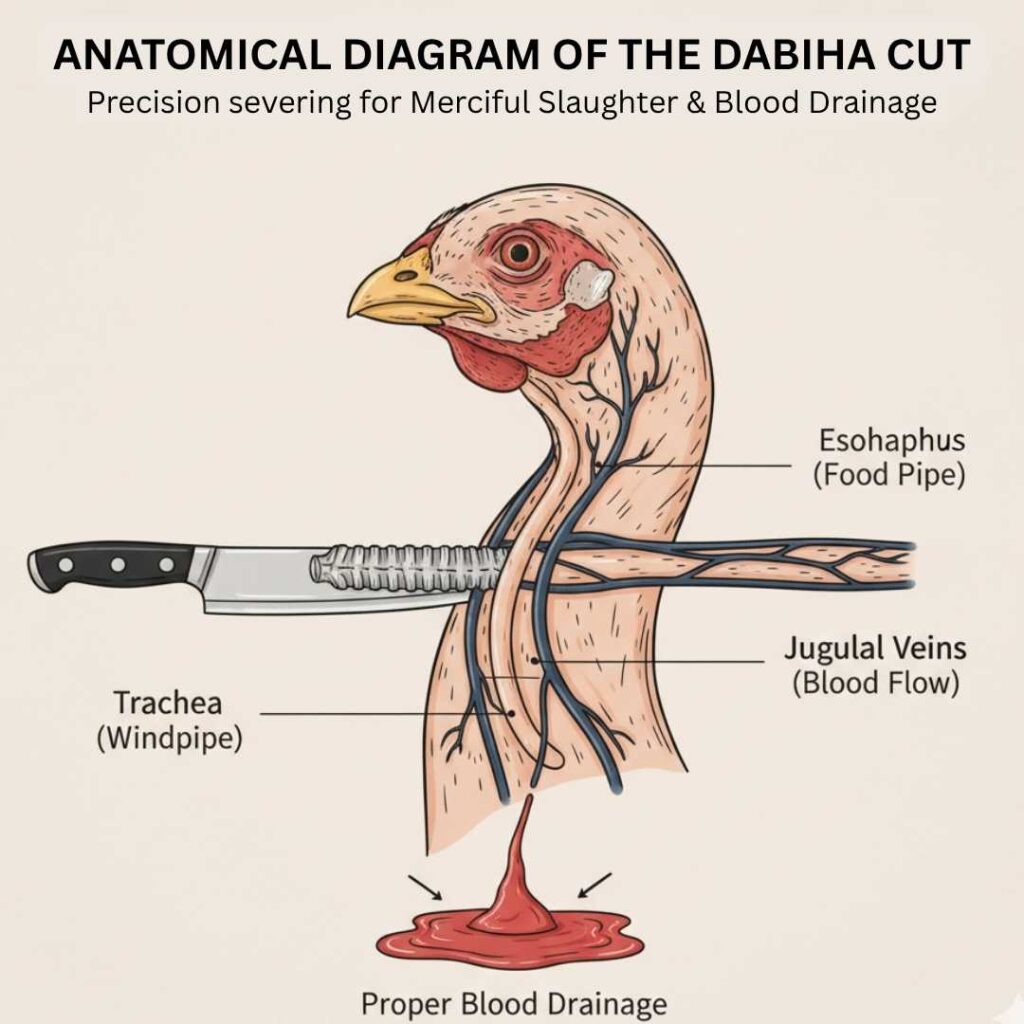
- The Method: The slaughter must involve a swift, deep cut to the throat, severing the windpipe, food pipe, and major blood vessels. Crucially, the chicken must be alive at the moment of the cut.
The Person Doing the Slaughter (The Slaughterer)
The person wielding the knife must be legally and religiously competent. They must be either:
- A Muslim who is an adult and of sound mind.
- A Person of the Book (Ahl al-Kitab): A practicing Jew or Christian who genuinely believes in God and follows their scripture.
This allowance for the People of the Book is mentioned in the Qur’an, specifically in Surah Al-Ma’idah (Chapter 5).
Allah Almighty says in the Qur’an: “This day [all] good foods have been made lawful, and the food of those who were given the Scripture is lawful for you and your food is lawful for them.”
However, it is essential to verify that the method they use still meets the exact Islamic requirements. You cannot assume all meat from a Christian or Jewish butcher is Halal unless the specific slaughter procedure is confirmed.
Can women perform the slaughter?
Yes, absolutely. There is a common misconception that only men can perform Dhabiha, but this is incorrect. Islamic scholars agree that women are fully permitted to slaughter animals, provided they know the correct procedure and can perform the cut properly. Gender is not a condition for validity.
The Method of Slaughter (Dhabiha)
The physical act of slaughter must be swift and precise, ensuring the animal’s life is taken quickly and mercifully. This is done with an extremely sharp knife.
The ideal cut must sever four critical passages in the neck in one swift motion (without lifting the knife) :
- The windpipe (trachea)
- The food pipe (esophagus)
- The two jugular veins (major blood vessels)
While the goal is to cut all four, most major scholars (Shafi’i, Maliki, and Hanbali schools) agree that cutting at least three of these four passages is the minimum requirement for the slaughter to be valid. This ensures rapid blood drainage and minimizes suffering.
Can Stunning Affect Whether Chicken Is Truly Halal?
One of the most contentious issues facing Muslims today, especially in Western countries, concerns the use of stunning methods before slaughter. Many commercial slaughterhouses use electrical stunning, gas stunning, or captive bolt guns to render animals unconscious before cutting their throats.
The critical question is this: Does the animal die from the stunning, or is it merely rendered unconscious?
If the stunning method kills the animal before the cut is made, the meat becomes “dead meat” (maytah) and is completely forbidden in Islam, regardless of whether blood flows afterward.
The Quran explicitly prohibits consuming “dead animals, blood, the flesh of swine, and that which has been dedicated to other than Allah, and [those animals] killed by strangling or by a violent blow or by a headlong fall or by the goring of horns” (Surah Al-Baqarah (Chapter 2) Ayah 173).
Many scholars rule that if the stunning is so severe that the animal would die without the subsequent throat-cutting, then the meat is not halal. The slaughter must be the direct cause of death, not a secondary action performed on an already-dead or dying animal.
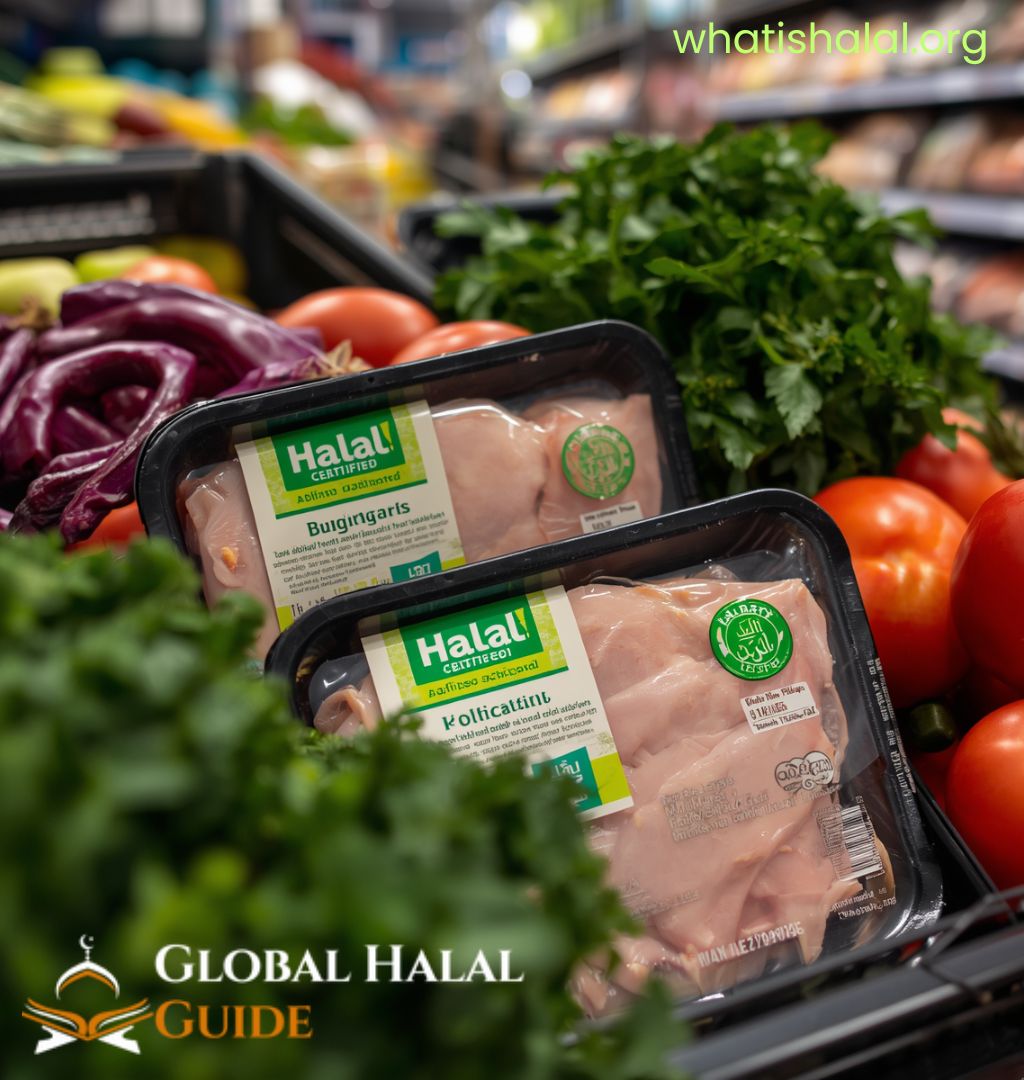
These conditions give a clear answer to the question often asked by Muslims in the West: What is the ruling on eating chicken in the UK or other Western countries when it is slaughtered in non-Islamic facilities? If the chickens are killed by stunning methods rather than proper dhabiha, or if the person performing the slaughter does not meet the Islamic requirements, then the meat cannot be considered halal, even if it comes from a grocery store that labels certain products as “halal.”
This is why verification and certification from trusted Islamic organizations are so important for Muslims seeking to maintain halal diets in non-Muslim majority countries.
Is Halal Chicken Humane? The Islamic Principle of Ihsan
Islamic slaughter is not just a technical checklist; it is an act of worship (‘ibadah) governed by Ihsan (excellence and compassion).
The Prophet Muhammad (peace be upon him) commanded Muslims to show kindness even when taking an animal’s life, stating: “Let each one of you sharpen his blade and let him spare suffering to the animal he slaughters”. (Sahih Muslim- Hadith Number: 1955)
Respect and Care During Slaughter
The principle of Ihsan means the animal must be treated with dignity and minimal stress:
- Preparation: The knife must be sharpened out of sight of the animal.
- Respect: The animal should be handled gently and never witness the slaughter of another animal.
Forbidden Practices that Compromise Ethics
Certain practices sometimes used in slaughterhouses contradict the mercy required by Ihsan and must be avoided.
- Pulling the Tongue: Sometimes done mistakenly to aid blood drainage, but this inflicts unnecessary pain and is not an Islamic requirement.
- Twisting a Leg: This act is also not required by Islamic law and constitutes needless torment to the animal.
These unnecessary actions are considered innovations (Bid’ah) and compromise the spiritual integrity of the Dhabiha.
What Happens If There Is Doubt About Halal Chicken?
Islamic law recognizes that humans make mistakes, especially in complex societies. The rulings here are merciful.
If you accidentally consume Haram food (e.g., a misleading label, cross-contamination, or a mistake at a restaurant) without knowing it was forbidden, there is no sin upon you.
This is based on the Qur’anic principle: “Our Lord, do not impose blame upon us if we forget or make a mistake” (Surah Al-Baqarah: Ayat Number: 286).
Sin requires conscious knowledge and intention, which were absent in the case of a mistake.
Clarification on Expiation (Kaffara)
There is a common worry that one must perform expiation (Kaffara)—such as fasting for three days—after accidentally eating Haram food. This is not required according to Islamic law.
Kaffara is only obligated for very specific, intentional violations (like breaking an oath). If you discover the error, the steps are simple:
- Stop eating the food immediately.
- Ask God for forgiveness (a general prayer).
- Continue with your normal life without burden or guilt.
How to Identify and Verify Genuine Halal Chicken

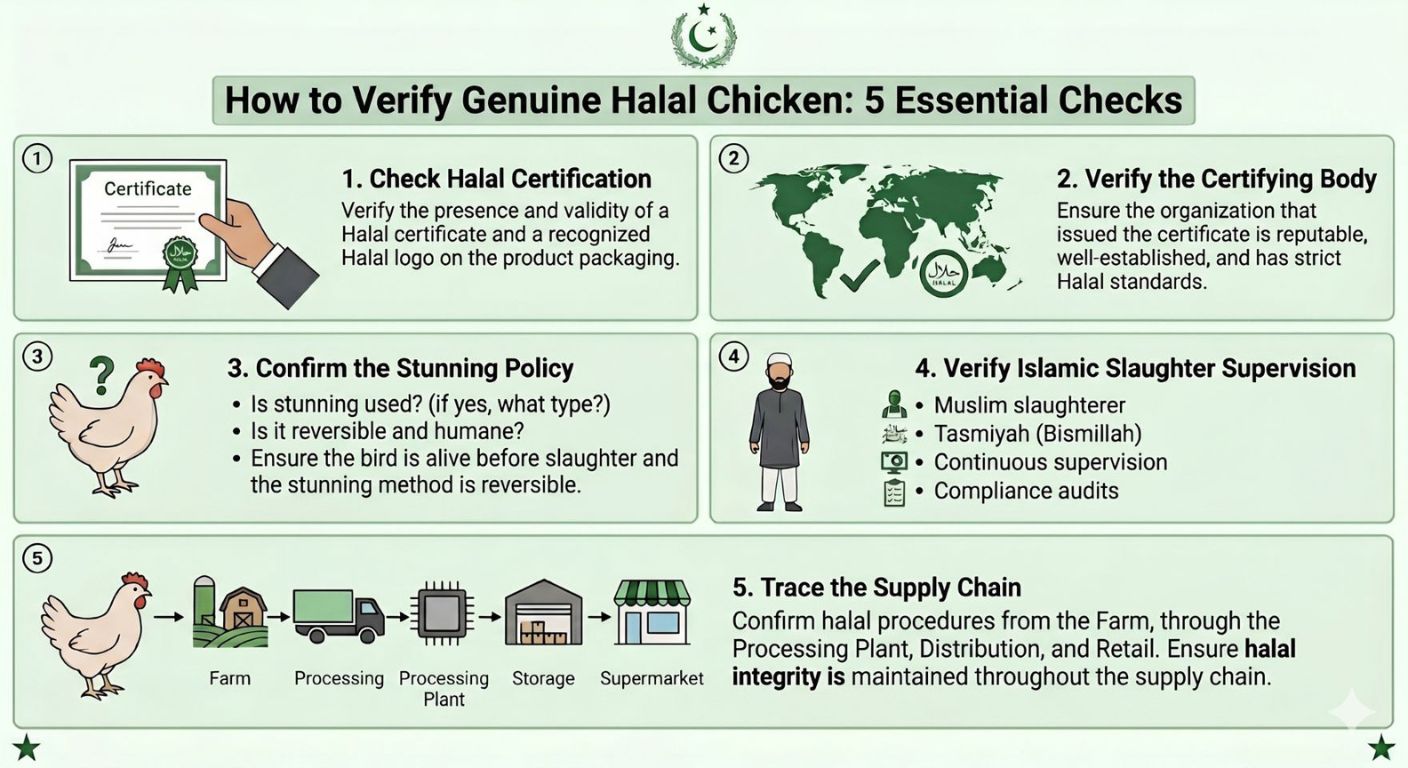
Look beyond the label. You should seek reputable Halal certification bodies that perform on-site inspections and demand transparency.1 Critical questions to ask or confirm:
- Stunning Policy: Is stunning used? If so, how can the certifier guarantee that no animal dies before the cut? (The safest option is non-stunned).
- Supervision: Is a Muslim supervisor present during the actual slaughter process to ensure the correct cuts are made on a living animal?.
- Source: What farming and feeding practices are used to ensure the chickens are not Jalalah?.
Halal Chicken: Key Takeaways for Muslim Consumers
Halal chicken is defined by a combination of lawfulness, purity, and compassion.1 It requires a competent slaughterer, a precise method, strict avoidance of pre-slaughter death (e.g., from stunning), and ethical treatment (Ihsan).
For consumers, diligence is key. Do not rely solely on vague labels.1 By verifying the certification, supporting ethical sources, and understanding the core requirements of Dhabiha and Ihsan, you ensure that your consumption aligns fully with the Islamic principles of lawfulness, purity, and mercy.