The Bottle vs. the Finished Food: Two Different Things
It’s worth being precise about what exactly is being discussed, because this is where a lot of confusion creeps in.
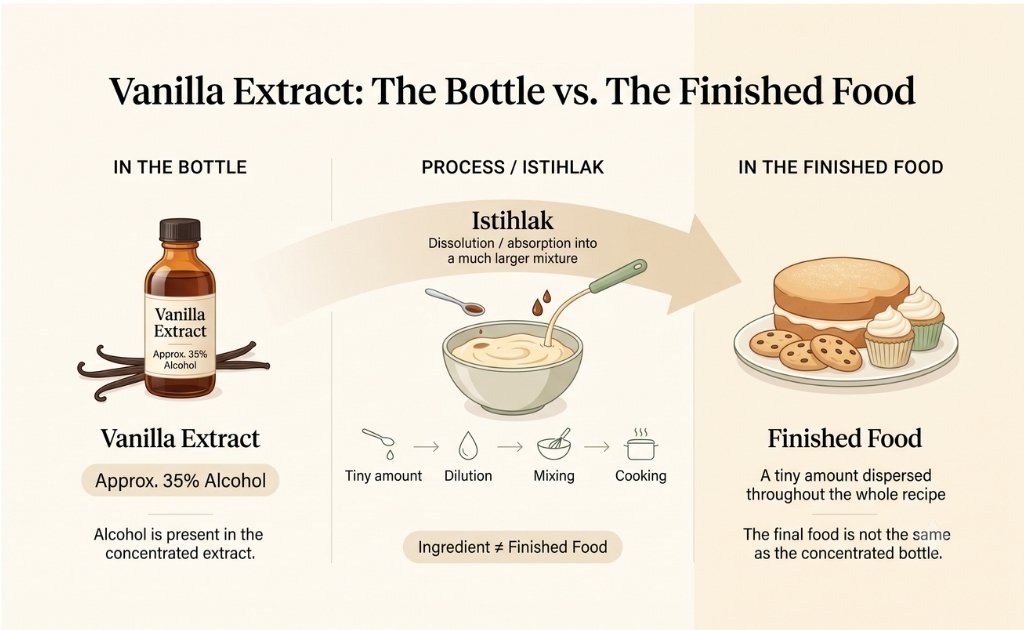
Pure vanilla extract as sold in the bottle is not a trace amount of alcohol — at 35%+ ABV, it’s a substantial concentration, comparable to many spirits. Drinking it directly from the bottle, on its own, would be haram by any scholarly view, since at that concentration and quantity it is capable of intoxicating.
The “small, non-intoxicating amount” argument that underpins most permissive rulings does not apply to the bottle itself; it applies to the diluted amount that ends up in a finished dish, once a teaspoon or two of extract has been mixed into an entire batch of batter, dough, or frosting and, in many cases, partially cooked. Keeping this distinction in mind matters, because the two things — the concentrated product and the diluted, prepared food — are genuinely different from both a chemistry and a fiqh standpoint.
This distinction relates to a classical fiqh concept called istihlak (استهلاك), meaning dissolution or consumption by absorption. The principle holds that when a small quantity of an impermissible substance is mixed into a much larger quantity of a permissible one, to the point that it dissolves completely and loses its distinct properties — taste, color, smell, or effect — some scholars hold that the mixture as a whole is no longer treated as containing that substance in a legally significant way. Applied to vanilla extract, this is essentially the jurisprudential basis for treating a teaspoon of extract stirred into a full batch of cookie dough differently from the same alcohol consumed on its own: in the finished food, the alcohol has been absorbed into a far larger, non-intoxicating whole. Not all scholars accept istihlak as sufficient grounds for permissibility in every case, which is part of why the stricter view described below still exists.
The Quran and Hadith Foundation
Before looking at the scholarly opinions on vanilla extract specifically, it helps to understand the textual basis they’re working from.
The Quran directly addresses intoxicants in Surah Al-Ma’idah (5:90-91)
“Where believers are commanded to avoid khamr (wine/intoxicants) and gambling, describing them as the handiwork of Shaytan meant to sow enmity and turn people away from remembering Allah and from prayer.”
On the Hadith side, two narrations are central to this discussion.
In Sahih Muslim, the Prophet Muhammad ﷺ is reported to have said that every intoxicant is khamr, and every khamr is haram — establishing that the prohibition applies to the category of intoxicating substances, not just grape wine specifically.
A second narration, recorded by Abu Dawud, At-Tirmidhi, and An-Nasa’i, states that whatever intoxicates in a large quantity, a small quantity of it is also haram — meaning even a tiny amount of something that would intoxicate in larger doses remains prohibited, regardless of quantity. (Sahih al-Bukhari, 2236)
This second hadith is actually the crux of the entire vanilla extract debate — but scholars apply it to two different objects, which is why the rulings diverge. Scholars who permit vanilla extract generally apply this threshold to the finished, vanilla-flavored food rather than the bottled extract itself: a slice of cake or a batch of cookies containing a teaspoon or two of vanilla extract, even eaten in a large quantity, would not produce any intoxicating effect, so the food as consumed does not meet the hadith’s threshold. Scholars who take a stricter view tend to apply the same threshold closer to the extract itself, or emphasize that the prohibition is fundamentally about the substance and its origin rather than only its immediate, measurable effect on the person eating it.
Perspective One: The Permissive View — Halal With Conditions
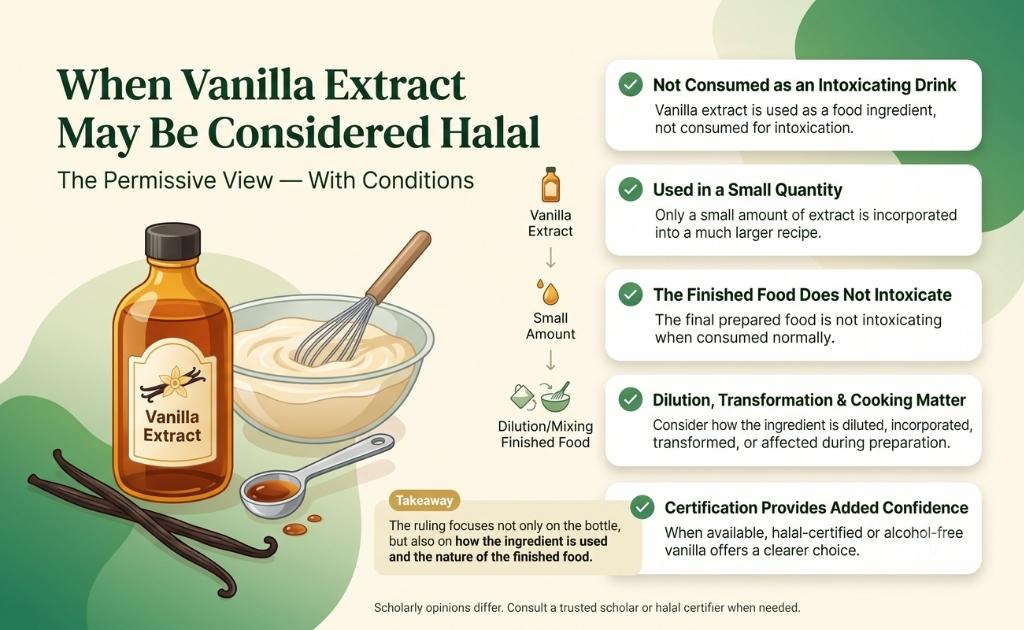
Many well-known contemporary scholars and fatwa authorities rule that vanilla extract, once used in food in normal quantities, is halal. This position generally rests on two supporting principles: alcohol itself is not considered najis (ritually impure) but rather tahir (pure), and a trace amount of alcohol that produces no intoxicating effect in the food as consumed does not render that food haram.
Shaykh Muhammad Salih al-Munajjid addressed this question directly, ruling that consuming vanilla is permissible even though alcohol is used in its preparation. His reasoning rests on the point that the alcohol leaves no discernible trace or effect in the final product — the person consuming it does not become intoxicated, and no effect of the alcohol is perceptible. He also cites a broader principle used by the Islamic Organization for Medical Sciences: what matters is not merely the presence of alcohol, but whether the ratio present is enough to cause intoxication if consumed. Read Shaykh al-Munajjid’s full fatwa on vanilla extract
Mufti Ebrahim Desai, following the Hanafi school, gave a related but slightly more specific ruling: foods containing vanilla extract are halal to eat, on the condition that the alcohol used to produce the extract was not derived from grapes or dates. This introduces an important qualifier that reappears throughout the Hanafi tradition — the source of the alcohol matters, not just the quantity. Read Mufti Desai’s Hanafi ruling on vanilla extract
Ustadh Tabraze Azam, writing for a Hanafi fiqh answers service, ruled that vanilla essence is permitted for use in food even if there’s some incidental remnant of the carrier alcohol in the final product. He notes, however, that it would be religiously preferable to avoid varieties containing such alcohol where reasonably possible, simply to respect the difference of opinion on the matter. Crucially, he specifies that this dispensation applies only to non-wine alcohol — that is, alcohol not extracted from grapes, dates, or raisins. Read Tabraze Azam’s ruling on vanilla essence
A more detailed fatwa from Darul Iftaa builds on this by drawing a distinction between alcohol used as a solvent versus alcohol used as an ingredient. Since non-wine alcohol in vanilla extract functions purely to extract flavor compounds from the bean — rather than being added for its own taste — the resulting extract is treated as a distinct, permissible end product. This is explicitly contrasted with cases like adding beer directly to a fish batter for flavor, where alcohol is not a solvent but a deliberate flavoring ingredient, making that practice impermissible. Read the full fatwa from Darul Ifta Chicago on vanilla extract
Perspective Two: The Stricter View — It Depends on the Exact Alcohol
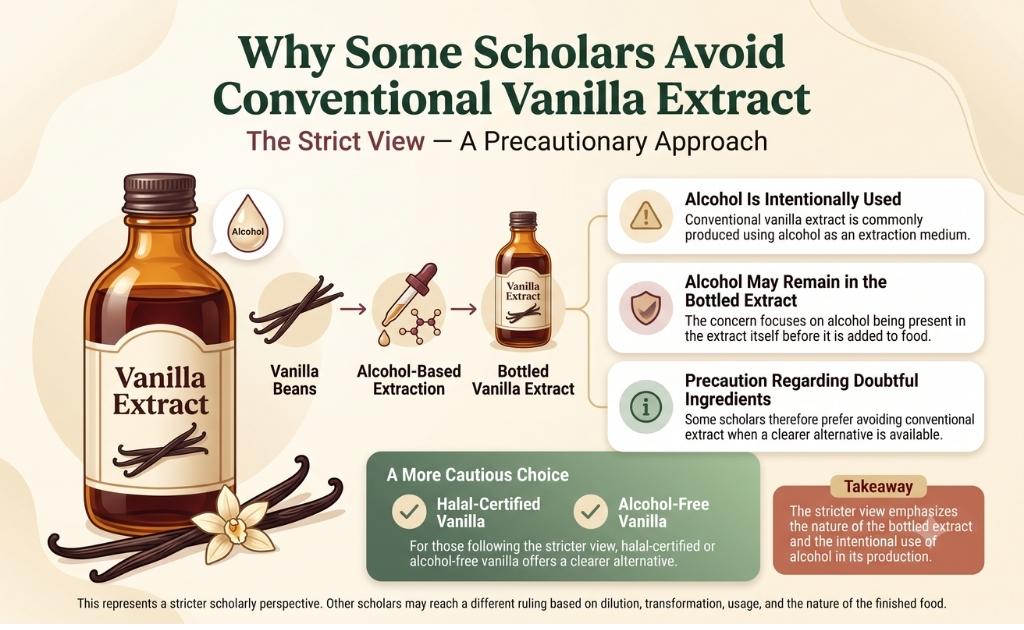
Not every scholar accepts the “solvent vs. ingredient” framing as sufficient. A stricter school of thought draws a more detailed distinction based specifically on which alcohol was used to make the extract:
- Vanilla extract made using grape-derived alcohol (wine, champagne, brandy, cognac) is considered categorically haram and najis, regardless of how diluted it is in the final product.
- Vanilla extract made using alcohol distilled from other intoxicating sources — such as rum, vodka, or tequila — is treated more cautiously: since the alcohol is functioning as a flavor-carrying agent rather than being fully separated out, some scholars in this camp classify it as makruh tahrimi (strongly disliked, bordering on impermissible) rather than outright permissible.
- Vanilla extract made using grain-based or synthetically manufactured alcohol (not intended or sold as an intoxicating beverage in its own right) is considered permissible without reservation by this same group.
It’s important to be clear about what this classification is not saying: it is a technical distinction within Islamic jurisprudence about the alcohol’s source and role in production, not a suggestion that drinking rum, vodka, or tequila as a beverage is permissible in any way – that remains unequivocally haram. The names of these spirits appear here only because they are common commercial sources of the alcohol used to extract flavor from vanilla beans.
This stricter camp also acknowledges that most commercially available vanilla extract bottles simply say “alcohol” on the label without specifying the exact source, which creates genuine uncertainty for the consumer. They conclude that, given this uncertainty, the path of taqwa (God-consciousness) and caution is to prefer alcohol-free vanilla wherever reasonably possible -a recommendation that, notably, even scholars from the more permissive camp echo, even while ruling the standard product halal.
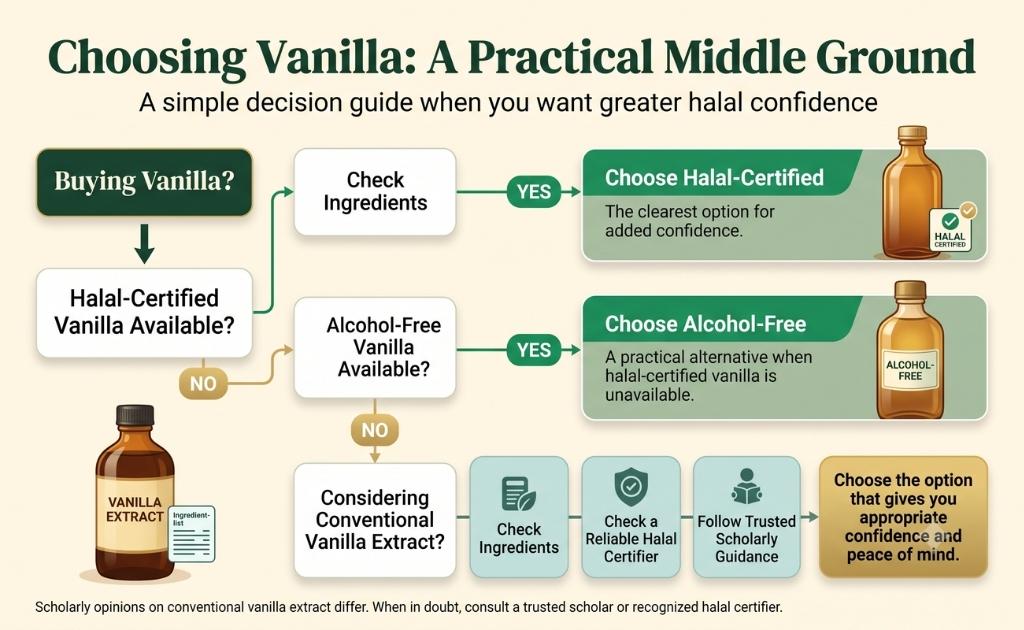
Perspective Three: A Practical Middle Ground
A third, more consumer-focused perspective treats this less as a strict fiqh debate and more as a practical labeling and certification issue. Some halal food writers point out that a vanilla flavoring containing roughly 35% alcohol might not itself qualify for halal certification as a standalone product, yet its use in a finished item like ice cream doesn’t automatically disqualify that finished item – because the quantity used is far too small to have any intoxicating effect on the consumer.
This view is echoed by halal certification bodies like IFANCA, whose consumer publications have stated that products containing vanilla in any form are generally permissible, while also cautioning that other ingredients in the same product (not the vanilla itself) may separately require halal verification.
The Science Behind the Ruling: Does Cooking Actually Remove the Alcohol?
It’s worth understanding why “small amount, no intoxicating effect” isn’t just a convenient assumption — it reflects genuine, if more nuanced, chemistry than the “alcohol just burns off” idea commonly repeats.
First, dilution matters most: a typical recipe calls for only one or two teaspoons of vanilla extract spread across an entire batch of dough, batter, or frosting, so even before any heat is applied, the alcohol is already spread very thin relative to the size of the finished dish.
Second, cooking does reduce the alcohol further, but it should not be assumed to remove all of it. According to the USDA’s widely-cited Table of Nutrient Retention Factors, alcohol stirred into a mixture and baked or simmered for 15 minutes still retains around 40% of its original content; after 30 minutes, about 35% remains; after an hour, around 25%; and even after 2.5 hours of cooking, roughly 5% is still measurable. In other words, cooking time alone is not a reliable way to guarantee zero alcohol — a small residual amount can remain even after extended cooking, depending on the method and duration. What matters most is the combined effect of extreme dilution (a teaspoon or two across a whole batch) and partial evaporation during baking, which together leave only a very small trace in each individual serving.
This helps explain one of the key considerations behind many permissive rulings: not that the alcohol vanishes entirely, but that what remains per serving is far too small and diluted to have any intoxicating effect on a healthy adult. It also explains why several stricter scholars still recommend caution with dishes that use vanilla extract raw or without any cooking at all — such as frostings, no-bake desserts, or ice cream — since in those cases neither heat nor extended cooking time reduces the alcohol content any further than the initial dilution.
If You Still Have Doubts: Practical Alternatives
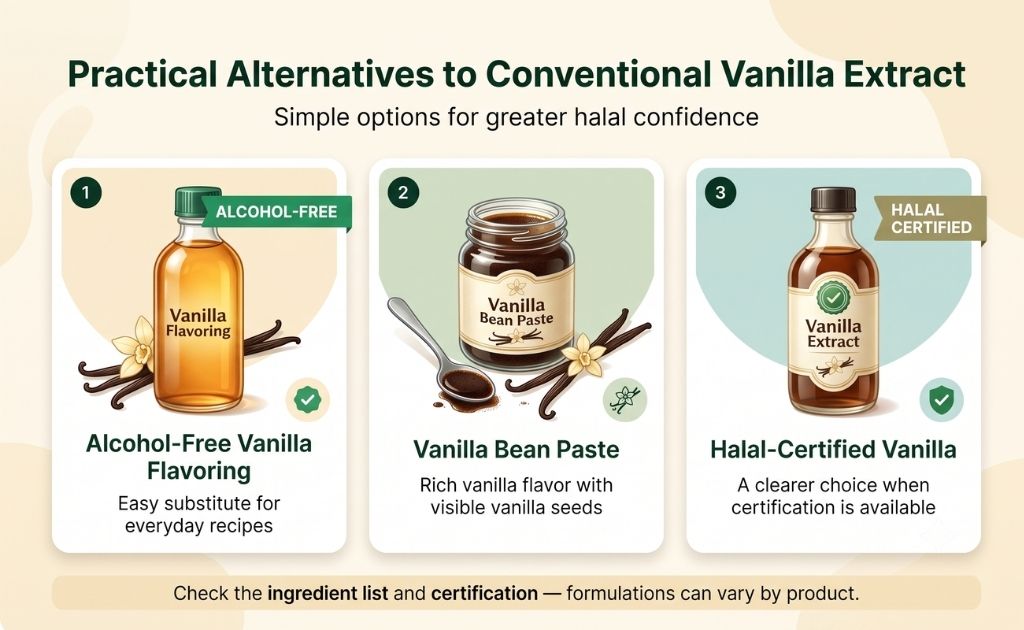
If you’d rather avoid the debate altogether, several halal-friendly alternatives exist:
- Alcohol-free vanilla flavoring: Uses glycerin or propylene glycol instead of alcohol as the extraction medium. Note that FDA rules mean these products are legally labeled “flavoring,” not “extract.”
- Whole vanilla beans: Naturally avoids the extraction-alcohol question entirely, though it’s typically the most expensive option.
- Vanilla bean paste: A convenient middle ground between beans and extract — but check the ingredient label carefully, since many commercial pastes are formulated with vanilla extract and/or alcohol as a base, so paste is not automatically alcohol-free.
- Halal-certified vanilla extract: A growing number of brands now offer vanilla extract certified using grain-based or synthetic alcohol under verified halal production standards.
This connects to istihalah — the idea that a complete transformation can change a substance’s ruling. It’s the basis of the Hanafi position (that cheesemaking transforms rennet enough to change its status); the stricter view doesn’t accept that this transformation is sufficient on its own.
In short: if you follow the Hanafi school, or the Ibn Taymiyyah-associated Hanbali view, an unconfirmed but presumably non-pork source is most likely permissible for you — though avoiding it when reasonably possible is still considered more cautious. If you follow the classical Shafi’i, Maliki, or mainstream Hanbali position, an unknown source is doubtful rather than confirmed haram, and standard guidance is to avoid it. Either way, halal certification remains the clearest way for any reader to verify the product against halal requirements with certainty.
Frequently Asked Questions
So, Is Vanilla Extract Haram?
There is no single, universally agreed-upon ruling — but there is a clear and well-supported permissive position.
Scholars including Shaykh Muhammad Salih al-Munajjid, Mufti Ebrahim Desai, and Ustadh Tabraze Azam have each supported permissibility in relevant cases, though their reasoning isn’t identical: al-Munajjid’s ruling centers on the alcohol’s purity and its lack of any detectable effect in the finished food, while the Hanafi rulings from Desai and Azam place particular importance on the alcohol’s source, requiring specifically that it not be derived from grapes, dates, or raisins. Based on these rulings, vanilla extract used in normal amounts in food can reasonably be considered halal.
A stricter view exists too, holding that only grain-based or synthetic alcohol should be considered fully acceptable, and recommending caution with extracts made using grape-derived or other intoxicating spirits as the extraction medium – a ruling about the source of the manufacturing alcohol, not an endorsement of drinking such spirits, which remains haram regardless of any view above.
Muslims who prefer this stricter view, or simply want certainty without wading into the underlying fiqh debate, can choose alcohol-free vanilla flavoring, whole vanilla beans, or halal-certified vanilla extract instead. If you’re unsure which ruling applies to your situation, the safest step is to ask a scholar whose methodology you already follow. And Allah knows best.