What's in Doritos Nacho Cheese? (Ingredient List)
Doritos are made by Frito-Lay, which is owned by PepsiCo — one of the biggest food and beverage companies in the world.
Based on the official ingredient list published on Doritos’ own product page, Nacho Cheese Doritos contain:
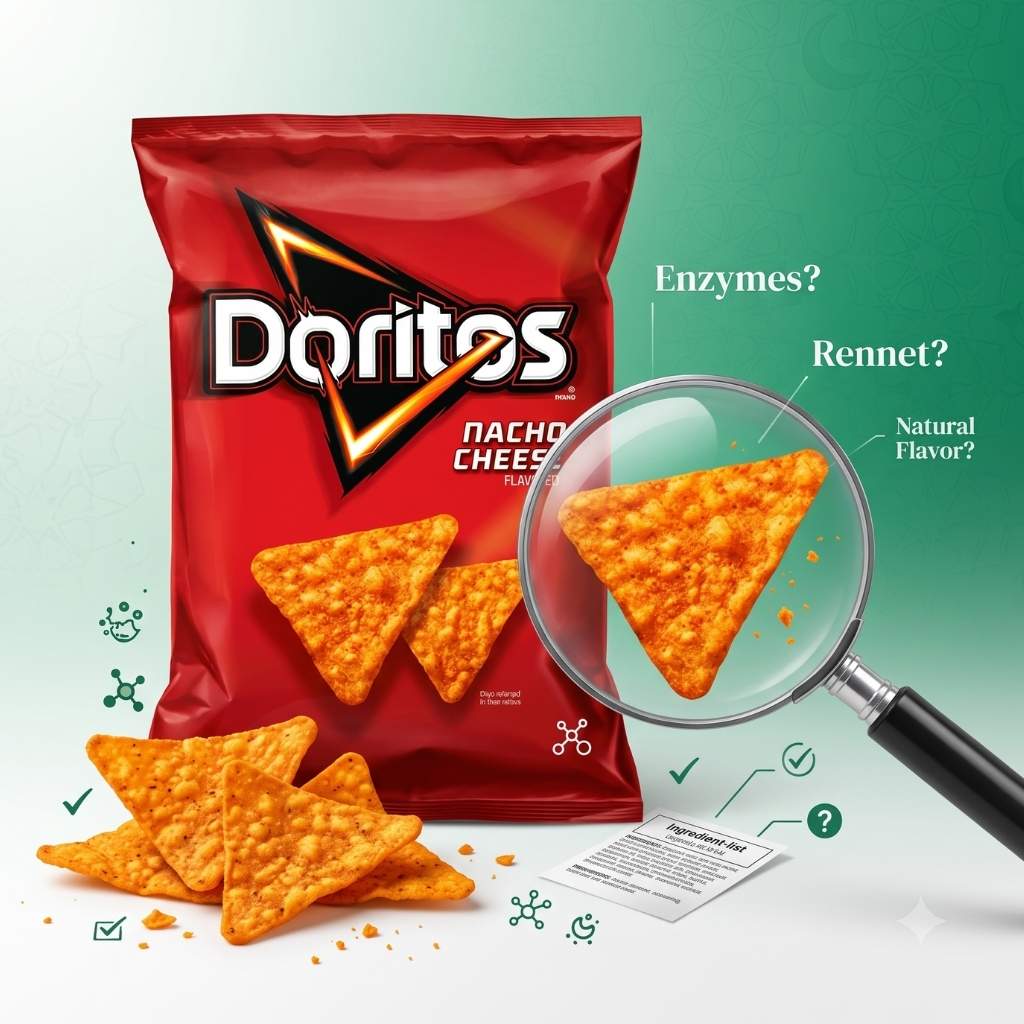
Corn, vegetable oil (corn, canola, soybean, and/or sunflower oil), corn maltodextrin, and less than 2% of: cheddar cheese (milk, cheese cultures, salt, enzymes), salt, whey, monosodium glutamate, buttermilk, romano cheese (milk, cheese cultures, salt, enzymes), whey protein concentrate, onion powder, potassium salt, corn flour, natural and artificial flavors, dextrose, tomato powder, lactose, spices, artificial color (Yellow 6, Yellow 5, Red 40), lactic acid, citric acid, sugar, garlic powder, skim milk, red and green bell peppers, and two flavor-enhancing salts (disodium inosinate and disodium guanylate) that aren’t derived from animals and aren’t a halal concern on their own.
Why Do Muslims Question Whether Doritos Are Halal?
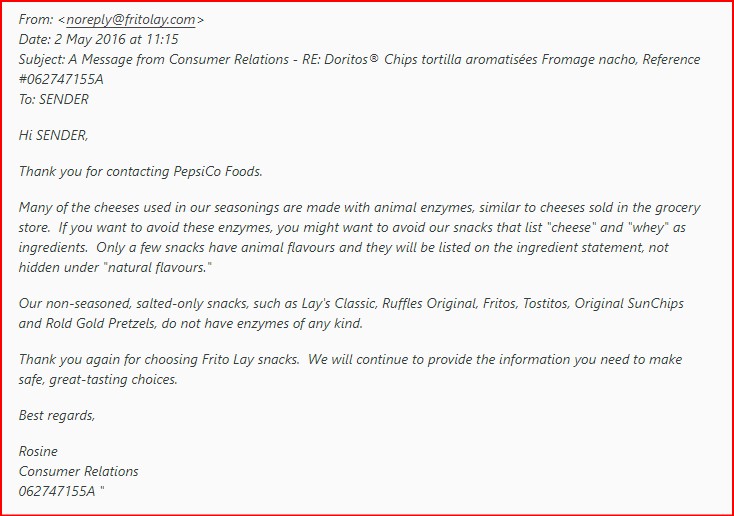
Beyond PepsiCo’s written confirmation that the enzyme is animal-derived, the specific source hasn’t been confirmed in any current official statement.
A few consumer reports offer clues, but none of them agree with each other or count as confirmed fact: a 2010 report from Mathabah.org cites a Frito Lay Canada phone representative naming beef and pork (Mathabah itself notes the formulation may have since changed); a more recent Scanhalal app report and a Quora post both point to beef, for the related Cool Ranch flavor. We’re including these as possibilities worth being aware of, not settled facts — and even if accurate, none of them confirm whether the source animal was slaughtered according to Islamic requirements.
Is an Animal-Derived Enzyme of Unconfirmed Origin Enough to Call a Food Not Halal?
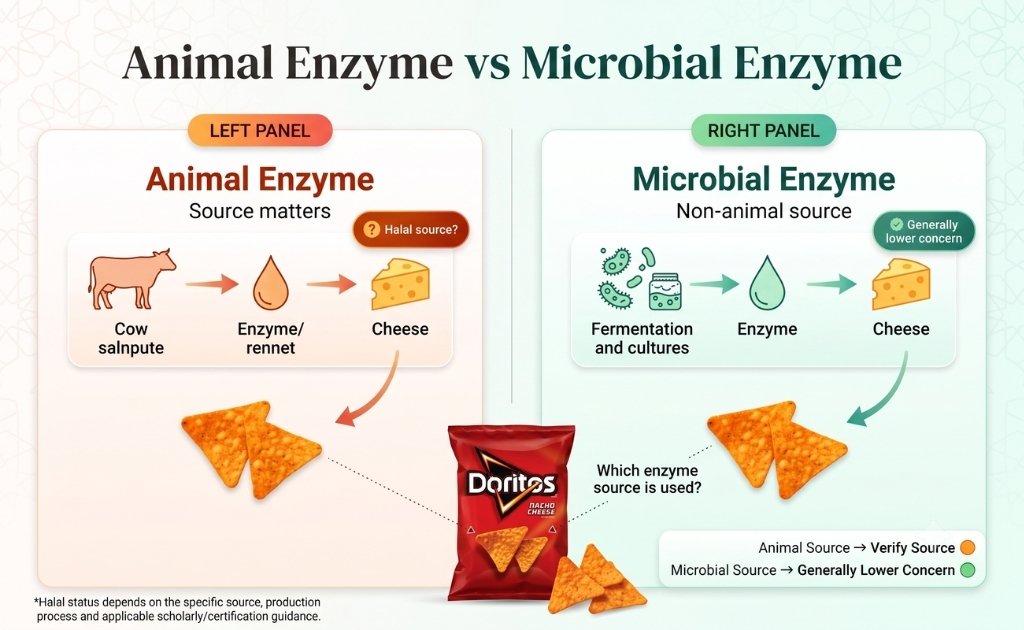
Not automatically — this deserves an honest answer rather than a glossed-over one. Scholarly opinion genuinely differs: the Hanafi school generally treats non-pig animal rennet as permissible regardless of slaughter method, while the Shafi’i, Maliki, and stricter Hanbali positions are more cautious about rennet from an animal not confirmed to be zabiha-slaughtered. See the school-by-school breakdown below.
In practice: there is no single, unanimous verdict that automatically makes an animal-derived enzyme of unconfirmed species and slaughter method haram. What exists is genuine scholarly disagreement, plus a real information gap — we know it’s animal-derived, not which animal or how it was sourced — that leaves the question open regardless of which position a reader follows.
Does Doritos Nacho Cheese Contain Pork?
No pork ingredient is listed on the official ingredient panel. The cheese enzyme is confirmed animal-derived, but the specific animal hasn’t been officially confirmed. One older, Canada-specific consumer report mentioned pork; other reports point to beef. Neither is confirmed, so we treat this as an open question, not a settled one.
Are Doritos Nacho Cheese Halal in the USA?
Doritos are not certified halal in the US by any recognized body such as IFANCA, HFA, or HMC. Frito-Lay does publish a list of its Kosher-certified products, but Nacho Cheese Doritos aren’t on it — and kosher certification follows a different standard than halal regardless.
Are Doritos Nacho Cheese Halal in Canada?
Doritos sold in Canada use a formulation very similar to the US version, with the same lack of disclosure and certification. Don’t assume the Canadian version is different unless you can confirm that directly.
What Scholars Say: Madhhab Differences on Animal Rennet
Scholarly opinion on non-pig animal rennet of unconfirmed origin isn’t a simple halal/haram split — it depends on which school you follow, and on whether the slaughter method is confirmed non-zabiha or simply unknown.
This connects to istihalah — the idea that a complete transformation can change a substance’s ruling. It’s the basis of the Hanafi position (that cheesemaking transforms rennet enough to change its status); the stricter view doesn’t accept that this transformation is sufficient on its own.
In short: if you follow the Hanafi school, or the Ibn Taymiyyah-associated Hanbali view, an unconfirmed but presumably non-pork source is most likely permissible for you — though avoiding it when reasonably possible is still considered more cautious. If you follow the classical Shafi’i, Maliki, or mainstream Hanbali position, an unknown source is doubtful rather than confirmed haram, and standard guidance is to avoid it. Either way, halal certification remains the clearest way for any reader to verify the product against halal requirements with certainty.
Which Other Doritos Flavors Are Halal-Friendlier?
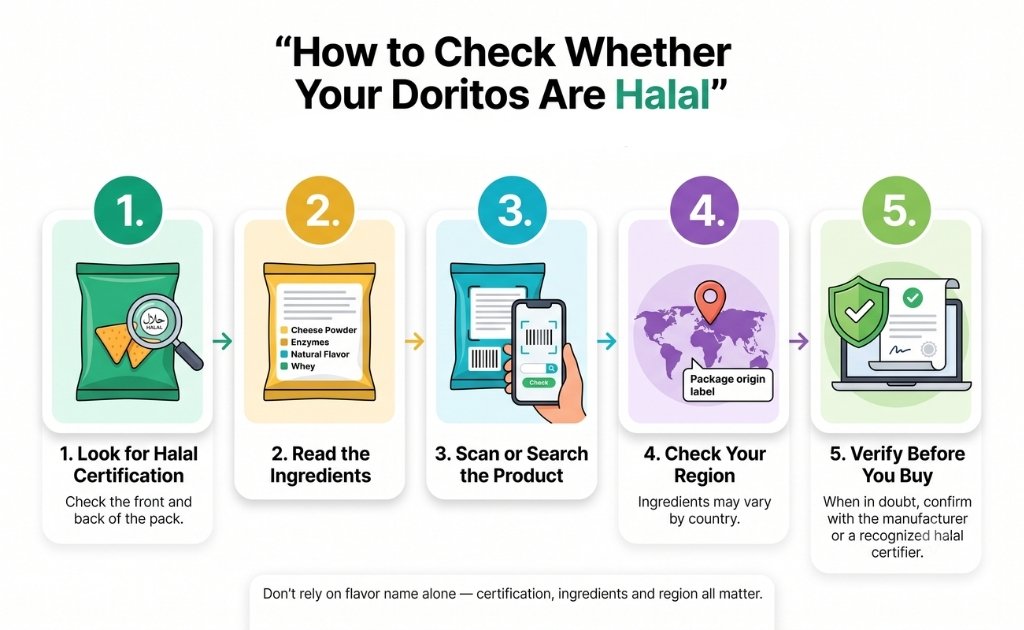
Because formulations can change and vary by country, always check the specific product in front of you:
- Note the exact product name, flavor, and country of manufacture.
- Note the product or UPC code, since formulations can differ even within the same flavor name.
- Read the current ingredient list, since it can change between production runs.
- Look for a halal certification logo (JAKIM, IFANCA, HFA, HMC, or your local body).
- If uncertain, contact the manufacturer directly through PepsiCo’s official site for confirmation on that specific product code.
- Note the date you checked, since this information can become outdated.
Helpful tip: PepsiCo’s non-seasoned, salted-only snacks — Lay’s Classic, Fritos, Original SunChips, and Rold Gold Pretzels — don’t contain any enzymes at all, since they skip the cheese-based seasoning. Worth knowing if you want a lower-risk option from the same manufacturer while no certified choice is available.
Frequently Asked Questions
Our Classification: Not Halal — Until Verified
- Confirmed: The cheese seasoning uses an animal-derived enzyme — confirmed in writing by PepsiCo.
- Unconfirmed: Which animal, and whether it was slaughtered according to Islamic requirements.
- Fiqh: Scholars genuinely differ on animal rennet of unknown or non-zabiha origin — see the breakdown above.
- Verification: No halal certification exists to independently establish the source.
- Classification: Because the source can’t be verified and isn’t certified, we do not classify this product as halal and recommend avoiding it as a precaution.
This isn’t a claim that every scholar considers unknown-source rennet haram — the breakdown above shows otherwise. It reflects our precautionary standard: without verification or certification, we don’t classify a product as halal. Readers following a fiqh position that treats non-pork animal rennet as permissible by default may reasonably reach a different personal conclusion.
The Bottom Line
We do not classify Doritos Nacho Cheese Flavored Tortilla Chips as halal. PepsiCo has confirmed the cheese seasoning uses an animal-derived enzyme, but the specific animal and slaughter method remain unconfirmed, and there’s no halal certification. This is a precautionary classification, not a claim of unanimous scholarly agreement — readers following the Hanafi school, or the Ibn Taymiyyah-associated Hanbali view, may reach a different conclusion. For certainty, verify the specific product’s enzyme source directly or look for recognized halal certification.