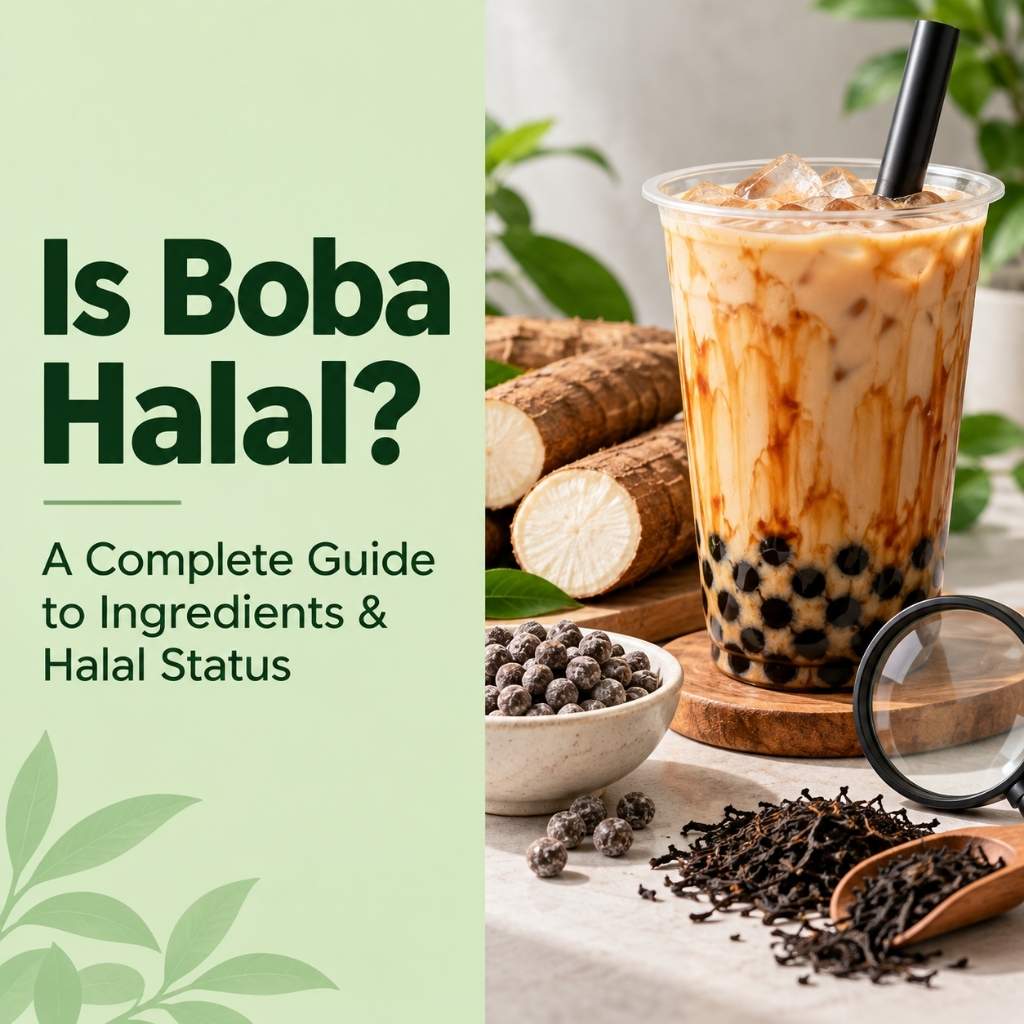
You’ve seen the tall cups with dark pearls sitting at the bottom, and the extra-wide straws. You may have even tried one. But if you’re a Muslim, there’s a question that comes before “which flavour?” — can I actually drink this?
The confusion is understandable. Boba shops rarely list ingredients. Toppings change from shop to shop. And words like “jelly”, “pudding” and “foam” can hide animal-derived ingredients.
This guide explains what boba is, where it came from and what goes into it. Then it goes through every common ingredient so you can make an informed, halal choice.
What Is Boba?
Boba is a small, chewy ball made from tapioca starch. It is usually cooked, soaked in sugar syrup and served at the bottom of a sweet tea drink.
Boba: The Pearls or the Whole Drink?
Both, depending on who you ask.
- Strictly speaking, boba means the tapioca pearls themselves.
- In everyday use, especially in the US, “boba” means the whole drink. “Let’s get boba” means “let’s get bubble tea”.
Some people even call a drink from a boba shop “boba” when it has no pearls at all, because the word has become shorthand for the whole category of drinks.
In this guide, “boba” or “pearls” means the balls, and “boba tea” means the full drink.
Why Is It Called Boba?
The most widely repeated explanation is that “boba” was Taiwanese slang in the 1980s, usually linked to Hong Kong actress Amy Yip, and the pearls were nicknamed after her. In Chinese, the drink is often called zhenzhu naicha (pearl milk tea).
The name has nothing to do with the ingredients, so it does not affect the halal question.
Boba vs. Bubble Tea vs. Milk Tea
These terms overlap, which causes a lot of confusion:
- Bubble tea: The broad name for the drink. The “bubbles” originally referred to the foam from shaking the tea, not the pearls.
- Boba tea: Bubble tea with tapioca pearls. In the US, people use “boba” and “bubble tea” interchangeably.
- Milk tea: Tea mixed with milk or creamer. It can be served with or without boba.
Bottom line: Bubble tea and boba tea are essentially the same drink. Milk tea is one style of it.
What Is Boba Made Of?
Classic boba pearls are made from just a few ingredients: tapioca starch, water and sugar. Some recipes also add caramel colour or brown sugar for the dark shade.
Tapioca Starch and the Cassava Root
Tapioca is a starch extracted from the root of the cassava plant (also called yuca or manioc).
- The cassava root is peeled, grated and washed.
- The starch is extracted and dried into a fine white powder.
- The powder is mixed with hot water, rolled into small balls and dried or frozen.
So yes, boba is tapioca. Unless a shop uses a different type of pearl (covered in the next section), the chewy black balls in your drink are tapioca.
Sweeteners and Colour: Why Is Boba Black?
Raw tapioca pearls are white or translucent. The black or dark brown colour usually comes from:
- Brown sugar or black sugar cooked into the pearls or the syrup
- Caramel colour added during manufacturing
After cooking, most shops soak the pearls in a brown sugar or honey syrup. This is what gives them their sweet taste.
What Does Boba Taste Like?
Tapioca has almost no flavour of its own. What you taste mostly comes from the syrup and the drink.
- Tapioca pearls: Mildly sweet, with a soft, chewy, slightly bouncy texture (often called “QQ” in Taiwan).
- Crystal boba: Firmer and more jelly-like, with a light, clean sweetness.
- Popping boba: A thin skin that bursts in your mouth, releasing fruit juice.
Bottom line: Boba is mainly about texture. The flavour comes from the tea, the syrup and the toppings.
Common Boba Myths: Plastic, Frog Eggs and Other Rumours
Because most people never see how boba is made, rumours spread easily. Here’s the truth:
- ❌ “Boba is frog eggs.” False. The round shape causes the joke, but boba is plant starch.
- ❌ “Boba is made from rabbit or goat droppings.” False. This is a viral joke based on appearance. Pearls are made from tapioca starch.
- ❌ “Boba is made of plastic.” False. Claims like this have circulated online for years, but tapioca pearls are a starch food, not plastic.
- ⚠️ “Boba contains lead.” Partly true. In September 2025, Consumer Reports tested boba from two chains (Gong Cha and Kung Fu Tea) and two packaged products, and found lead in every sample. None exceeded CR’s level of concern, but three of the four reached more than half of it in one serving. CR noted that lead exposure builds up over time and recommended treating bubble tea as an occasional treat, not an everyday staple.
Cassava and cassava-based foods are a known source of lead. But in CR’s tests, the liquid part of the shop drinks contained even more lead than the pearls, so water, tea, equipment or other ingredients may also contribute.
Important note: Lead is a health concern, not a halal one. It does not make boba haram, but moderation is wise.
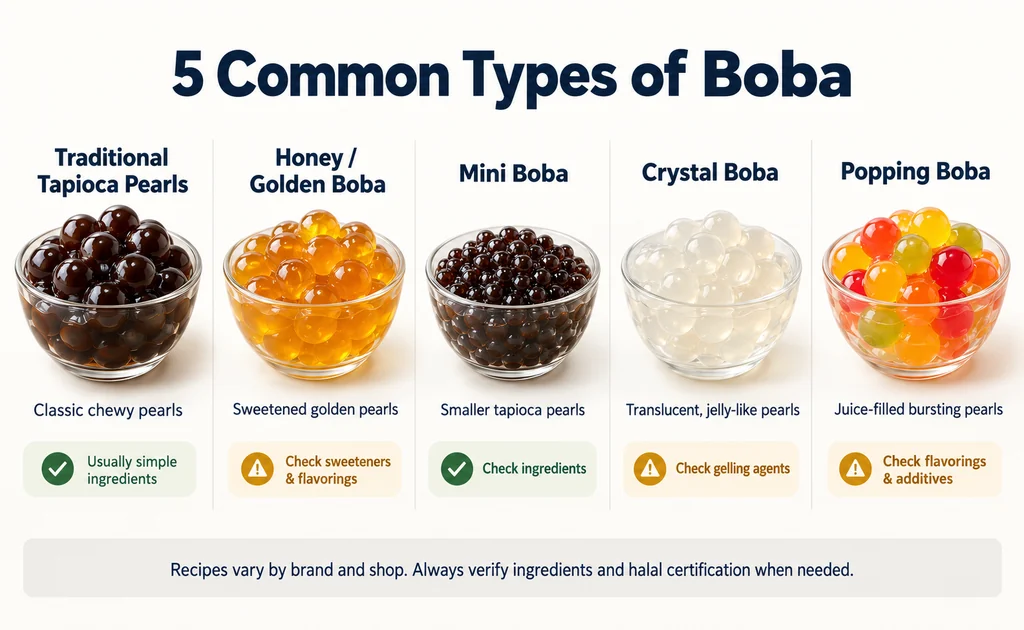
Types of Boba
Not every “boba” is tapioca. Each type has a different base, and that matters for its halal status.
Traditional Tapioca Pearls (Black and Brown Sugar Boba)
The classic. Tapioca starch pearls, coloured with brown sugar or caramel and soaked in syrup.
Brown sugar boba is the same pearl cooked or served in a thick brown sugar syrup. The popular “tiger” drinks get their striped look from this syrup running down the cup.
- Base: Tapioca starch, sugar
- Halal concern: Low. Check the syrup, colouring and any gelatin if buying commercial pearls.
Honey (Golden) Boba
Tapioca pearls soaked in honey or a honey-flavoured syrup, giving them a golden colour. Some shops use golden pearls that are lighter in colour from the start.
- Base: Tapioca starch, honey or syrup
- Halal concern: Low.
White Pearls and Mini Pearls
- White pearls: Tapioca without added colour. Often used in fruit teas.
- Mini pearls: Smaller tapioca pearls that cook faster and are easier to drink.
- Base: Tapioca starch
- Halal concern: Low.
Sago vs. Tapioca Pearls
Small white pearls sold as “sago” (sabudana in South Asia) look almost identical to small tapioca pearls, which confuses many people buying pearls for the first time.
- True sago is a starch from the pith of the sago palm.
- Tapioca is a starch from the cassava root.
- In practice, many packets labelled sago, including most sabudana, are made from tapioca. Check the ingredient list.
Both are plant starches, so both are halal. For boba, use larger tapioca pearls; small white sago-style pearls are mainly used in desserts and won’t give the same chewy bite.
Crystal Boba (Agar Boba): What Is It Made Of?
Crystal boba (also called agar boba or white crystal pearls) is translucent and firmer than tapioca. It is usually made from agar (a seaweed-based gelling agent) or konjac (a plant root).
- Base: Agar or konjac, sugar, sometimes flavourings
- Halal concern: Low to medium. Agar and konjac are plant-based, but some brands may use other gelling agents. Check the label.
Popping Boba: What Is It Made Of?
Popping boba (also called bursting boba or popping pearls) is a thin, jelly-like skin filled with fruit juice. It bursts when you bite it.
It is made through a process called spherification:
- Fruit juice is mixed with sodium alginate (from brown seaweed).
- Drops of this mix fall into a calcium solution (such as calcium lactate or calcium chloride).
- A thin skin forms around each drop, sealing the juice inside.
- Base: Fruit juice, sugar, sodium alginate, calcium salts, colours and flavourings
- Halal concern: Medium. The core ingredients are plant or mineral-based, but colours and flavourings need checking (see the halal section below).
What Is Boba Tea?
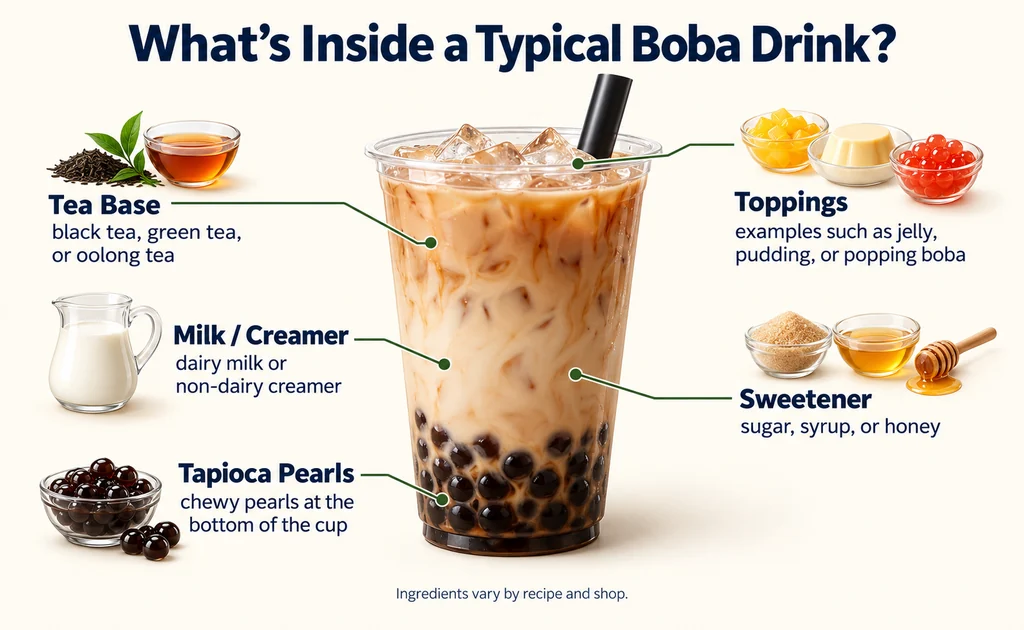
Boba tea is a cold (sometimes hot) drink made of four parts: a tea base, milk or fruit, a sweetener, and toppings like tapioca pearls.
Choosing the Tea Base
Most boba drinks start with one of these teas:
- Black tea: The classic base for milk tea. Strong and slightly bitter.
- Green tea or jasmine tea: Lighter and floral. Common in fruit teas.
- Oolong tea: Between black and green. Toasty and smooth.
- Matcha: Powdered green tea with an earthy flavour.
Some drinks, like taro or fruit slushes, may contain no tea at all.
Milk Teas vs. Fruit Teas
- Milk teas: Tea mixed with fresh milk, non-dairy creamer, condensed milk or plant milk. Creamy and rich.
- Fruit teas: Tea mixed with fruit juice, syrup or fresh fruit. Lighter and often paired with popping boba or jellies.
From a halal view, milk teas need more checking because creamers and milk powders can contain animal-derived additives.
Popular Boba Tea Flavors: Taro, Tiger and More
- Classic milk tea: Black tea, milk and tapioca pearls.
- Taro: A purple drink made from taro root (or taro powder). Sweet, nutty and vanilla-like. If you’ve wondered “what is the purple boba called?”, it’s usually taro.
- Brown sugar (tiger) milk: Fresh milk with brown sugar syrup and pearls. Often has no tea.
- Thai milk tea: Spiced black tea with a bright orange colour.
- Matcha milk tea: Green tea powder with milk.
- Fruit teas: Mango, passion fruit, lychee, strawberry and peach are common.
- “Dirty” boba: A drink where brown sugar syrup is smeared around the inside of the cup.
Other Toppings: Jellies, Pudding and Cheese Foam
Besides pearls, shops offer many toppings:
- Jellies: Coconut jelly, grass jelly, lychee jelly, rainbow jelly and aloe vera.
- Pudding: Usually egg or custard pudding.
- Cheese foam (milk foam): A salty-sweet cream layer on top, made from cream cheese, cream and milk.
- Red bean: Sweetened adzuki beans.
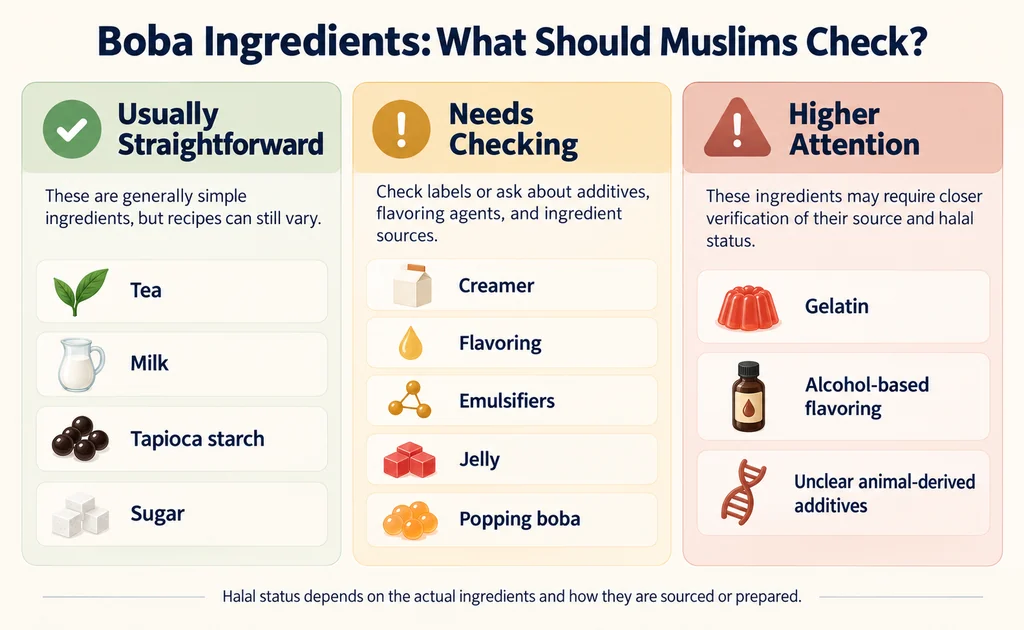
Important note (for Muslim consumers): Toppings are where most halal problems hide. Jellies, puddings and foams may contain gelatin or other animal-based ingredients. The halal section below covers each one.
Sugar Levels, Ice Levels, and Hot vs. Cold Boba
Most shops let you choose sugar level (often 0%, 25%, 50%, 75% or 100%) and ice level.
Boba is usually served cold, but many shops offer hot milk teas too. Tapioca pearls stay soft in a warm drink. Popping boba and some jellies are only served cold.
Is Boba Tea Halal?
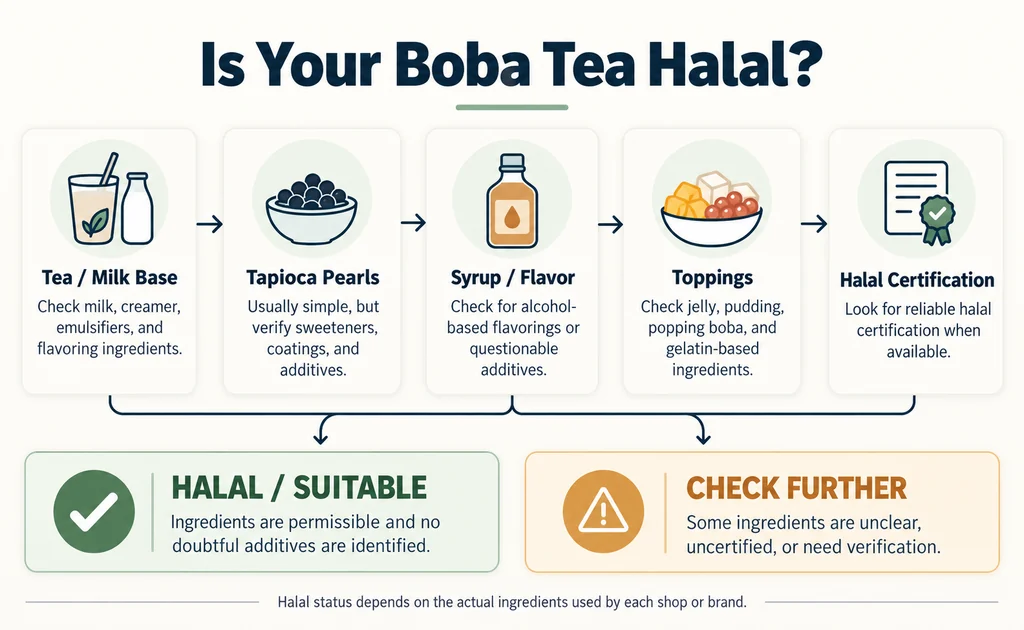
Short answer: Tapioca starch is halal, and simple tapioca pearls made from starch, water and permissible sweeteners are generally halal. A boba drink is halal only when every ingredient in the cup is halal, and nothing haram is added during preparation.
Boba Pearls Can Be Halal, But Bubble Tea Is a Multi-Ingredient Drink
A single boba drink can contain 6 to 10 ingredients: tea, milk or creamer, syrup, pearls, toppings, flavourings and sometimes a foam on top. Each one has its own halal status.
So the question is never just “is boba halal?” It’s “is this exact drink, from this exact shop, halal?”
Is Tapioca Halal?
✅ Yes. Tapioca starch is halal.
The halal logic follows the ingredient from field to cup:
- Cassava root: A plant. All plants are halal unless harmful or intoxicating.
- Tapioca starch: Extracted from cassava with water. Nothing haram is added.
- Plain tapioca pearl: Starch, water and sugar. Still halal.
- Complete drink: Halal only if everything else added is halal.
Tapioca as an ingredient is clearly halal. Commercial pearls are usually simple too, but commercial pearls can contain colours, flavourings or even gelatin, so check the label. The bigger concerns usually come from steps 3 and 4: colourings, syrups, toppings and other ingredients added on top.
Halal Status of Common Bubble Tea Ingredients
Does Boba Contain Gelatin?
Traditional tapioca pearls don’t need gelatin. Tapioca starch already gives them their chew. However, some halal guides, such as Tayib, report that cheaper commercial pearls may use gelatin as a texturiser. So check the packaging, or ask which brand of pearls the shop uses.
Gelatin, however, can appear in:
- Some cheaper commercial tapioca pearls
- Some jellies and fruit jellies
- Egg pudding and panna cotta-style toppings
- Some whipped creams and foams
- Some popping boba or crystal boba brands (rare, but possible)
Gelatin is made from animal skin, bones or connective tissue. Its halal status depends on the source:
- ❌ Pork gelatin: Haram.
- ❌ Gelatin from animals not slaughtered Islamically: Not halal. This includes most bovine gelatin sold without halal certification.
- ✅ Fish gelatin or halal-certified bovine gelatin: Halal.
Our position on istihalah: Some scholars hold that gelatin becomes permissible through istihalah (complete transformation), because it has chemically changed from its source. We do not accept this view for gelatin. In our assessment, gelatin keeps the ruling of its source, so gelatin from pork or from animals not slaughtered Islamically is not halal.
Are Popping Boba, Crystal Boba and Jelly Toppings Halal?
Popping boba: ✅ The main ingredients (juice, sodium alginate, calcium salts) are halal. Two things to check:
- Colours: Some red or pink popping boba may be coloured with carmine (E120), a dye made from cochineal insects. Scholars differ on it:
- Flavourings: May use alcohol as a carrier (see below).
Crystal boba:  Usually halal when made from agar or konjac.
Jellies: Coconut jelly and grass jelly are usually plant-based. Fruit jellies and rainbow jelly vary: some use konjac or carrageenan, others use gelatin. Ask or check the packaging.
Are Pudding and Cheese Foam Halal?
Egg pudding: ⚠️ Often set with gelatin. Some shops use agar or carrageenan instead. Always ask.
Cheese foam: ⚠️ Two possible issues:
- Cream cheese and dairy powders: May involve enzymes (such as rennet) or other processing aids whose halal status depends on their source and certification.
- Whipping cream: Some brands add gelatin as a stabiliser.
Creamers, Powders, Syrups and Additives
This is the part most people never think about. Many shops use pre-made powders for flavours like taro, matcha milk or Thai tea, and non-dairy creamer instead of milk.
Watch for these on labels:
- Milk: Cow’s milk is halal in itself. Some halal guides recommend choosing milk from halal-certified suppliers to rule out additives.
- E471 (mono- and diglycerides): Can come from plant or animal fat.
- E422 (glycerol): Can be plant-based, animal-based or synthetic.
- Whey or casein: From milk; the enzymes used in production can vary by source.
- “Natural flavourings”: The source or carrier is usually not disclosed on the label. Check certification or manufacturer information.
Safe approach: Choose drinks made with fresh milk and real tea, or ask the shop for the creamer brand and look up its halal status.
Does Bubble Tea Contain Alcohol? (Boozy Boba vs. Alcohol as a Flavour Solvent)
There are two very different situations here:
- Boozy boba ❌ Some bars and restaurants serve boba cocktails made with rum, vodka, soju or liqueurs. These are haram. If a shop sells boozy boba, ask whether the same equipment is used for regular drinks.
- Alcohol as a flavour solvent ⚠️ Some flavourings, syrups, flavoured tea blends and vanilla extracts contain a small amount of ethanol used to carry the flavour. The final drink is not intoxicating.
- Permissive view: Many contemporary scholars allow such trace, non-intoxicating amounts.
- Our position: We do not accept this. Flavourings and syrups containing alcohol should be avoided, so check for halal certification or ask the manufacturer.
Cross-Contact With Non-Halal Ingredients and Shared Equipment
Even if every ingredient is halal, cross-contact with non-halal ingredients can happen when:
- The same shakers or blenders are used for alcoholic drinks.
- Gelatin-based and halal toppings share scoops or containers.
- Non-halal food (like pork snacks) is prepared on the same surfaces.
Properly washing equipment between uses generally addresses this concern. If a shop cannot confirm separate or properly cleaned equipment, a halal-certified shop is the safer choice.
Verdict: ✅ Tapioca, and simple tapioca pearls served with tea, fresh milk and sugar, are halal. ❌ Gelatin from pork or non-zabiha animals, alcohol-based flavourings and boozy boba are not. ⚠️ Creamers, carmine colours, cheese foam and unlabelled toppings need checking.
How to Make Sure Your Boba Tea Is Halal
Since ingredients change from shop to shop, use this checklist every time you try a new place.
Halal Certification vs. "No Pork, No Alcohol" Claims
These are not the same thing.
- ✅ Halal certification: An independent body has checked the ingredients, suppliers and preparation. This gives the clearest practical assurance.
- ⚠️ “No pork, no alcohol” or “Muslim-friendly”: The shop’s own claim. It may be true, but it does not cover gelatin from non-zabiha beef, rennet, emulsifiers or flavourings.
Recognised certification bodies include:
- JAKIM (Malaysia)
- MUI / BPJPH (Indonesia)
- MUIS (Singapore)
- SANHA (South Africa)
- IFANCA (USA)
- HFA (UK)
- AFIC (Australia)
How to Read an Ingredient Label
When buying packaged boba, toppings or syrups:
- Look for a halal logo from a recognised body.
- Scan for gelatin. If present, the source must be stated (fish or halal-certified bovine).
- Check E-numbers: E441 is gelatin. E120 (carmine) is insect-derived. E471 and E422 can come from plant, animal or synthetic sources, so their source needs confirming.
- Look for alcohol in the flavouring or ingredient list.
- Check “suitable for vegetarians” or “vegan” labels. These rule out gelatin and meat-based additives, but do not guarantee halal, as alcohol-based flavourings may still be present.
Questions to Ask at a Boba Shop
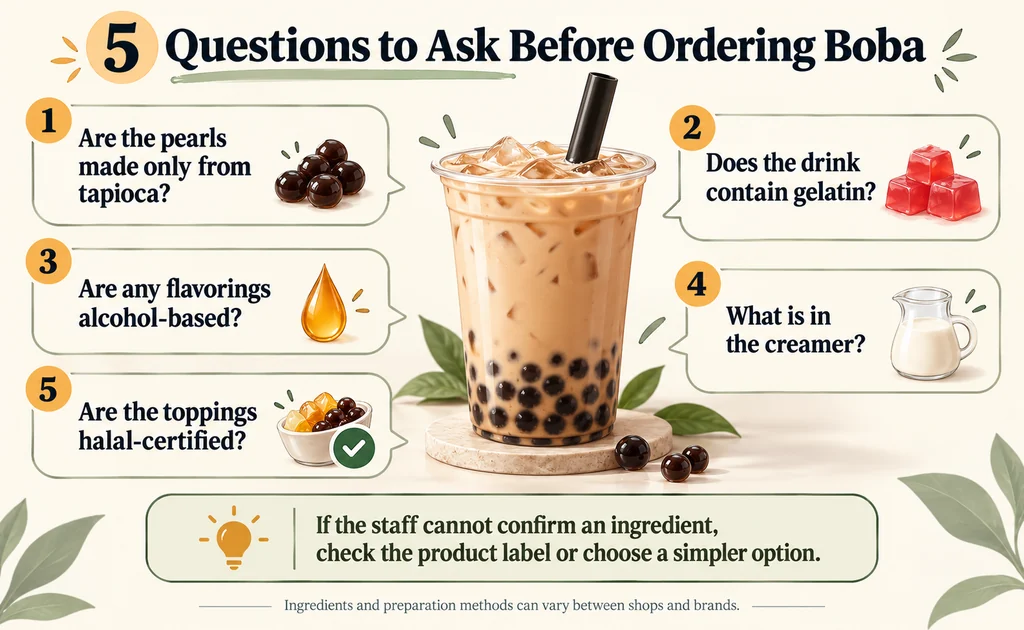
Most boba shops won’t list ingredients, so ask directly:
- “Are you halal certified? Can I see the certificate?”
- “Which brand of tapioca pearls, syrups and powders do you use?”
- “Can I see the packaging of your pearls and syrups?”
- “Do your jellies or pudding contain gelatin?”
- “Which creamer or milk powder do you use?”
- “Is the cheese foam made in-house or from a ready-made mix?”
- “Do you serve alcoholic drinks? Do you use separate equipment?”
Why ask to see the packaging: Staff often don’t know the ingredients themselves; they mix what suppliers send. The original bag or bottle shows the real ingredient list. Some large Taiwanese bubble tea suppliers, such as Sunnysyrup, now offer halal-certified pearls, popping boba and syrups, so the brand name alone can tell you a lot.
If staff can’t answer, stick to the safest options: tapioca pearls, real tea, fresh milk and sugar syrup.
Does Halal Status Vary by Country, Branch or Supplier?
Yes. Halal status can vary by country, franchisee, branch and supplier. A certificate issued in one country, or to one company, should not be assumed to cover the same brand everywhere.
Important note: Even within one country, franchise branches may use different suppliers. Check the certificate at the outlet you visit, or search the official halal database for that country.
Packaged Boba and Instant Kits
Instant boba kits and dried pearls are sold in supermarkets and online. Before buying:
- Check for a halal logo or certification.
- Read the ingredients on the pearls, the syrup and any included creamer separately.
- Be careful with kits that include jelly or pudding powders.
Bottom line: A current certificate from a recognised halal certification body gives the clearest practical assurance. Without it, ask questions and stick to simple ingredients.
How Boba Tea Is Made
Knowing how boba is made also helps you see where non-halal ingredients could enter.
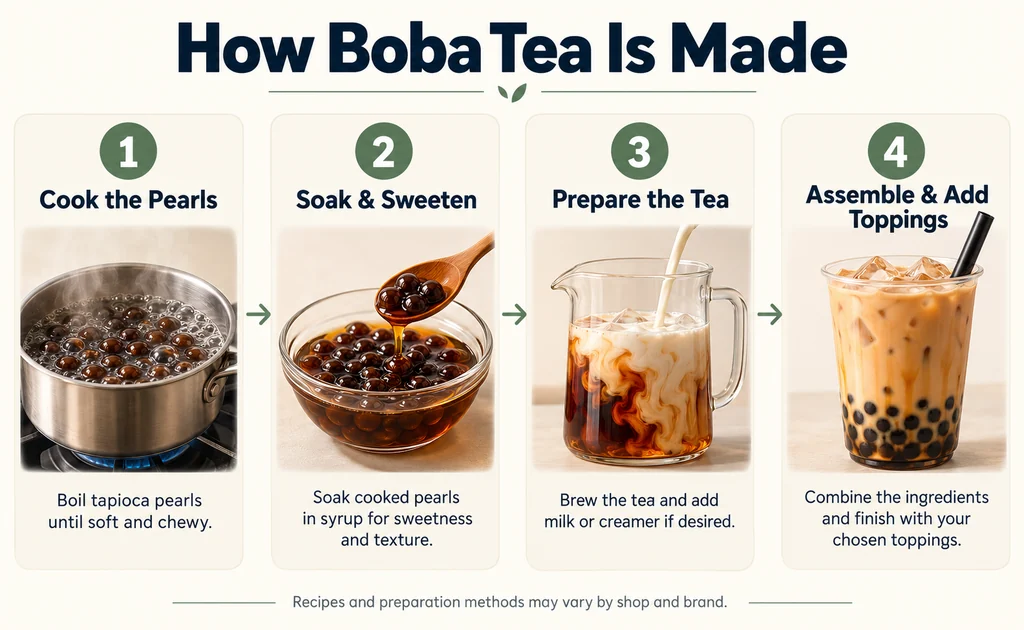
Cooking the Tapioca Pearls
- Boil water: Use plenty of water, roughly 6 to 8 times the volume of the pearls.
- Add the pearls: Stir gently so they don’t stick.
- Cook: Usually 15 to 30 minutes for regular pearls, depending on the brand. Quick-cook pearls take about 5 minutes.
- Rest: Turn off the heat, cover and let them sit so the centre softens.
- Rinse and soak: Rinse in cool water, then soak in brown sugar or honey syrup.
Types of packaged pearls
- Instant (microwave) pearls: Pre-cooked and often pre-sweetened. Heat briefly following the package instructions.
- Quick-cook pearls: Boil for around 5 minutes. Some come pre-flavoured with brown sugar.
- Regular (shop-style) pearls: Boil for roughly 20 to 40 minutes depending on size and brand, then rest covered off the heat.
Why homemade pearls taste bland: Tapioca has almost no flavour of its own, and plain pearls are not sweetened. After cooking, rinse them in cold water, then soak them in brown sugar syrup, honey or simple syrup. This is the step most people skip.
Assembling, Sealing and the Wide Straw
At the shop, staff add pearls to the cup first, then the tea, milk, syrup and ice. The drink is shaken, and the cup is usually sealed with a plastic film by a machine.
The wide straw is cut at an angle so you can pierce the seal and suck up the pearls.
Making Boba Tea at Home with Halal-Friendly Ingredients
Making boba at home gives you much more control over the ingredients.
For the pearls:
- Tapioca starch
- Boiling water
- Brown sugar (for colour and flavour)
Bring water and brown sugar to a boil, then mix in the tapioca starch while the mixture is still hot and knead quickly into a dough; it stiffens as it cools. Roll into small balls and dust them with starch so they don’t stick. A common home method is about 30 minutes of boiling, 30 minutes resting off the heat, then a quick ice-water bath. Some home cooks add a little cocoa powder for a darker colour instead of caramel colouring. Or simply buy halal-certified dried pearls.
For the drink:
- Strong black tea (or green, jasmine, oolong)
- Fresh milk or a halal-certified plant milk
- Brown sugar syrup or honey
- Ice
Halal tip: Skip ready-made creamers and flavour powders unless they are halal certified. Use fresh fruit, real taro or matcha powder instead. Many online recipes also use milk powder or whipping cream; check both for halal certification, as they can contain animal-derived additives, and some whipping creams contain gelatin.
Can You Make Popping Boba at Home?
Yes. Popping boba needs no gelatin at all. You need fruit juice, sodium alginate and a calcium bath (calcium lactate or calcium chloride), which are sold as food-grade powders.
The juice-and-alginate mix is dropped into the calcium bath, forming small juice-filled spheres. It takes some practice, but it lets you control every ingredient, including the colour.
How to Store Cooked Boba
Cooked tapioca pearls are best eaten fresh.
- Best within 4 to 6 hours: Keep them at room temperature, covered, in syrup.
- In the fridge: They harden and lose their chew. You can soften them in hot water or syrup, but texture won’t fully return.
- Freezing: Cooked pearls don’t freeze well. Homemade uncooked pearls can be frozen and cooked straight from frozen.
- Dried pearls: Store in an airtight container in a cool, dry place.
- Popping boba: Once opened, keep refrigerated and follow the package’s use-by guidance.
How to Order and Drink Boba
A boba menu can look overwhelming the first time. Ordering is simple once you know the steps.
How to Choose Your First Boba Drink
- Pick a drink: Milk tea, fruit tea or a specialty drink like brown sugar milk.
- Pick a size: Usually regular or large.
- Pick sugar and ice levels: 50% sugar is a good starting point if you don’t like very sweet drinks.
- Pick toppings: Tapioca pearls are the classic choice.
Halal-safe first order: Classic black milk tea with fresh milk, tapioca pearls and 50% sugar. Ask whether the shop uses fresh milk or creamer.
Best Drinks to Pair with Each Type of Boba
Are You Supposed to Chew Boba?
Yes. Tapioca pearls are meant to be chewed, not swallowed whole. The chewy texture is the whole point.
Swallowing pearls whole, or several at once as they come up the wide straw, increases the choking risk, especially for children.
Popping boba is different: you just bite gently to burst it.
Is Boba Tea Healthy?
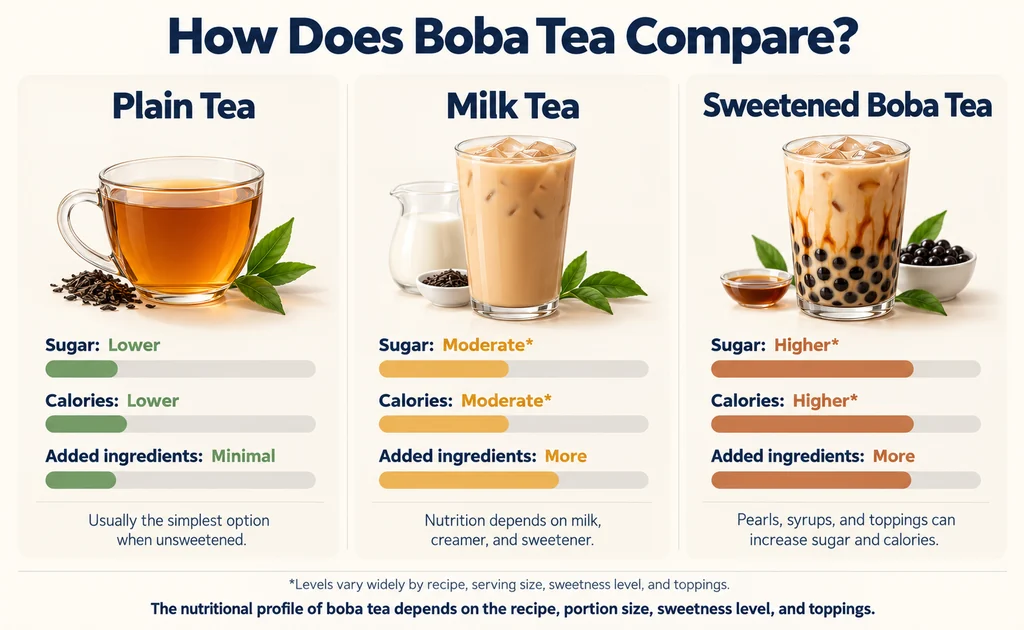
Honest answer: Boba tea is a sweet treat, not a health drink. It is fine occasionally, but the sugar and calories add up quickly.
Islam encourages moderation in eating and drinking. Something can be halal and still be best enjoyed in moderation.
Calories, Sugar and Nutrition
Figures vary a lot by shop, size and sugar level. These are approximate ranges:
- A regular milk tea with pearls: Roughly 250 to 450 calories.
- Tapioca pearls alone (a typical serving): Roughly 100 to 200 calories, mostly carbohydrates.
- Sugar in a full-sugar drink: Often 30 to 60 grams or more.
Tapioca pearls provide energy but very little protein, fibre, vitamins or minerals.
What about the tea itself? Plain, unsweetened tea can be part of a healthy diet. But in most boba drinks, the sugar, creamer and pearls far outweigh any benefit from the tea. If health matters to you, a low-sugar tea with fresh milk is the better choice.
Does Boba Tea Have Caffeine?
Tapioca pearls themselves have no caffeine. The caffeine comes from the tea.
- Black, green, oolong and Thai milk teas: Contain caffeine, roughly similar to a cup of tea.
- Matcha drinks: Usually higher in caffeine.
- Taro, brown sugar milk and fruit slushes without tea: Often caffeine-free, but some taro and fruit drinks are made with a tea base. Ask the shop.
Can You Drink Boba While Pregnant?
Boba tea can generally fit into a pregnancy in moderation, as long as caffeine, sugar, food hygiene and your own medical advice are taken into account.
- Caffeine: ACOG says moderate caffeine intake of less than 200 mg per day does not appear to be a major contributor to miscarriage or preterm birth. Choose caffeine-free options or count tea-based drinks toward that limit.
- Sugar: High-sugar drinks are worth limiting, especially if you have or are at risk of gestational diabetes.
- Lead: Consumer Reports notes that lead is particularly harmful during pregnancy, another reason to keep boba occasional.
- Freshness: Choose shops that cook pearls fresh and keep good hygiene.
If you have any medical condition, ask your doctor.
Is Boba Safe for Kids? Choking Risks
Boba is enjoyed by many children, but parents should take care:
- Choking: Whole tapioca pearls can be a choking risk for younger children, especially when they come up a wide straw quickly. Consider your child’s age and chewing ability, supervise closely, and follow your paediatrician’s guidance.
- Caffeine: Choose caffeine-free drinks for children.
- Sugar: Ask for low sugar.
- Lead: Consumer Reports notes that lead is particularly harmful for young children, so boba is best kept as an occasional treat.
Tips for a Healthier Boba Tea
- Choose 25% to 50% sugar.
- Pick a smaller size.
- Choose fresh milk or unsweetened plant milk over creamer.
- Try fruit teas with real fruit.
- Pick one topping instead of several.
- Make it an occasional treat, not a daily habit.
Is Boba Vegan, Gluten-Free or Dairy-Free?
Tapioca pearls are naturally vegan, gluten-free and dairy-free. The rest depends on the drink.
- Vegan / vegetarian: ✅ Tapioca, crystal boba (agar or konjac) and popping boba are usually vegan. ❌ Milk, creamers with casein, honey, egg pudding, cheese foam and gelatin jellies are not.
- Gluten-free: ✅ Tapioca comes from cassava, which contains no gluten. ⚠️ Some flavour powders, cookie toppings and malt-based syrups may contain gluten. People with coeliac disease should ask about cross-contact.
- Dairy-free: ✅ Fruit teas and drinks made with oat, soy or almond milk. ⚠️ “Non-dairy” creamers can still contain milk proteins like casein.
- Keto: ❌ Tapioca is almost pure starch, so boba is not keto-friendly.
Important note: Vegan does not automatically mean halal, because flavourings may contain alcohol. But a vegan drink does rule out gelatin and animal-based additives, which removes most halal concerns.
Where Did Boba Come From?
Boba tea comes from Taiwan, where it appeared in the 1980s.
Bubble Foam Tea: The Predecessor
Before the pearls, Taiwanese tea stalls served iced tea shaken with sugar until it foamed. This “bubble” or “foam” tea is where the name bubble tea comes from.
Taiwanese Origins and the Invention Dispute
Two Taiwanese tea houses claim to have invented pearl milk tea:
- Chun Shui Tang (Taichung): Says a staff member added sweetened tapioca balls to iced tea in the late 1980s.
- Hanlin Tea Room (Tainan): Says its founder created the drink in the mid-1980s using white tapioca balls.
Both shops still claim the title today.
Is Boba Japanese, Korean or Chinese?
Modern bubble tea originated in Taiwan in the 1980s.
The confusion is common because:
- Boba shops often use Japanese-style branding or anime artwork.
- Boba is hugely popular in Korea, Japan, mainland China and Southeast Asia.
- Taiwanese culture shares a language and many foods with mainland China.
Tapioca itself comes from cassava, a root native to South America. But the boba drink as we know it was created in Taiwan.
How Boba Spread Around the World
Boba spread across East and Southeast Asia in the 1990s. Taiwanese immigrants brought it to the US West Coast, especially California, around the same time.
In the 2010s, social media and chains like Gong Cha, Chatime and Kung Fu Tea took it worldwide. Today you can find boba shops in Dhaka, London, Dubai, Toronto and almost every major city in between.
Boba Culture and Global Popularity
Boba is more than a drink. For many people, it’s a social habit and a cultural symbol.
Boba Shops as Social Spaces
Boba shops have become hangout spots, especially for students and young people. They offer an alcohol-free place to meet friends, study or spend an evening out.
For many young Muslims in the West, this makes boba shops a natural alternative to bars and pubs, as long as the drinks themselves are halal.
Boba as a Symbol of Taiwanese and Asian-American Identity
In Taiwan, pearl milk tea is a national icon. In the US, “boba culture” became closely tied to Asian-American youth identity, especially in California, where the term “boba” itself became mainstream.
Today boba is global. Local shops in Muslim-majority countries have adapted it with local flavours and halal-certified ingredients.
Frequently Asked Questions
Conclusion
Boba itself is simple: tapioca starch from the cassava plant, rolled into chewy pearls. Simple tapioca pearls are generally halal, though commercial pearls are still worth checking.
The real question is the rest of the cup. Gelatin in jellies and puddings, rennet in cheese foam, emulsifiers in creamers, carmine in colourings, alcohol in flavourings and shared equipment with boozy drinks can all affect the halal status of your drink.
The safest approach:
- ✅ Choose halal-certified shops wherever possible.
- ✅ Stick to tapioca pearls, real tea, fresh milk and sugar syrup when unsure.
- ⚠️ Ask about gelatin, creamers and cheese foam.
- ❌ Avoid boozy boba and shops that don’t separate alcohol equipment.
When in doubt, remember the guidance of the Prophet ﷺ, narrated by al-Hasan ibn Ali (may Allah be pleased with him): “Leave what makes you doubt for what does not make you doubt.” (Jami’ at-Tirmidhi 2518, graded hasan sahih by at-Tirmidhi; also in Sunan an-Nasa’i 5711)

 Usually halal when made from agar or konjac.
 Coconut jelly and grass jelly are usually plant-based. Fruit jellies and rainbow jelly vary: some use konjac or carrageenan, others use gelatin. Ask or check the packaging.