What's Actually in a Marshmallow?
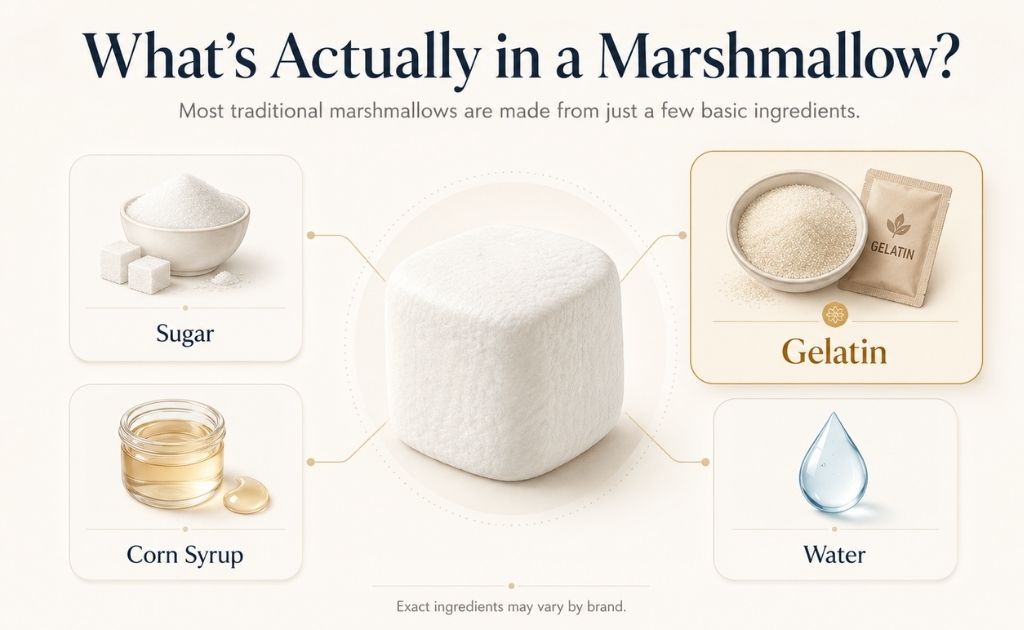
A marshmallow is a surprisingly simple thing: sugar, corn syrup, water, a little flavouring – and one ingredient that holds it all together in that soft, springy shape. That last one is almost always gelatin.
Gelatin is made by boiling down animal skin, bones, and connective tissue until it turns into a jelly-like substance. That’s it. That’s why the source animal matters so much: the ingredient is the animal.
And why is pork gelatin so common? It’s cheaper, it gives manufacturers the exact chewy texture they want, and it’s far easier to buy in bulk than halal-certified gelatin. Nothing sinister – just cost and convenience, which is exactly why so many everyday sweets end up off-limits.
One more small thing worth a glance: some flavourings (especially vanilla) are made using alcohol during processing. Most halal authorities don’t treat a trace processing aid the same as drinking alcohol, but if you like to be thorough, a certified pack removes the question entirely.
That’s really all there is to a plain marshmallow. Sugar and gelatin.
Why Most Marshmallows Aren't Halal: The Gelatin Problem
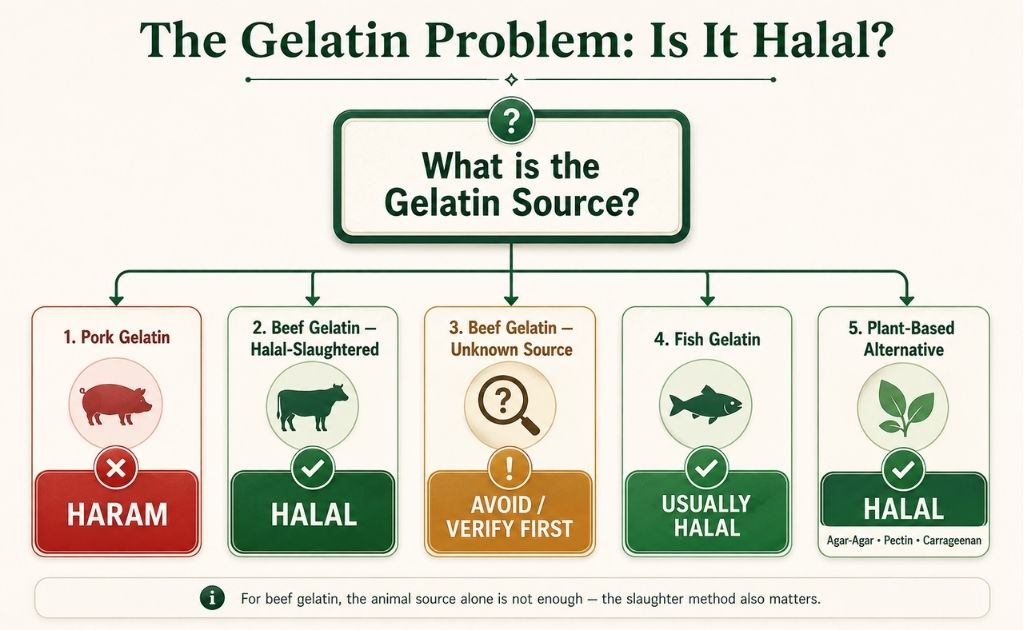
Gelatin has no single ruling. Its status depends entirely on which animal it came from and how that animal was slaughtered.
- Pork gelatin → not halal. Always. No processing changes that in the view of the halal certifiers.
- Beef gelatin → halal only if the cow was slaughtered the halal way. A label that just says “beef gelatin” doesn’t tell you that, so it stays unclear.
- Plain “gelatin” with no source → treat as unclear. In practice, unlabelled gelatin in Western candy is most often pork.
- Fish gelatin → generally fine, because fish don’t require the same method of slaughter.
Plant-based setting agents → fine, because no animal is involved at all.
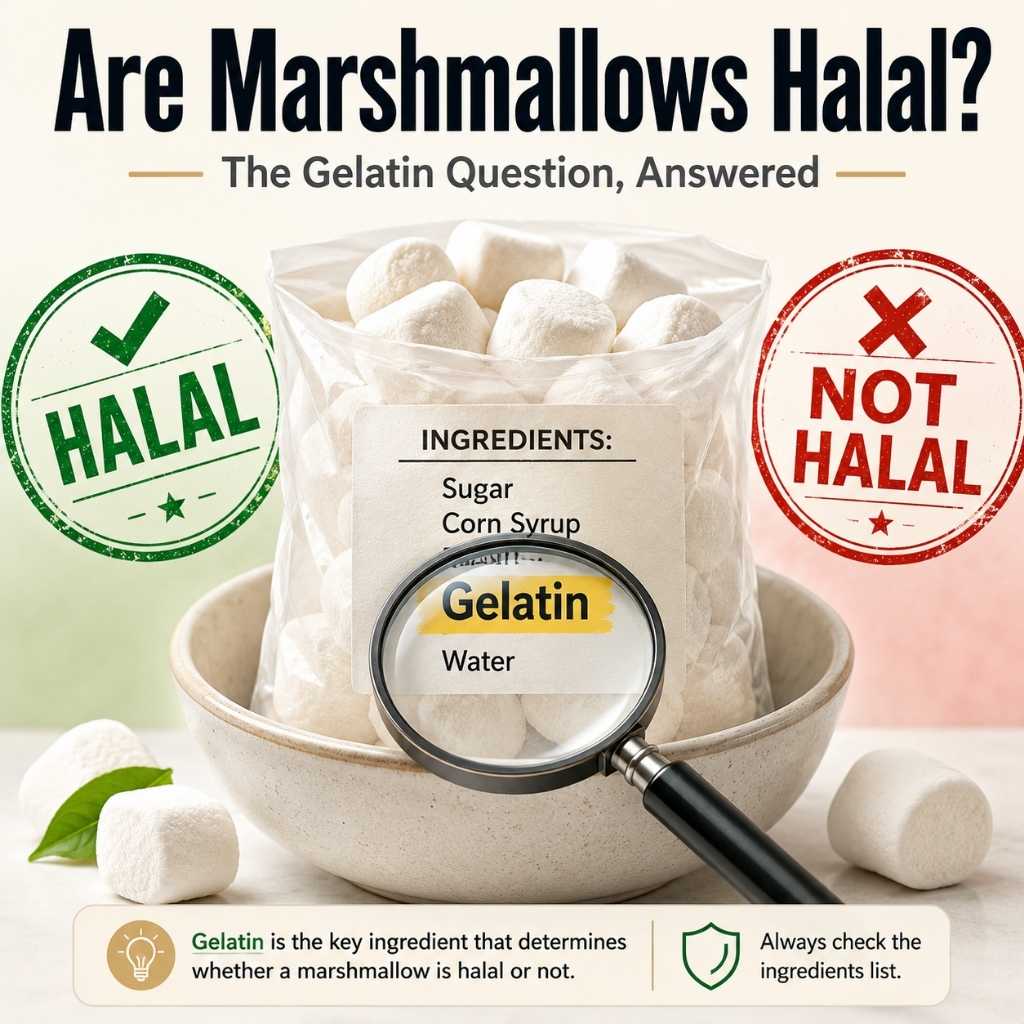
So what should you actually do? If you’re not sure, choose a halal-certified or plant-based option. That single sentence covers 95% of real shopping situations.
You may have heard that some scholars discuss whether gelatin is so heavily processed that it becomes a “new substance” and is therefore permissible. It’s a real discussion — but you don’t need to resolve it to buy marshmallows. Nearly every major halal certifier still requires gelatin to come from a halal or plant source, so that’s the practical rule to follow.
And please don’t read this as a lecture. Almost every Muslim family has eaten marshmallows without thinking about it at some point. The point of knowing this isn’t guilt — it’s that next time you’ll know which bag to reach for.
Gelatin source → verdict
(Production note: build this table as a standalone vertical graphic as well, so it can be shared and linked to on its own — a text table alone doesn’t carry the same way a designed infographic does.)
Are Vegan Marshmallows Halal?
Vegan marshmallows are one of the most searched terms in this whole topic — and the short answer is: usually, but not automatically.
Vegan marshmallows are made without any animal-derived ingredients at all, including gelatin. Instead, they use plant-based setting agents like tapioca starch, carrageenan, pectin, or agar-agar — the same ingredients you’ll find in gelatin-free marshmallows. Since gelatin is the main halal concern with regular marshmallows, removing every animal ingredient removes that concern too. That’s why vegan marshmallows are generally considered halal-friendly.
Popular vegan marshmallow brands:
- Dandies — widely available, made with tapioca syrup and rice protein, no gelatin.
- Trader Joe’s Vegan Marshmallows — store-brand option, similar plant-based formula.
- Sweet & Sara — a smaller vegan brand, often found in health food stores.
- Freedom Mallows — a UK/EU vegan option, popular for baking and hot chocolate.
But “vegan” isn’t the same as “halal-certified.” A product can be 100% plant-based and still run into other halal concerns that have nothing to do with gelatin — for example:
- Vanilla extract made using an alcohol-based extraction process
- Wine-based or alcohol-based natural flavorings
- Cross-contamination on equipment shared with non-halal products
- Food colorings or additives derived from questionable sources
None of these are common in mainstream vegan marshmallow brands, but they’re not impossible either — which is why “vegan” should be treated as a strong positive signal, not a guarantee.
Quick rule: Vegan marshmallows are almost always halal-friendly. If you want certainty, look for a halal certification on top of the vegan label.
Gelatin-Free (Non-Gelatin) Marshmallows: Are They Automatically Halal?
You’ll often see marshmallow bags labeled “gelatin-free” or “non-gelatin” – the two terms mean the same thing: no gelatin of any kind. It’s easy to assume that automatically means halal. It’s usually a strong signal, but gelatin-free and halal aren’t automatically the same thing either.
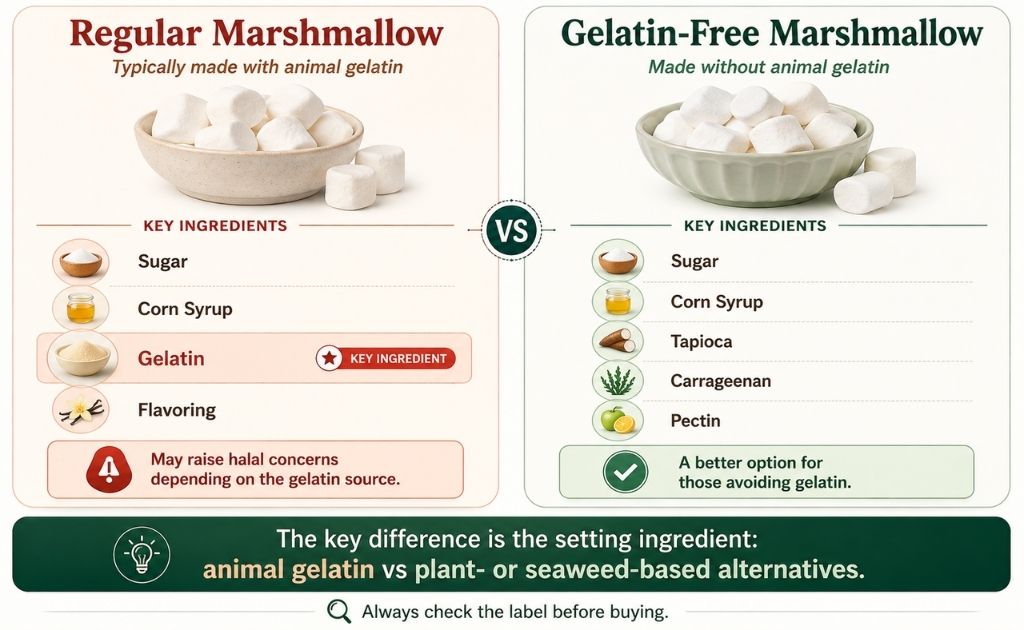
Gelatin-free marshmallows replace gelatin with a plant-based setting agent – most commonly tapioca starch, carrageenan (a seaweed extract), pectin, or agar-agar. Since the halal concern with regular marshmallows is almost always about where the gelatin comes from, removing gelatin altogether removes that specific problem. This is why gelatin-free and vegan marshmallows are usually a safe bet for halal diets.
That said, “gelatin-free” isn’t a halal guarantee by itself. A product can be entirely plant-based and still use alcohol-based flavoring extracts, non-halal food colorings, or be processed on shared equipment with non-halal ingredients — issues that have nothing to do with gelatin. So gelatin-free marshmallows solve the biggest hurdle, but checking the full ingredient list (or looking for an actual halal certification) is still the safer habit.
Quick rule: Gelatin-free almost always means halal-friendly. Halal-certified means halal, guaranteed.
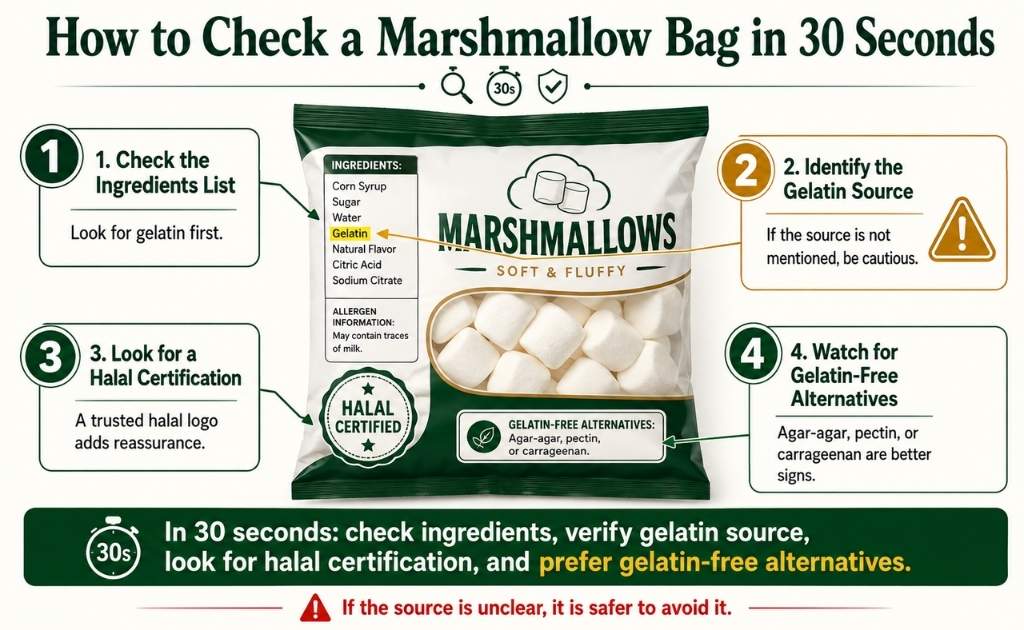
How to Check a Marshmallow Bag in 30 Seconds
- Look for a halal logo on the front or back of the pack. If it’s there, you’re done.
- Read the ingredients list. If it says “gelatin” with nothing after it, treat it as unclear — and likely not halal.
- Look for “vegan” or “plant-based” on the front. That almost always means there’s no gelatin in the bag at all.
- Learn the three good words: agar-agar, pectin and carrageenan. These are the plant and seaweed ingredients used instead of gelatin. Seeing one of them is a very good sign.
- Don’t rely on a kosher symbol. Kosher marshmallows can be made with fish gelatin or with beef that wasn’t slaughtered the halal way. Kosher is a different standard, not a shortcut to halal.
If you’re standing in the aisle right now: step 1, then step 3, then step 2. That’s the fastest path to an answer.
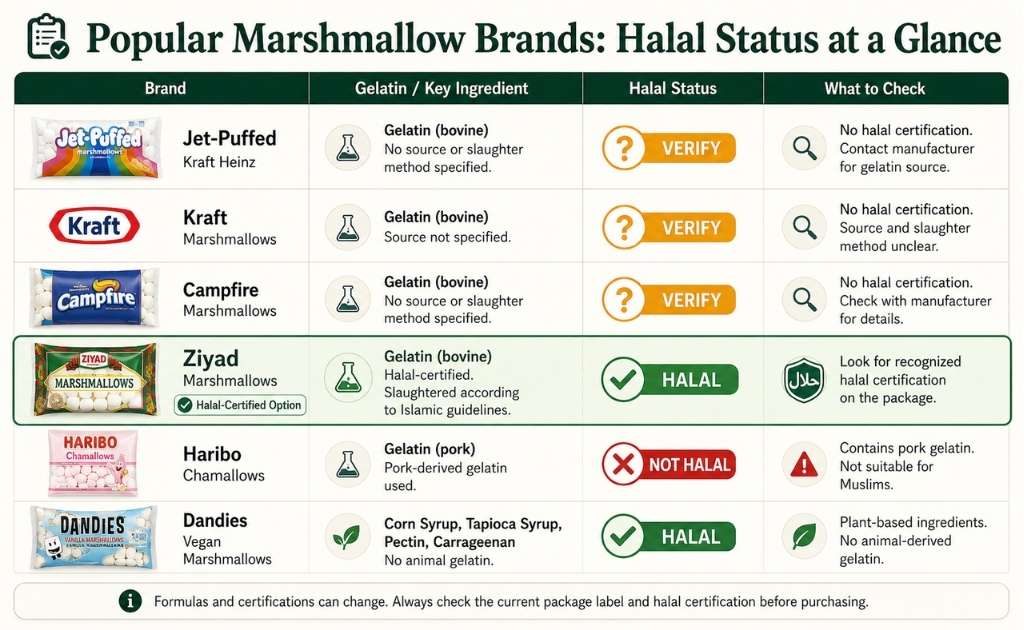
Popular Marshmallow Brands: Are They Halal?
Companies change suppliers and recipes over time, so always check the ingredient list on the bag you’re actually holding. This is a starting guide, not a lifetime guarantee.
These verdicts reflect what’s on the label or certified by a halal body at the time of writing — they’re a shopping guide, not a religious ruling. If you want a formal ruling, ask a local scholar or your certifier of choice.
Jet-Puffed (Kraft)
The classic American marshmallow, and the one most people ask about. The ingredients list includes gelatin with no source named, and the bag carries no halal certification. Kraft has not publicly confirmed a halal or plant source for it. Without that confirmation, the safest reading is that Jet-Puffed marshmallows are not halal — most halal-conscious shoppers skip them.
Great Value (Walmart)
Walmart’s store-brand marshmallows follow the same pattern as the big national brands: sugar, corn syrup and unlabelled gelatin, with no halal logo anywhere on the bag. Store brands also change suppliers more often than name brands, which makes an unlabelled ingredient even harder to trust. Treat these as not halal unless the packaging in front of you says otherwise.
Campfire
Campfire is a s’mores-night staple in the US, and it too is a gelatin marshmallow with no halal certification and no stated gelatin source. Nothing on the pack lets you confirm the animal or the slaughter method. Unless you find a version with a halal mark or a plant-based label, it belongs in the “not halal” column for shopping purposes.
Dandies
Dandies are plant-based marshmallows with no gelatin at all — they use starch and plant-based gelling agents instead. That removes the entire gelatin question, which is why they’ve become the go-to swap for Muslim families in the US, UK and Canada. They aren’t halal-certified, so if you want a formal certification you’ll want a certified brand instead, but ingredient-wise they’re clean.
Trader Joe's
Trader Joe’s has sold both regular gelatin marshmallows and, at times, a vegan/plant-based version — so this one genuinely depends on which bag you pick up. Turn the pack over and look for either “gelatin” (skip it) or a vegan/plant-based claim with agar or starch (fine). Don’t assume based on a previous shop; the range changes.
Pascall
Pascall marshmallows, sold in New Zealand, Australia and parts of Asia, mostly rely on standard gelatin, and Pascall doesn’t publicly list a halal certification for its marshmallow range. We weren’t able to confirm the current ingredient panel or gelatin source at the time of writing, and formulations can vary between markets — so this is a check-the-pack brand every time, rather than one with a confirmed answer either way.
Ziyad
Unlike the mainstream brands above, Ziyad Brothers Farsan makes marshmallows specifically for the halal market. The company has been importing and producing halal-certified Mediterranean and Middle Eastern foods since 1966, and their marshmallows carry proper halal certification rather than relying on vague “gelatin source” wording.
That’s the key difference: instead of guessing whether the gelatin came from a permissible source, the certification confirms it for you.
You’ll typically find Ziyad marshmallows at Middle Eastern grocery stores, halal markets, and online retailers like Amazon rather than mainstream supermarket shelves — so if your local store doesn’t carry mainstream halal options, this is one of the more reliable names to search for by brand name.
A Note on Mini Marshmallows
Mini marshmallows follow the exact same rules as regular-sized ones — size doesn’t change the ingredients. If a brand’s regular marshmallows use gelatin from an unknown or non-halal source, its mini version will use the same gelatin. The same goes the other way: if a brand is halal-certified or gelatin-free, its mini marshmallows are typically made from the same halal-friendly formula.
So whenever you’re checking a bag of minis (for hot chocolate, cereal, or snack packs), apply the same 30-second check from earlier — the size on the label doesn’t matter; the ingredient list does.
Other Brands: Quick Verdicts
- Kroger, Aldi, Signature Select, Good & Gather, Hill Country Fare — store brands, and all follow the same rule: unlabelled gelatin, no halal logo, so treat as not halal unless the specific bag says otherwise.
- Haribo — recipes and labelling vary by country. Some markets do carry halal-labelled marshmallow and jelly sweets sold alongside Haribo products (for example, “Haribo Sweetzone” in the UK) — but Sweetzone is a separate confectionery line, not proof that Haribo’s own standard product is halal-certified. Standard Haribo marshmallows in Europe and the US list gelatin without a halal certification, so check the specific pack and don’t assume a halal-branded sweet nearby on the shelf means the same about a Haribo-branded one.
- Peeps — made with gelatin and not halal-certified, so treat them as not halal.
- Lucky Charms and Froot Loops marshmallow bits — these are gelatin marshmallow pieces. See the cereal section below for the full picture.
Where to Buy Halal Marshmallows
Here’s the good news: you don’t have to give marshmallows up. Certified and plant-based options are easier to find now than they were even a few years ago.
Ziyad is the name to remember if you want an actual halal certification rather than just “no gelatin.” It’s the most widely stocked certified halal marshmallow in North America, and most halal grocery shops carry it. Its packaging carries a halal certification mark, though the specific animal source of the gelatin isn’t something we could confirm from public product information — if that detail matters to you, it’s worth checking with the manufacturer or certifier directly.
If you’d rather shop by ingredient than by brand, the plant-based aisle is your friend — anything labelled vegan marshmallow is gelatin-free by definition.
Quick tip: searching “halal marshmallows” online works, but so does searching “vegan marshmallows” – you’ll usually get more results, lower prices, and faster delivery, and the gelatin question is already answered.
Is Marshmallow Fluff Halal?
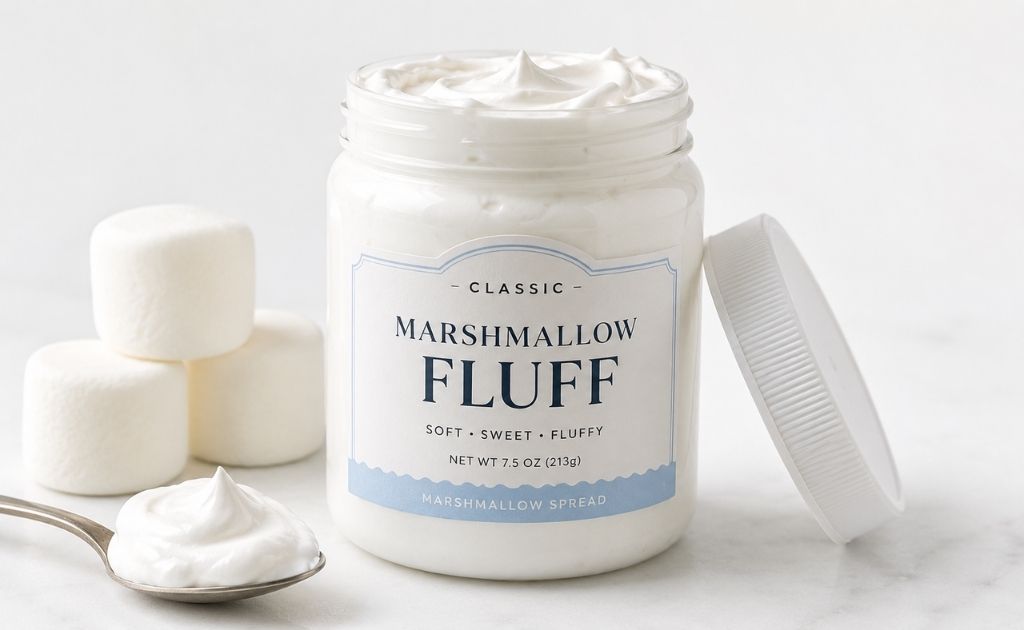
Marshmallow fluff (the spreadable, jar version of marshmallow — used in fluffernutter sandwiches, s’mores dip, and frosting) follows a different recipe than bagged marshmallows, but the halal question comes down to the same ingredient: gelatin.
Most major fluff brands, including the most common jarred version sold in supermarkets, use corn syrup, sugar, and egg whites as the base — not gelatin. That’s actually good news: since gelatin is usually the main halal concern, a gelatin-free fluff clears that specific hurdle. However, always double-check the label, since formulations can vary by brand and region, and some fluff-style spreads do use gelatin as a stabilizer.
What to check on a fluff jar:
- Ingredient list for “gelatin” (if absent, that’s a good sign)
- Any alcohol-based flavoring or non-halal additives
- A halal certification mark, if you want full certainty
Verdict: Most standard marshmallow fluff is gelatin-free and halal-friendly, but always check the label — it’s not guaranteed across every brand.
Marshmallows in Cereal, Hot Chocolate and Candy
The marshmallow question gets trickier once the marshmallow is inside something else.
Cereal marshmallows — the little shapes in Lucky Charms, Froot Loops and similar cereals are gelatin marshmallows, and the gelatin source isn’t stated. That’s why those cereals are generally treated as not halal in the US, even though the rest of the box is just grain and sugar.
Two extra ingredients to know about here. Carmine (also written cochineal or E120) is a red colouring made from crushed insects, and shellac (E904, sometimes listed as confectioner’s glaze) is a shiny coating made from a resin insects leave behind. Scholars differ on insect-derived ingredients, so some Muslims avoid them and others don’t. They’re worth recognising on a label so you can make your own call.
Marshmallow Fluff and creme are actually good news. Most versions — including the classic jarred kind — are made with dried egg whites, corn syrup, sugar and cream of tartar instead of gelatin, so they’re usually fine from a halal standpoint. It’s still worth a quick glance at the flavouring line if you want to be thorough, but the gelatin question that dominates the rest of this guide mostly doesn’t apply here.
Hot chocolate sachets with mini marshmallows almost always use gelatin marshmallows — so the sachet is only as halal as the marshmallow in it. Buy plain cocoa and add your own halal or plant-based minis instead. It tastes better anyway.
Dunkin’ marshmallow cold foam and similar coffee-shop add-ins are harder to pin down than a bag off the shelf, since recipes, syrups and suppliers can vary by store and change over time. If it matters to you, the most reliable move is to ask in-store directly or check the chain’s published ingredient list rather than assume either way.
Candy-coated and filled sweets — chocolate-covered marshmallow treats, marshmallow-filled biscuits, mallow cups and similar products all rely on the same gelatin, so the same rule applies: no source, no certification, treat it as unclear.
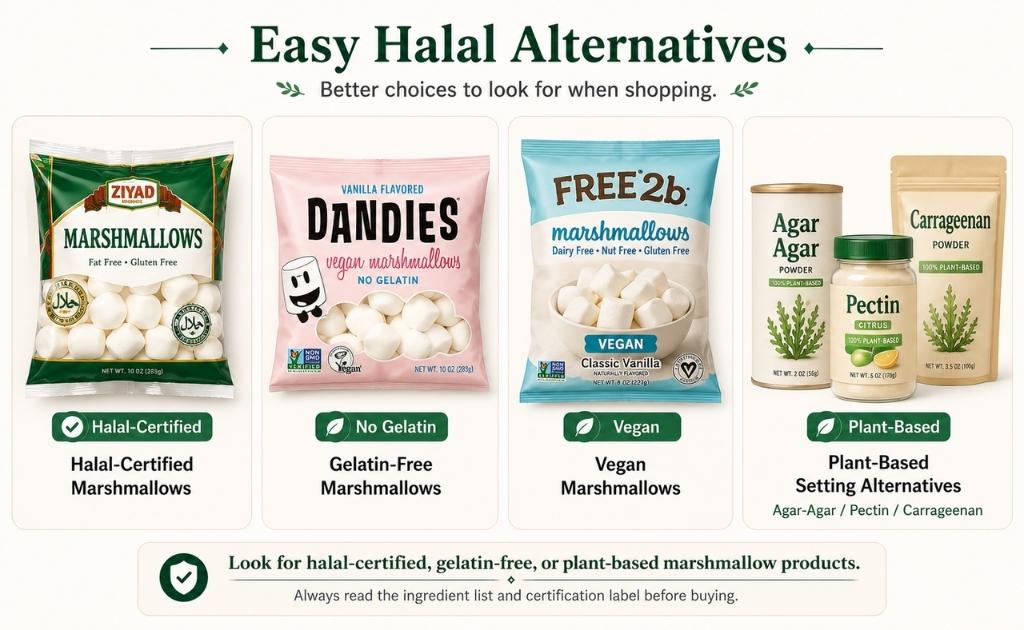
Easy Halal Alternatives
If you’d rather not depend on what’s in stock, marshmallows are genuinely easy to make at home. Sugar, water and agar-agar (or a halal-certified gelatin) is all it takes, and you’ll know exactly what went in. It’s a good weekend project with kids, and it sidesteps the label-reading entirely.
Everything else works exactly the same way. Hot chocolate, s’mores, rice cereal treats, marshmallow frosting — swap in a halal-certified or plant-based marshmallow and nothing about the recipe changes. Plant-based marshmallows toast and melt a little differently over a fire, but they still puff, brown and squash between two biscuits just fine.
Common Misconceptions
Myth: “All marshmallows are haram.” Reality: plenty of certified and plant-based marshmallows exist. This is about checking labels, not giving up marshmallows.
Myth: “Kosher means halal.” Reality: kosher marshmallows can still use fish gelatin or beef that wasn’t slaughtered the halal way. Two different standards.
Myth: “Vegan means halal-certified.” Reality: vegan marshmallows are usually halal-friendly because there’s no animal gelatin — but “vegan” and “halal-certified” are separate labels with separate audits.
Myth: “Beef gelatin is fine because it’s not pork.” Reality: beef gelatin is only halal if the animal was slaughtered the halal way. Unlabelled “beef gelatin” still needs certification before you can be sure.
Frequently Asked Questions
The Simple Rule to Remember
- If the bag just says “gelatin” with nothing else, treat it as unclear — and skip it if you want to be safe.
- Look for a halal logo, or the words “vegan” or “plant-based” on the front.
- Ziyad and most vegan brands are easy, reliable choices.
- When in doubt, homemade is always an option.
One label check, and marshmallows go back on your shopping list with a clear conscience.
Everything else works exactly the same way. Hot chocolate, s’mores, rice cereal treats, marshmallow frosting — swap in a halal-certified or plant-based marshmallow and nothing about the recipe changes. Plant-based marshmallows toast and melt a little differently over a fire, but they still puff, brown and squash between two biscuits just fine.