Where the “Pepsi Contains Alcohol” Claim Comes From
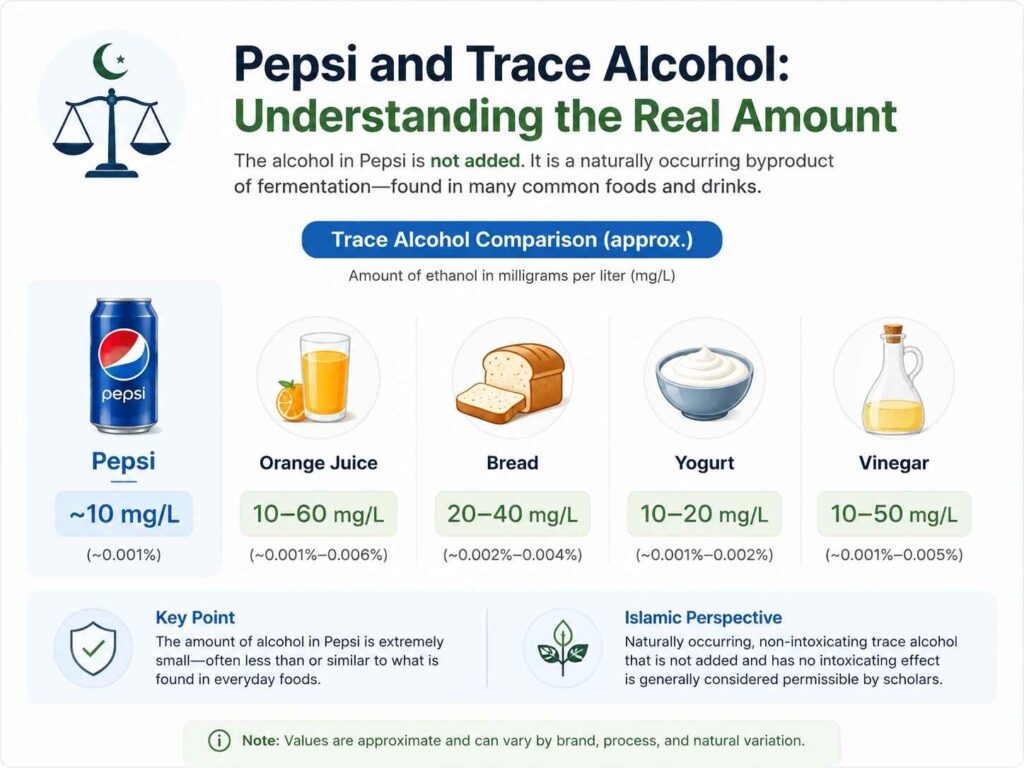
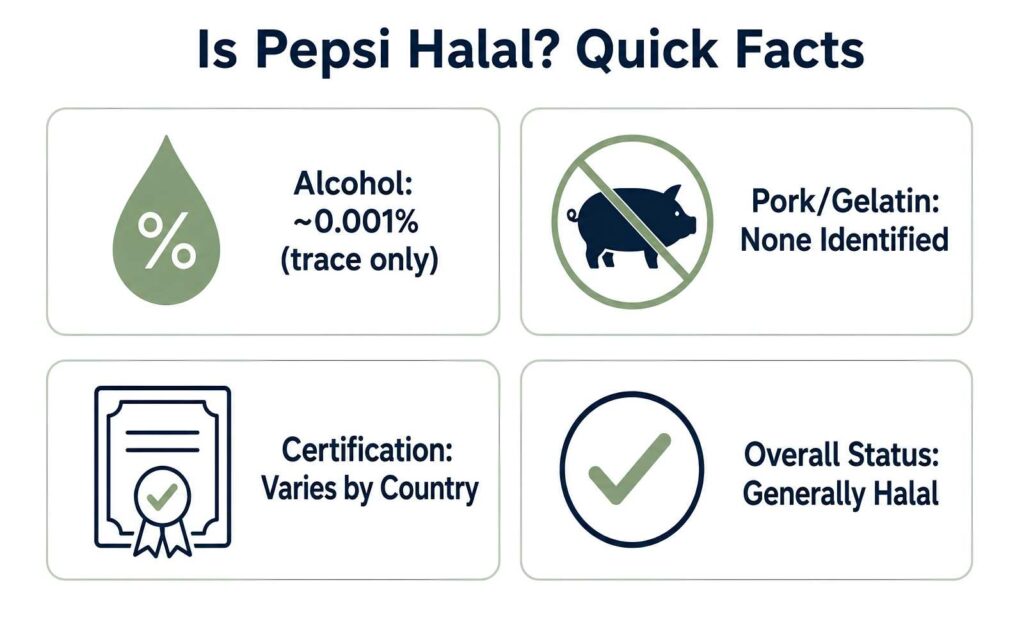
The controversy traces back to a French consumer study, reported by the magazine Le Point, which tested about 19 cola-type beverages and found both Coca-Cola and Pepsi contain trace ethyl alcohol — roughly 10 milligrams per liter, or about 0.001%.
The report framed this as a potential issue for Muslim consumers, and the story spread quickly across religious forums and social media.
What often gets left out: this alcohol isn’t added on purpose. It’s a byproduct of natural fermentation — the same process behind trace alcohol in orange juice, bread, yogurt, vinegar, and ripe fruit. Some fruit juices actually contain higher trace alcohol than Pepsi or Coca-Cola.
What PepsiCo Officially Says About Halal Certification
Here’s what PepsiCo itself states in its official FAQ:
- No added alcohol: PepsiCo confirms its entire Pepsi lineup is non-alcoholic, and it doesn’t add alcohol to any product.
- No formal halal or kosher certification: PepsiCo doesn’t manufacture specifically for halal or kosher diets, and its products don’t carry a recognized certification. It doesn’t proactively collect compliance data from suppliers, though it keeps such information on file if provided voluntarily.
- Vegetarian and vegan status: The full range is vegetarian-suitable, and regular Pepsi and Pepsi MAX are vegan-suitable too.
This distinction matters: “we don’t add alcohol” and “no formal halal certification exists” are different things. PepsiCo isn’t denying trace alcohol can form during production — it’s confirming it doesn’t deliberately include any.
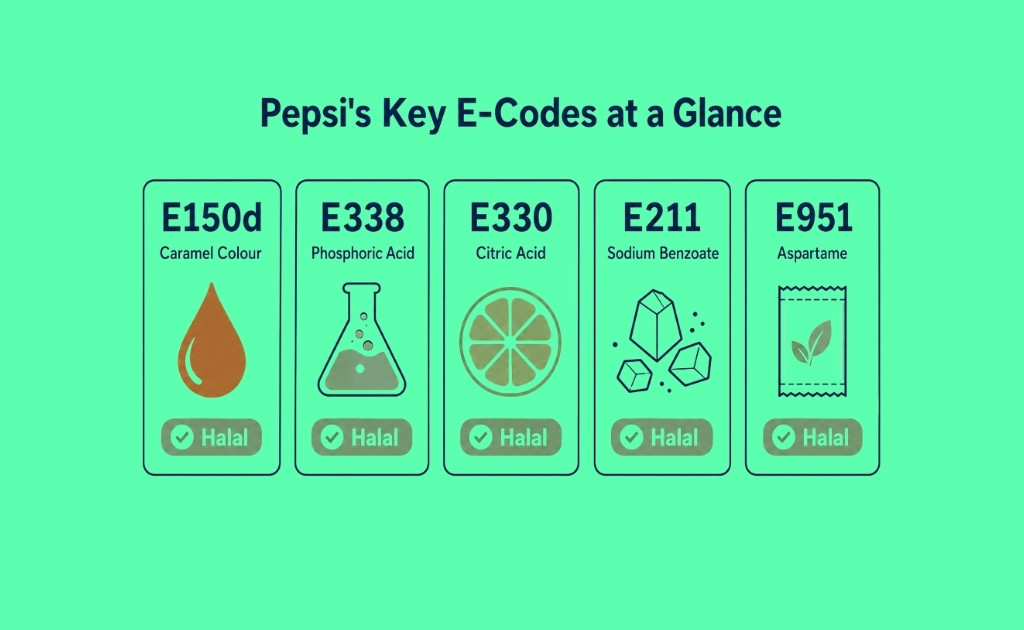
Which E-Codes Appear in Pepsi, and Are They Halal?
Beyond the headline ingredients, several E-numbered additives determine Pepsi’s colour, tartness, and preservation — here’s the status of each, most commonly flagged by halal-conscious consumers.
Underlying principle (usul): E150d and E330 both raise the classical question of istihala — whether transforming a substance into something with new properties gives it a fresh ruling, regardless of source. Hanafi and Maliki jurists generally accept istihala as sufficient, even if an impermissible input was involved upstream. Shafi’i and Hanbali jurists apply it more narrowly, sometimes requiring the original substrate to have been permissible first.
Does Pepsi Contain Pork or Gelatin?
No pork-derived ingredients or gelatin appear in PepsiCo’s published ingredients for standard Pepsi cola — carbonated water, sugar or HFCS, caramel colour (E150d), phosphoric acid (E338), caffeine, and natural flavours — with no animal-derived components. Unlike wine or some ciders, cola production doesn’t typically use gelatin as a fining agent.
One area that remains genuinely unresolved is the exact composition of Pepsi’s “natural flavours.” Flavour carrier agents industry-wide sometimes use glycerin or mono- and diglycerides, which can occasionally be animal-derived. PepsiCo’s own ingredient glossary states this composition is proprietary and can’t be disclosed. The carrier source can’t be independently confirmed from public information alone — consumers wanting absolute certainty should contact PepsiCo directly or choose a country with third-party halal certification.
Underlying principle (usul): Two principles are in tension here. The majority position — Hanafi and Shafi’i — follows al-yaqin la yazulu bi al-shakk (certainty isn’t overridden by mere doubt): an unspecified “natural flavour” alone isn’t grounds for haram. The Maliki school weighs sadd al-dhara’i (blocking the means to doubt) more heavily, which is why some Maliki-leaning bodies still recommend certified alternatives.
Is Pepsi Halal or Haram? What Islamic Scholars Say
This exact question — given the French alcohol study — was formally addressed by Islamweb’s Fatwa Center, a widely referenced jurisprudence authority. Here’s a breakdown:
1. The default ruling: all things are permissible unless proven otherwise
Food and drink are halal by default (al-asl fi al-ashya al-ibaha), and specific evidence is required to declare something haram — a single magazine report isn’t enough.
2. Naturally occurring alcohol isn't treated the same as added alcohol
Alcohol forms naturally in many everyday foods — leavened bread, cakes, biscuits — and even inside the human gut. Many scholars do not treat this kind of unavoidable, trace fermentation alcohol the same way as deliberately added, intoxicating alcohol.
3. Scholars disagree on whether alcohol itself is “impure” — but that doesn't change the verdict here
Jurists have historically held different views on whether alcohol is physically impure. Some (including classical jurists like Rabi’ah and Layth ibn Sa’d, and several modern scholars) hold it isn’t impure — only drinking it intoxicatingly is forbidden. Islamweb’s Fatwa Center leans toward treating alcohol as impure in principle, but clarifies the French study’s findings aren’t sufficient grounds to declare Pepsi or Coca-Cola impure or haram.
Bottom line: The trace, natural alcohol in these drinks simply doesn’t meet that bar.
Does It Matter If Pepsi Is “Unhealthy”? The Harm-Based Argument
Some people argue that Pepsi should be considered haram simply because sugary, caffeinated soft drinks are widely viewed as unhealthy. A well-known Islamic fatwa organization has directly addressed this line of reasoning, and it breaks down into a few key principles:
- Proven harm must be avoided — Islamic law prohibits genuinely harmful substances, per Qur’anic verses and hadith on not harming oneself or others.
- Speculation isn’t evidence — an unconfirmed study alone isn’t sufficient grounds to rule something haram.
- This is the same default– permissibility principle established earlier — applied here to the harm question specifically.
- Quantity matters — even if harmful in large quantities, only that amount is prohibited; moderate, harmless consumption remains permissible.
- Personal caution is fine, but not a religious obligation — avoiding Pepsi out of health caution is commendable but can’t be imposed on others without solid evidence.
Pepsi Product Line: Halal Status by Variant
Halal status can shift by variant, since flavourings and sweeteners differ across the range. The table below summarizes the standard lineup.
For flavoured and colour-added variants, check the label for E120 (cochineal/carmine), an insect-derived red colourant used in some fruit-flavoured drinks industry-wide. It doesn’t appear in PepsiCo’s published Pepsi Max Cherry list, but formulations vary by bottler and region, so label-checking remains good practice.
Is Pepsi Max Halal?
Pepsi Max is halal under the same reasoning as regular Pepsi, with two differences worth addressing: it replaces sugar with aspartame (E951), a synthetic sweetener, and carries higher caffeine.
Aspartame is synthetic, not derived from alcohol or animals, and is accepted as halal by most fatwa bodies. Caffeine isn’t classified as an intoxicant (muskir) under standard fiqh, which requires impairing the mind in ordinary amounts — caffeine doesn’t meet that bar.
Underlying principle (usul): Hanafi, Maliki, Shafi’i, and Hanbali jurists agree caffeine is halal, since it fails the muskir test. Where some scholars introduce caution, it’s on the separate principle of darar (harm), covered under the harm-based reasoning discussed above — not a prohibition unique to Pepsi Max.
Is Diet Pepsi Halal?
Diet Pepsi follows the same reasoning as regular Pepsi — non-alcoholic, with only trace natural alcohol — so the majority view holds it halal for the same reasons. The one practical difference: sweeteners and flavouring agents can vary by market, so checking your country’s label is a good habit.
Is Pepsi Halal in the USA?
In the US, Pepsi isn’t certified halal by any recognized body, but its core ingredients — carbonated water, HFCS or sugar, caramel colour, phosphoric acid, natural flavours, caffeine — aren’t derived from alcohol or animals. Most U.S. halal advocacy resources and fatwa councils consider it permissible. For absolute certainty, check with a local halal authority, since U.S. formulations can occasionally differ from international ones.
Is Pepsi Halal in the UK?
In the UK, standard Pepsi doesn’t carry a formal halal logo — such as from the Halal Monitoring Committee (HMC) or Halal Food Authority (HFA). As in the US, absence of a logo isn’t a haram finding: the UK ingredient list matches the same additive profile in the E-code table above.
This mirrors the same default-permissibility principle already discussed above. A directly relevant, citable ruling comes from Saudi Arabia’s Standing Committee for Issuing Fatwas (al-Lajnah al-Da’imah), which was asked specifically about drinking chilled soft drinks such as Pepsi and ruled them permissible on the same default-permissibility grounds — though this is an international ruling rather than a UK-specific one, since no separate UK-based fatwa body addressing Pepsi by name could be confirmed for this guide.
Does Pepsi Have Halal Certification in Muslim-Majority Countries?
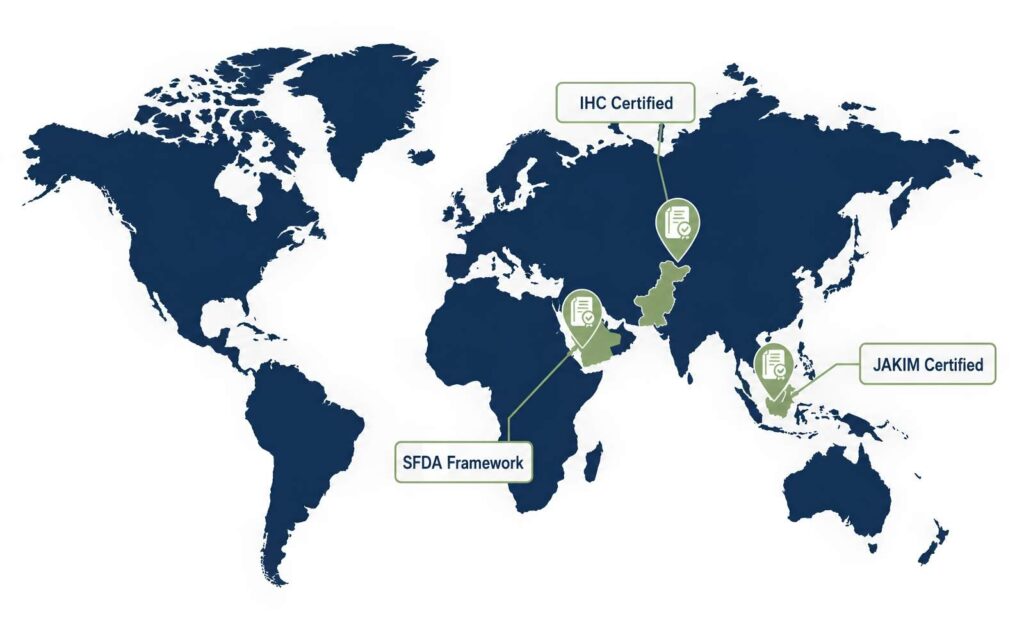
In several Muslim-majority markets, Pepsi is bottled by local franchise partners rather than shipped from US or UK lines, so formulations and certification can differ.
Certification status varies by country. In Malaysia, PepsiCo (Malaysia) Sdn Bhd is confirmed halal-certified by JAKIM, the federal halal authority. In Pakistan, Pepsi-Cola International (Pvt.) Ltd’s Haripur facility holds a Halal Certificate (No. CR/IHC/PCI/05/25/HC, issued 19 May 2025) from International Halal Certification (IHC) under PS 3733:2022 / OIC-SMIIC-1:2019. In Saudi Arabia, compliance falls under the SFDA‘s framework and the SASO/GSO 2055-1 standard, though a specific named bottler certificate couldn’t be confirmed.
What About Other PepsiCo Brands? (7UP, Mountain Dew, Tropicana)
PepsiCo owns a wide portfolio beyond Pepsi cola, and halal status doesn’t transfer automatically between brands — each product needs its own check.
- 7UP and Mountain Dew: Plain, uncoloured variants follow the same reasoning as standard Pepsi. Fruit-coloured versions should be checked for E120 (cochineal), an insect-derived colourant used industry-wide.
- Tropicana: PepsiCo’s juice brand is plant-based and generally halal, but some juices industry-wide use gelatin as a fining agent — check on a product-by-product basis.
Underlying principle (usul): Halal status attaches to a product’s ingredient list, not the parent company — a flagship product’s ruling doesn’t carry over to a sibling brand, which is why this guide treats Pepsi Max Cherry, Tropicana, and 7UP as separate questions.
Pepsi vs. Coca-Cola: Are Both Halal?
Coca-Cola was part of the same French study and returned nearly identical trace alcohol results to Pepsi. The same Islamic legal reasoning already outlined above — natural fermentation byproduct, far too small to intoxicate — applies equally, so most scholars consider Coca-Cola halal for the same reasons.
Quick Answers: Other Common Pepsi Questions
Is Pepsi gluten-free?
Yes. Pepsi’s core ingredients don’t include wheat, barley, or rye, and PepsiCo doesn’t list gluten as an allergen. Unrelated to halal status, but a common related search.
Is Pepsi vegan?
Yes — regular Pepsi and Pepsi MAX contain no animal-derived ingredients, per PepsiCo.
Is root beer halal?
A related but separate question. Root beer’s status depends on the brand and recipe, since some formulations historically used alcohol-based flavouring extracts. Check the label or brand-specific guidance, since root beer varies more than mainstream colas.
The Standards That Determine the Final Verdict
A few reusable standards emerge from the above that anyone can apply to evaluate a drink like this independently:
- Trace alcohol vs. intoxicating amounts: the core standard is iskar — whether a substance causes intoxication in normal quantities, not whether trace amounts are merely detectable.
- Natural vs. deliberate addition: unavoidable natural byproducts are treated differently from ingredients added on purpose.
- Scholarly disagreement is normal: on matters requiring independent reasoning (ijtihad), a majority view and a cautious minority view can both be respected positions.
How We Verified This Ruling
This guide was reviewed by Mufti Eakub Sheik, trained in Hadith, Fiqh, Tafsir, and Al-Ifta, applying classical usul al-fiqh methodology. Tier-1 sources checked directly:
- PepsiCo’s official ingredient and FAQ statements (pepsi.co.uk/faq) — no added alcohol, no formal halal/kosher certification, vegan/vegetarian suitability for the core range.
- Islamweb Fatwa Center ruling (Fatwa No. 84368, “Coca Cola, Pepsi, Sprite, 7 Up”) — no harm in these drinks unless they contain an intoxicating substance, even in a small quantity.
Country certification claims were checked against JAKIM’s public directory (Malaysia) and an IHC certificate for Pepsi-Cola International (Pakistan). The Saudi Arabia claim reflects the SFDA/SASO framework rather than a confirmed named bottler certificate.
Madhab-relevant principles: this guide draws on principles recognised across Sunni jurisprudence — default permissibility, absence of intoxication, and istihala (transformation) for E150d and E330 — though their application and degree of precaution can vary among scholars and schools. Where a formulation isn’t fully disclosed, a more precautionary position may recommend a certified alternative.
Final Verdict: So, Is Pepsi Halal?
Applying the standards above to Pepsi specifically: based on the sources reviewed for this guide, standard Pepsi is generally considered halal, because:
- The alcohol content is negligible and doesn’t come close to causing intoxication.
- That alcohol isn’t intentionally added — it’s an unavoidable natural fermentation byproduct.
- The default Islamic ruling for food and drink is permissibility absent solid evidence otherwise.
That said, anyone who avoids Pepsi out of personal health or religious caution is making a valid choice — it just shouldn’t be presented as a universal “haram” ruling.
Since PepsiCo doesn’t hold a blanket halal certification and ingredient sourcing varies by country, it’s always worth checking with a knowledgeable local scholar or halal certification authority for current, region-specific guidance.
Frequently Asked Questions